



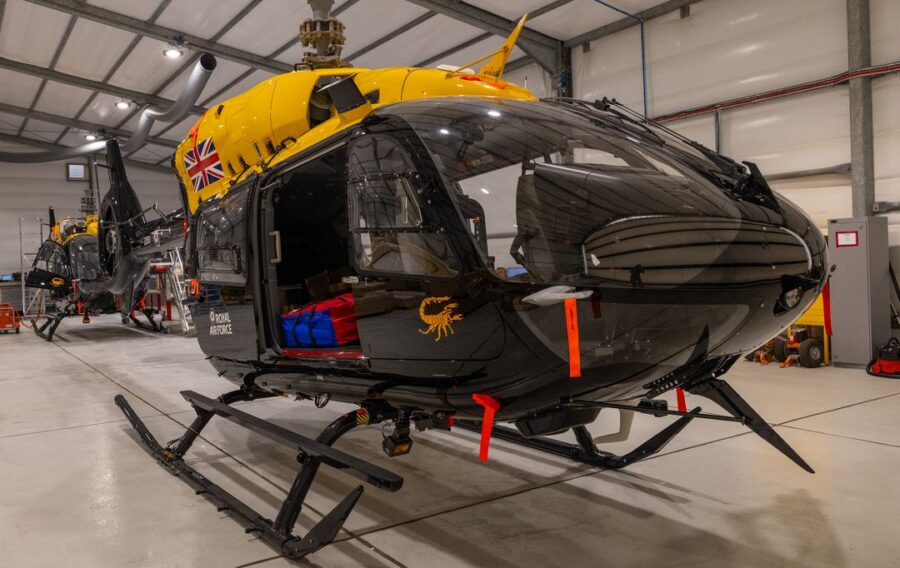
The RAF’s rotary-wing capability in Cyprus has been significantly strengthened with the delivery of two Airbus H145 Jupiter HC Mk2 helicopters to 84 Squadron, marking a major milestone in a £148 million MOD programme that has moved from contract signature to operational deployment in just two years.
The aircraft will fulfil a broad operational mandate across British Forces Cyprus, covering emergency response, aerial firefighting, troop transport, medical evacuation and intelligence, surveillance and reconnaissance, replacing the retired Puma HC2 in each of those roles. The speed of delivery has been highlighted by senior MOD figures as evidence that defence acquisition can move at pace when industry and government work in close alignment.
The six-helicopter contract, placed with Airbus Helicopters UK, directly supports 250 jobs at the company’s Oxford facility. A dedicated support contract sustains a further 30 highly skilled positions, with 10 personnel deploying to Cyprus, eight to Brunei and 12 remaining at Oxford. Two aircraft are already operational in Brunei with the Army Air Corps’ 667 Squadron, and the remaining aircraft for both locations are due for delivery by the end of July.
Mark Langrill, Director Rotary Wing and Uncrewed Air Systems at the National Armaments Director Group, said the programme demonstrated “our ability to safely deliver a modern and reliable capability at pace whilst providing value for money”, crediting the outcome to collaborative effort across MOD and industry. Richard Atack, Managing Director of Airbus Helicopters UK, noted that the contract brings the UK MOD’s total H145 fleet to 13 aircraft across training and operational roles – a figure that reflects growing confidence in the platform across the wider rotary-wing portfolio.
The Jupiter HC Mk2 forms part of the UK’s Defence Rotary Wing Strategy, which is rationalising helicopter types across the fleet to reduce complexity, improve interoperability and drive down whole-life costs. For the supply chain, the programme signals continued demand in the following areas:
- Rotary-wing platform support, maintenance and through-life sustainment
- Avionics, sensor integration and ISR system supply
- Aircrew and ground crew training and simulation
- Forward-deployed logistics and technical support
- Component supply chains aligned to the H145 platform

Post written by: Vicky Maggiani
Vicky has worked in media for over 25 years and has a wealth of experience in editing and creating copy for a variety of sectors.
RELATED ARTICLES

September 10, 2026
Homeland - Why 'Structured Collaboration' is Becoming a Defence Necessity
This week, Stuart John, from the Future Defence Support Services (FDSS) Bid Team at Leidos, examines new research with the

September 7, 2026
Homeland - Government commits £71m to Hemerdon tungsten and tin mine near Plymouth
The National Wealth Fund has committed up to £71 million to Tungsten West to restart the Hemerdon tungsten and tin