



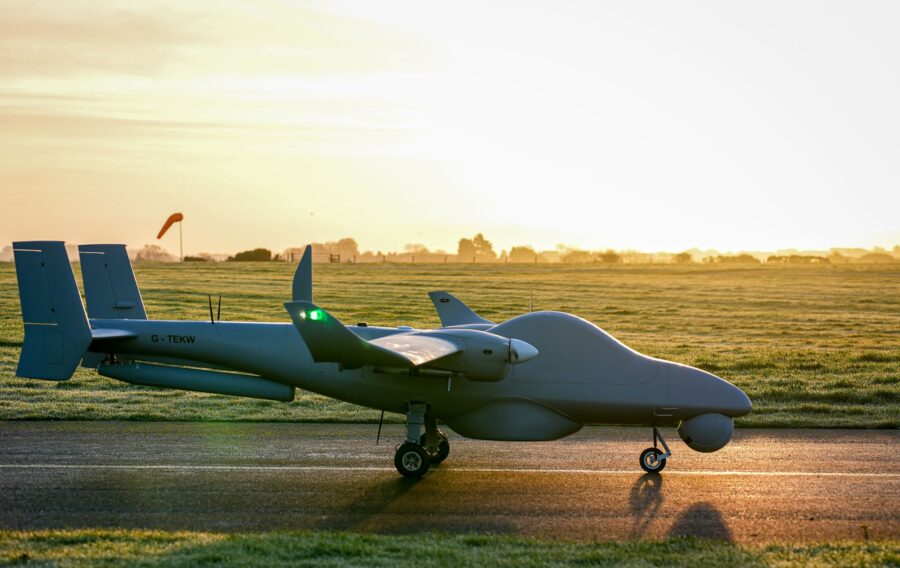
The selection of Tekever’s AR5 drone for the British Army’s next-generation battlefield surveillance capability signals a significant step in UK autonomous systems procurement – and confirms Swindon as the manufacturing base for a system already proven in Ukraine.
The National Armaments Director Group has selected Tekever’s AR5 uncrewed aerial system to replace Watchkeeper as the British Army’s primary intelligence, surveillance, target acquisition and reconnaissance capability, under a contract worth up to £400 million. Known as Project Corvus, the programme will see up to 24 AR5 drones delivered by 2029, built at Tekever’s new facility in Swindon and capable of carrying up to 50kg of surveillance equipment including cameras and sensors. Subject to contract signature and final approvals, the new capability will begin entering service later this year, with support sustained for at least five years and options to extend.
The AR5 replaces Watchkeeper, which has been in service since 2014 and is reaching the end of its operational life. The new system offers significantly improved endurance, sensor capacity and reliability – providing commanders with real-time battlefield intelligence at greater range and for longer than its predecessor. Its operational credentials are already established: the AR5 has been used by Ukraine’s Armed Forces on the battlefield, giving the British Army the confidence of selecting a system with a proven record in high-intensity, contested operations rather than one that is unvalidated outside of trials environments.
Defence Secretary Wes Streeting described the selection as backing a UK-based company delivering kit that will keep British soldiers ahead of emerging threats, while simultaneously driving reindustrialisation and supporting British innovation. The industrial dimension is substantive. The full contract will sustain and create hundreds of jobs at Tekever’s UK sites, with Swindon established as the manufacturing base for a sovereign capability that the Army’s Senior Responsible Owner for Corvus, Brigadier Matt Birch, described as reflecting the demands of contemporary warfare. Tekever UK Managing Director Karl Brew framed the significance of the programme in terms that go beyond platform procurement – describing Corvus as being about building and sustaining sovereign capability that stays one step ahead of adversaries rather than simply replacing a legacy system.
The NAD Group’s selection of a second Tekever platform – following the AR3’s procurement for the RAF’s StormShroud capability – positions the company as a significant and growing presence within the UK’s sovereign UAS industrial base, and signals a degree of confidence in its manufacturing and support infrastructure that is likely to attract further programme interest. The Swindon facility’s role in delivering both platforms also reinforces the government’s reindustrialisation narrative, placing advanced drone manufacturing in a UK region and supply chain rather than sourcing from overseas.
Project Corvus is the latest in a series of autonomous systems procurement decisions that collectively represent a fundamental shift in how the British Army is approaching battlefield intelligence and surveillance. Alongside the Dstl VANAHEIM counter-drone programme, the ANVIL computer vision system and the wider £5 billion committed to drones and autonomous systems in the Defence Investment Plan, the AR5 selection confirms that uncrewed capability is no longer a supplementary consideration within Army procurement but a central and accelerating investment priority.
For the UK defence supply chain
The AR5’s selection and the establishment of Swindon-based UK manufacturing creates a direct and growing supply chain requirement across the life of the programme. With up to 24 platforms to be delivered by 2029 and a support contract of at least five years with extension options, the demand for components, systems integration, sensor payloads, ground control infrastructure, maintenance and through-life support is substantial and sustained. The programme’s trajectory – with the NAD Group having now selected Tekever for two distinct platform requirements – also suggests a pipeline of further procurement and capability development that extends well beyond the initial Corvus contract.
Image: DE&S
Join our new expanding community at DPRTE.co.uk – our new Defence Community Platform, creating a single, year-round digital hub for the UK’s defence procurement and supply chain sector.

Post written by: Vicky Maggiani
Vicky has worked in media for over 25 years and has a wealth of experience in editing and creating copy for a variety of sectors.
RELATED ARTICLES

September 10, 2026
Homeland - Why 'Structured Collaboration' is Becoming a Defence Necessity
This week, Stuart John, from the Future Defence Support Services (FDSS) Bid Team at Leidos, examines new research with the

September 7, 2026
Homeland - Government commits £71m to Hemerdon tungsten and tin mine near Plymouth
The National Wealth Fund has committed up to £71 million to Tungsten West to restart the Hemerdon tungsten and tin