



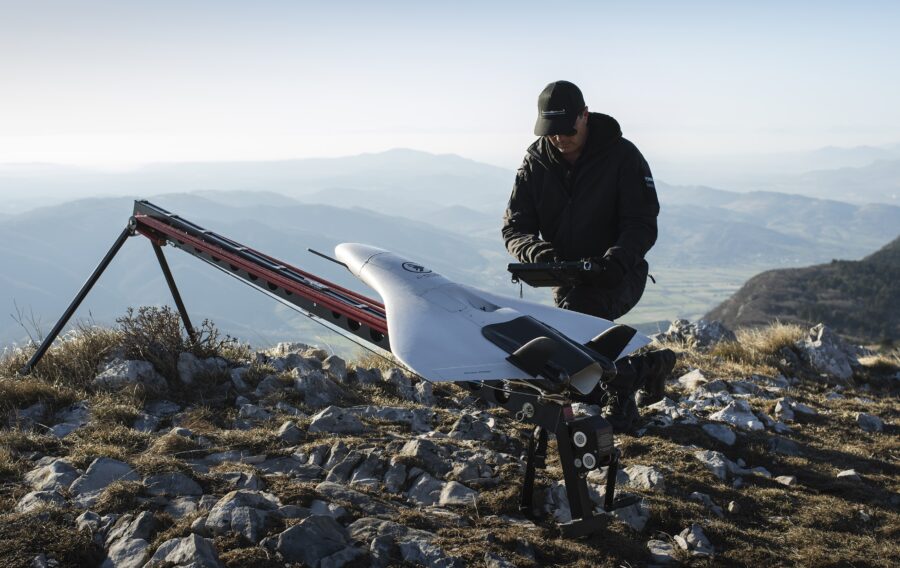
The European Defence Agency’s Sentinel Strike Challenge moves to live field testing in Portugal this autumn, as five companies advance to compete for €1.8 million in prizes – and generate the operational evidence that EU defence ministries will use to shape future loitering munition procurement.
The European Defence Agency has named five finalists for its Sentinel Strike Challenge, a competition testing loitering munition systems under realistic operational conditions as part of the EU OPEX26 experimental campaign. Helsing of Germany, Destinus of the Netherlands, C-Astral of Slovenia, UAVision of Portugal and Spirit Aeronautical Systems of Greece have been selected from more than 140 initial expressions of interest to advance to Stage 2, where their systems will be tested at the Santa Margarida military training area in Portugal this autumn. Each finalist receives a €30,000 Stage 1 prize and the opportunity to compete for a total of €1.8 million in Stage 2 prizes.
A further five companies – Renegade UxS and Robotto from Denmark, Cerberon Defence Systems and THALES LAS from Germany and France respectively, and ALTUS LSA from Greece – have been recognised as top ten finalists and will each receive a €10,000 Stage 1 prize, reflecting the competitive quality of submissions across the field.
The Sentinel Strike Challenge uses a two-stage award procedure that deliberately extends assessment beyond written proposals into live field testing under the same competition framework. That design choice is significant. By evaluating all five finalist systems against identical scenarios under controlled, realistic and contested operational conditions, the challenge generates comparable operational data that defence ministries across EU member states can use when making capability development and procurement decisions. The emphasis is on evidence generation rather than straightforward procurement – the EDA is explicit that selection for Stage 2 does not mean the technologies are ready to be purchased or deployed, but that they have earned the right to be tested under more demanding conditions.
Loitering munitions – attack drones that search for a target before striking – have become one of the most rapidly evolving capability areas in contemporary conflict. Their widespread and decisive use in Ukraine has accelerated interest across allied and partner nations, with technological advances and battlefield adaptations frequently outpacing traditional development and procurement cycles. The Sentinel Strike Challenge is designed to address that pace mismatch directly, using operational experimentation to evaluate emerging systems against military users’ requirements faster and on a more comparable basis than conventional assessment processes allow.
The involvement of military users from EU member states throughout the Portugal testing phase is a deliberate feature of the competition’s methodology. Participants will assess not only whether systems function as claimed, but how they perform across the full mission cycle, how resilient they are under operational stress, and how they compare when evaluated in identical scenarios. The results, expected to determine overall winners announced in 2027, will feed into future European capability development decisions across the loitering munition domain.
The challenge sits within the broader European defence investment landscape shaped by the EU SAFE instrument, ReArm Europe and the growing alignment between EU and NATO capability priorities – all of which are driving sustained demand for loitering munition and wider autonomous strike capability across European member states.
For the UK defence supply chain
The Sentinel Strike Challenge is directly relevant to UK suppliers for two reasons. First, the competition’s finalists and the operational evidence it generates will influence European procurement decisions in one of the most active and growing segments of the uncrewed systems market – a market UK companies are increasingly well positioned to compete in. Second, the challenge methodology itself – operational experimentation generating comparable evidence before procurement – is increasingly the model being adopted across allied defence innovation programmes, including UKDI’s own Innovation Support to Operations competition. UK businesses developing loitering munition systems, autonomous strike platforms and related technologies should be tracking both the Sentinel Strike outcomes and the broader European procurement pipeline they will inform.
Join our new expanding community at DPRTE.co.uk – our new Defence Community Platform, creating a single, year-round digital hub for the UK’s defence procurement and supply chain sector.

Post written by: Vicky Maggiani
Vicky has worked in media for over 25 years and has a wealth of experience in editing and creating copy for a variety of sectors.
RELATED ARTICLES

September 10, 2026
Homeland - Why 'Structured Collaboration' is Becoming a Defence Necessity
This week, Stuart John, from the Future Defence Support Services (FDSS) Bid Team at Leidos, examines new research with the

September 7, 2026
Homeland - Government commits £71m to Hemerdon tungsten and tin mine near Plymouth
The National Wealth Fund has committed up to £71 million to Tungsten West to restart the Hemerdon tungsten and tin