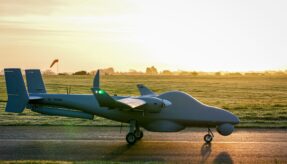



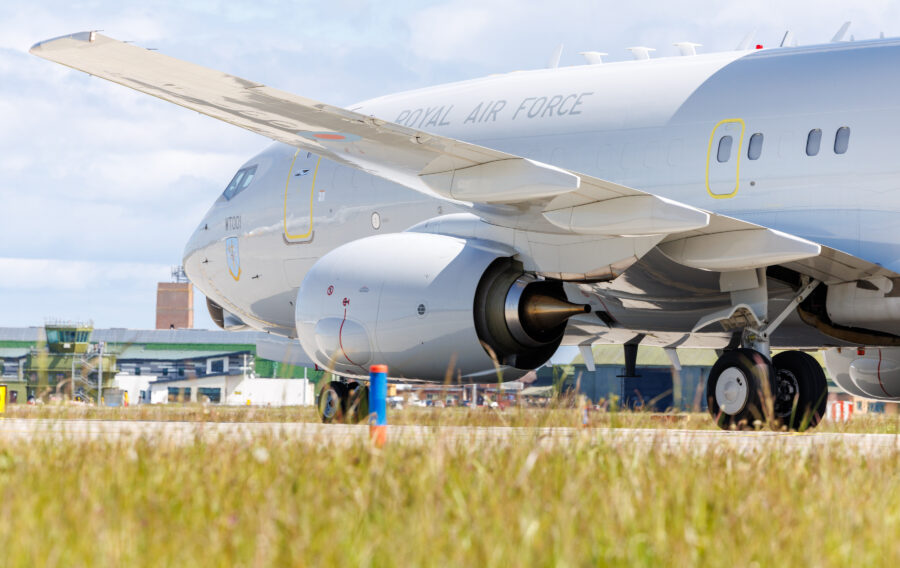
The RAF’s next-generation airborne early warning aircraft has touched down in Scotland, with the first Boeing E-7 Wedgetail AEW Mk1 arriving at RAF Lossiemouth on 21 May – greeted, appropriately, by a member of the station’s pipe band.
Registered as WT001, the aircraft departed STS Aviation Services at Birmingham Airport before flying north to its future Main Operating Base, crewed jointly by personnel from Boeing UK and the RAF. The arrival marks a significant milestone in the Wedgetail programme’s progression toward operational service.
Test and Evaluation Phase
WT001 is now continuing its Test and Evaluation phase at Lossiemouth, split with MOD Boscombe Down, to ensure safe and fully assured progression toward service entry. On completion of that phase, the aircraft will be formally handed over from Boeing UK to the RAF, where it will be operated by 8 Squadron.
Group Captain Sarah Brewin, Station Commander RAF Lossiemouth, said: “This marks a significant step in delivering the Royal Air Force’s next generation of airborne surveillance and control capabilities that will support the defence of the UK for the years to come. RAF Lossiemouth has been working hard to get ready to operate these aircraft, and we are looking forward very much to this next exciting chapter in the Station’s history.”
Capability and Context
The Wedgetail is designed to deliver long-range surveillance, battle management, and command and control for air and joint operations – a capability that becomes increasingly critical as the strategic environment in the North Atlantic and High North continues to evolve. The platform is already proven in service with the Royal Australian, Republic of Korea and Turkish Air Forces.
At Lossiemouth, the Wedgetail will serve alongside the station’s nine-strong fleet of Poseidon maritime patrol aircraft. Both are based on the Boeing 737 Next Generation airframe, enabling the RAF and Boeing to draw on significant operational and logistical synergies across the two fleets.
Stu Voboril, Boeing E-7 Vice President and Program Manager, noted that alongside delivering world-leading capability, the programme is “supporting British industry through UK jobs and supply chain opportunities.”
Supply Chain Implications
The Wedgetail programme – and its co-location with the Poseidon fleet at Lossiemouth – represents a sustained, long-term commitment to Scotland as a centre of airborne maritime and surveillance operations. For businesses in advanced engineering, MRO, digital systems, sensors and defence support services, the growing operational footprint at RAF Lossiemouth is an increasingly significant part of the Scottish defence landscape.
It also underlines a theme heard clearly at last week’s DPRTE Scottish Defence Procurement and Supply Chain Summit in Glasgow: Scotland is not on the periphery of UK defence – it is at its strategic centre.
Image: RAF

Post written by: Vicky Maggiani
Vicky has worked in media for over 25 years and has a wealth of experience in editing and creating copy for a variety of sectors.
RELATED ARTICLES

August 3, 2026
Land - BAE Systems Reports £84 Billion Order Backlog and Upgraded Guidance as Global Defence Spending Drives Record Performance
BAE Systems’ strongest first-half results in years – with sales up 9%, a record order backlog and full-year guidance raised

August 3, 2026
Maritime - US Awards $76.6 Billion Submarine Contract in Historic Undersea Modernisation Drive
A landmark US shipbuilding investment spanning Columbia and Virginia Class submarines signals the scale of allied commitment to undersea deterrence