



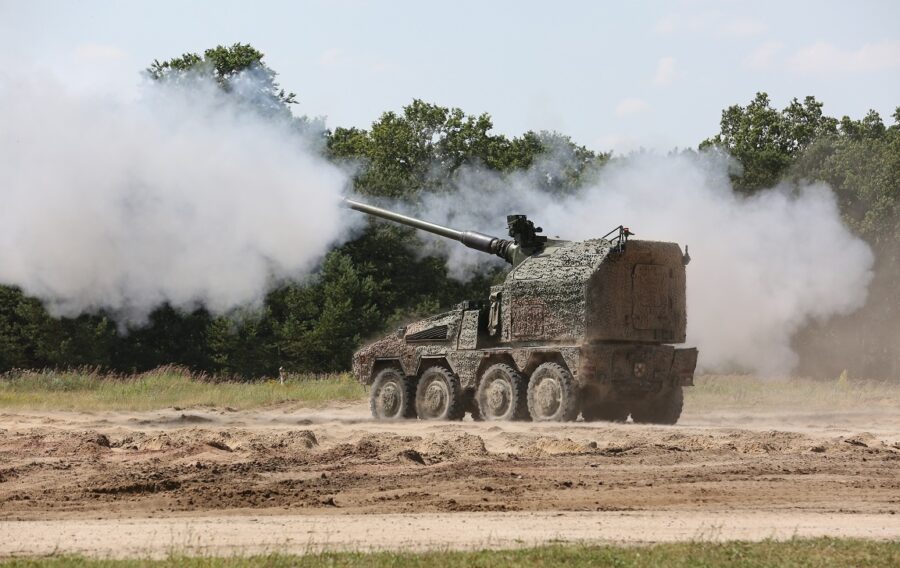
The British Army is to be equipped with 72 Remote Controlled Howitzers (RCH 155) under a nearly £1 billion contract – the most significant British artillery procurement in a generation, and a direct response to the capability gap created when the UK donated its AS90 systems to Ukraine in 2023.
The contract, awarded by the Organisation for Joint Armament Cooperation (OCCAR) on behalf of the British Army to ARTEC GmbH – a joint venture between KNDS and Rheinmetall – includes initial training and in-service support, with first deliveries expected in 2028. The programme is expected to support at least 500 British jobs across Rheinmetall’s Telford facility, KNDS’s Stockport site and the wider UK supply chain.
What the RCH 155 Delivers
The RCH 155 represents a generational leap in British artillery capability. Mounted on a BOXER chassis, it can fire eight rounds per minute at targets up to 70km away – significantly outranging the systems it will eventually replace. It can redeploy at speeds of up to 100km/h, making it substantially harder for adversaries to target after firing. Advanced turret automation means the entire system can be operated at the push of a button by just two soldiers from within the protected crew compartment, reducing personnel exposure and cognitive burden in high-tempo operations.
The system directly supports the British Army’s goal of delivering tenfold greater lethality within the next decade – a target set by the Strategic Defence Review – and will replace the Archer artillery system currently serving as an interim capability following the AS90 donation to Ukraine.
Deputy Chief of the General Staff, Lt Gen Simon Hamilton CBE, was direct about the context: “Britain answered the call for aid by providing artillery systems to Ukraine at the outbreak of the war. We knew the risk – the gap in our warfighting capability – that this would present. The success of bringing the RCH 155 onto contract marks the first significant milestone in replenishing this capability.”
UK Industrial Benefit
The programme has been structured to anchor significant industrial benefit in Britain, with the weapon system – barrel, breech, recoil system and trunnions – manufactured at Rheinmetall’s large-calibre production facility in Telford. The BOXER drive module will be manufactured by KNDS UK in Stockport, sustaining critical armoured steel welding capability and supporting 100 skilled jobs at that site. A further 100 new skilled jobs are expected to be created at Telford, with 300 additional roles supported across the wider supply chain.
Notably, Rheinmetall is set to source British steel through Sheffield Forgemasters – the specialist steelmaker in which the government invested over £420 million last year to bolster sovereign manufacturing capability for defence programmes including gun barrels and nuclear submarines. The linkage between the RCH 155 programme and Sheffield Forgemasters is a deliberate expression of the government’s intent to use major procurement contracts to strengthen the domestic industrial base end-to-end, from raw material to finished system.
The Trinity House Dimension
The RCH 155 contract delivers on the UK-Germany Trinity House Agreement signed in October 2024, which committed both nations to deeper bilateral defence cooperation and improved interoperability between Allied forces. The programme will exploit the combined capabilities of both nations’ test and evaluation centres, enabling faster delivery at lower cost while directly strengthening NATO’s collective defence on the eastern flank.
German Federal Minister of Defence Boris Pistorius welcomed the contract as evidence that “we take interoperability within NATO seriously and are putting it into practice,” adding that joint exercises and training would “bring our armed forces even closer together” in the long term.
For UK industry, the bilateral structure of the programme also creates a template worth understanding. As the UK deepens defence cooperation agreements with European allies – including through the EU loan facility for Ukraine announced earlier this month – joint procurement programmes structured around shared industrial benefit are likely to become an increasingly common feature of the landscape.
Supply Chain Implications
The RCH 155 programme represents a substantial and long-duration opportunity for UK businesses across several sectors. Large-calibre ammunition, artillery fire control systems, platform maintenance, crew training infrastructure, digital integration and logistics support are all areas where the programme will generate demand over its lifetime.
The programme’s explicit use of Sheffield Forgemasters steel also signals the MoD’s intent to apply domestic content requirements as a deliberate industrial policy instrument – a trend that businesses across the defence materials and components supply chain should factor into their strategic planning.

Post written by: Vicky Maggiani
Vicky has worked in media for over 25 years and has a wealth of experience in editing and creating copy for a variety of sectors.
RELATED ARTICLES

September 10, 2026
Homeland - Why 'Structured Collaboration' is Becoming a Defence Necessity
This week, Stuart John, from the Future Defence Support Services (FDSS) Bid Team at Leidos, examines new research with the

September 7, 2026
Homeland - Government commits £71m to Hemerdon tungsten and tin mine near Plymouth
The National Wealth Fund has committed up to £71 million to Tungsten West to restart the Hemerdon tungsten and tin