



UK Defence Innovation and the British Army’s Experimentation and Trials Group have deployed passive counter-drone detection systems at a garrison in under six months, moving from concept to live operational capability through a partnership between two UK suppliers.
A layered drone detection system is now operational at Warminster garrison following a rapid deployment programme initiated by the British Army’s Experimentation and Trials Group (ETG) and funded by UK Defence Innovation (UKDI). The system combines radio frequency (RF) and optical detection technologies supplied by Dedrone and Quell respectively, delivering what is described as a UK first for Army base protection. Within the first 17 days of live monitoring, the system recorded 29 drone position alerts with detections reaching up to 5 kilometres away, none of which presented a threat to the base.
Two-layer detection architecture
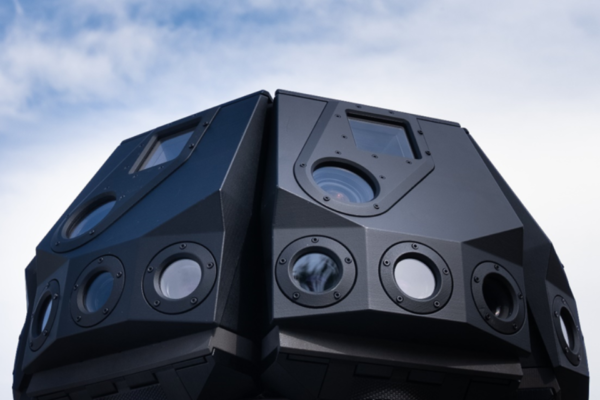
Dedrone, now part of Axon and described as protecting over 1,130 sites across 35 countries, provided a command and control software platform integrating multiple sensor types. Three RF sensors triangulate drone position across the garrison, while a fourth handles recognition and identification of both the aircraft and its operator, displaying that information in real time. Quell, a British company, delivered SkySpyke as the second detection layer. The system operates autonomously to provide complete hemispheric sky coverage, detecting, tracking, and identifying all airborne objects using AI-enabled surveillance to filter alerts and reduce operator burden.
Rapid transition from trials to deployment
The speed of delivery was enabled by prior field work. ETG had already demonstrated both systems through earlier exercises including Project Vanaheim and Project Flytrap, where the technology was tested against live drone activity. This familiarity with the suppliers, defence networks and integration standards accelerated the move from demonstration to operational deployment.
Nick McRobb, Dedrone’s UK defence lead and a former Army Colonel, said: “We moved quickly. The demonstration event took place in November 2025, and we did our on-site recce in January 2026. We were installed and operational a few months later by March 2026.” Quell’s path to Warminster was underpinned by earlier UKDI funding that enhanced the SkySpyke system and built out its Deep Truth software platform, improving detection range and creating a modular hardware design. Bobby Hamilton, Quell’s Chief Operating Officer, noted: “The UKDI funding allowed us to implement a lot of the learnings we took from the British Army’s Army Warfighting Experiment and pushed us forward into operational testing with Taskforce RAPSTONE on their C-UAS Exercises, Project Vanaheim and Project Flytrap. Having systems deployed with the UK MOD has allowed us to prove the capability in real operational environment, and demonstrate how it could perform across the wider defence estate.”
Foundation for wider rollout
ETG’s technical input throughout Project Halo Shield has created a foundation for expansion across UK garrison sites. Future phases may incorporate additional sensor types including radar and acoustic systems alongside existing RF and optical detection to create a layered detection architecture. Col James Howard, Experimentation & Trials Group, said: “Working with UKDI and industry on this kind of dual use capability has been beneficial to all parties, making the British Army more safe from real, modern, threats while in its barracks as well as allowing the Experimentation and Trials Group to further develop the British Army’s counter drone capabilities.” McRobb added: “What this project proves is that sensor fusion is the answer. Each technology brings something the others don’t — and when you bring them together into a single picture, you get a level of confidence and clarity that no single system can match on its own.”
For the UK Defence Supply Chain
Project Halo Shield demonstrates UKDI’s model for accelerating dual-use counter-drone capability from concept to frontline deployment, a pattern likely to inform future garrison protection programmes across the defence estate. Counter-drone RF sensor manufacturers, optical detection system integrators, and C2 software providers that can demonstrate proven performance in field trials and exercise environments are positioned to compete in expanded rollout phases. Suppliers will need to evidence interoperability with defence network standards, successful performance in Army-led experimentation, and ability to operate within a layered, multi-sensor architecture. The project sits within the broader MOD drive to protect critical defence infrastructure from emerging unmanned threats, establishing sensor fusion as the preferred operational model.
Image Source: www.gov.uk
Post written by: Stephen Donlan
RELATED ARTICLES

February 10, 2025
Homeland - Aiming Far and High: New DASA Market Exploration seeks revolutionary uncrewed systems
The Defence and Security Accelerator (DASA) is pleased to launch a new Market Exploration called ‘Air Launched Effects: Revolutionary Deployment Systems’. Run

February 5, 2025
Land - Babcock and Patria agree partnership to deliver for British Army
Babcock and Patria, the provider of defence technology solutions have signed a Memorandum of Understanding to offer the Patria 6×6