



A rapid two-week mobilisation by Dstl analysts to support a naval table-top exercise has delivered evidence-based insights that are already influencing the Royal Navy’s mine-hunting programme – and reducing procurement risk on a significant capital investment.
The Defence Science and Technology Laboratory has delivered a critical contribution to the Royal Navy’s Mine Hunting Capability programme, mobilising specialist analysts with just two weeks’ notice to design and implement realistic mine countermeasure scenarios for a high-profile naval table-top exercise. Working collaboratively with Naval Design Partnering, Defence Equipment and Support and Royal Navy stakeholders across a two-day exercise, Dstl generated actionable insights that have directly influenced future capability decisions – including identifying a key design change required for the adoption of an offshore support vessel design from Norway that will form the basis of the UK’s future mine-hunting mother ship.
The pace and agility of Dstl’s response is itself part of the story. Two weeks from notification to delivery of a rigorous, operationally relevant exercise is not a timeline that traditional defence science engagement typically accommodates. That the team was able to design realistic vignettes, provide real-time expert advice throughout the exercise and generate evidence-based findings within that window reflects both the operational urgency attached to mine-hunting capability development and the kind of rapid science and technology support that the MoD increasingly needs as procurement decisions accelerate.
The operational context for the investment is clear and well established. Underwater mines are a low-cost, high-impact threat capable of blocking sea lanes, disrupting trade and endangering lives across both military and commercial maritime operations. The UK’s economic security and its NATO obligations both depend on assured maritime access, and mine-hunting capability – the ability to detect, identify and neutralise mines before they can deny freedom of manoeuvre – is a fundamental enabler of that access. As mines grow more sophisticated, incorporating autonomous features and more complex fuzing, the systems and methods used to counter them must evolve in parallel. The Royal Navy’s investment in a new mine-hunting mother ship and associated capability is a direct response to that requirement.
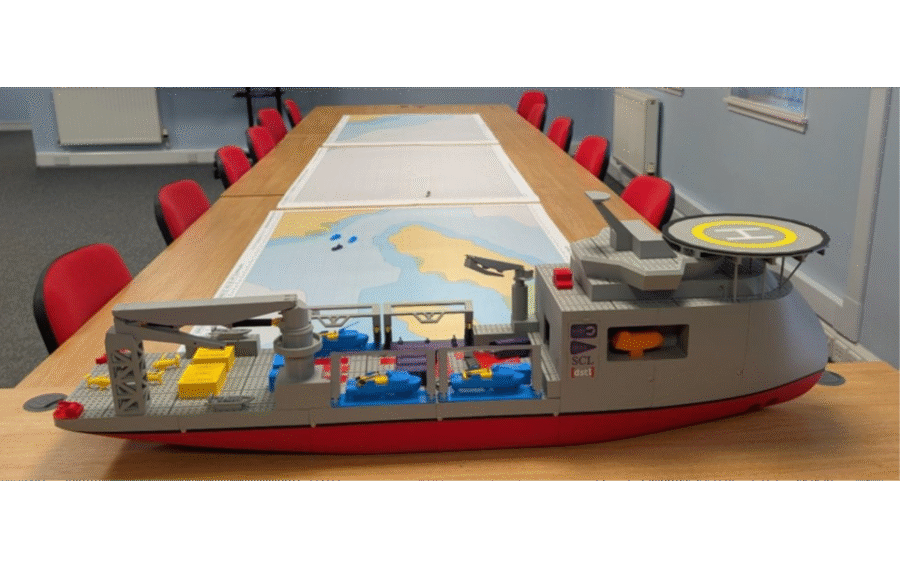
One of the most innovative elements of the Dstl-led exercise was its use of large-scale 3D printed modelling, produced by Naval Design Partnering, to facilitate exploration of deck operations for future mine-hunting mother ship designs. The physical model allowed stakeholders to visualise, test and assess integration challenges and operational frictions before any design commitment was made – a relatively low-cost intervention that can prevent significantly more expensive corrections later in the procurement cycle. The approach exemplifies a broader shift in how complex naval procurement is being de-risked, using rapid physical and digital modelling to expose integration issues early rather than discovering them during detailed design or, worse, build.
The findings from the exercise have already informed future work to reduce risk and cut planned expenditure, and have enabled the UK to engage with the Norwegian Government – whose offshore support vessel design is being assessed for adaptation as the mine-hunting mother ship – from a position of greater clarity about British requirements and what the UK can offer in return. That bilateral positioning is significant: a table-top exercise that generates both domestic procurement intelligence and a stronger negotiating foundation for an international acquisition represents considerable value from a two-day investment.
Richard Murray’s National Armaments Director Group Materiel function oversaw delivery of the exercise alongside DE&S and the Royal Navy, with the collaborative model – science, acquisition, industry and operational expertise working as a single team – cited as central to the quality and speed of the outcomes achieved.
For the UK defence supply chain
The Royal Navy’s mine-hunting capability programme is an active and growing area of procurement investment with direct supply chain implications across autonomous underwater systems, vessel design, sensor technology and through-life support. The identification of a Norwegian offshore support vessel design as the basis for the future mine-hunting mother ship – and the design changes now being worked through as a result of the Dstl-led exercise – signals that the programme is moving from concept assessment towards procurement decisions, creating a near-term window for supply chain engagement. The programme’s emphasis on autonomous systems and advanced modelling as essential components of future mine countermeasures also points to growing demand for technology businesses beyond the traditional naval shipbuilding supply chain.
Image: NDP
Join our new expanding community at DPRTE.co.uk – our new Defence Community Platform, creating a single, year-round digital hub for the UK’s defence procurement and supply chain sector.

Post written by: Vicky Maggiani
Vicky has worked in media for over 25 years and has a wealth of experience in editing and creating copy for a variety of sectors.
RELATED ARTICLES

September 10, 2026
Homeland - Why 'Structured Collaboration' is Becoming a Defence Necessity
This week, Stuart John, from the Future Defence Support Services (FDSS) Bid Team at Leidos, examines new research with the

September 7, 2026
Homeland - Government commits £71m to Hemerdon tungsten and tin mine near Plymouth
The National Wealth Fund has committed up to £71 million to Tungsten West to restart the Hemerdon tungsten and tin