



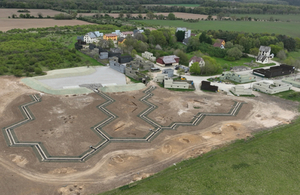
New trench infrastructure at Salisbury Plain and Stanford Training Area reflects how the lessons of modern conflict are being embedded directly into the UK’s military training estate – and the sustained construction and engineering pipeline that programme of estate modernisation is generating.
More than £4.4 million has been invested in new trench training infrastructure across the Defence Training Estate, delivering realistic battlefield environments designed to reflect the character of contemporary conflict. Delivered through a partnership between the Defence Infrastructure Organisation, the British Army and Landmarc Support Services, the investment covers new trench systems at Copehill Down Training Village on Salisbury Plain and Eastern European-style trench networks at Eastmere Village within Stanford Training Area in Norfolk – two of the most actively used training areas in the UK military estate.
The facilities are explicitly designed around the operational lessons emerging from the Russia-Ukraine conflict, where extensive trench networks, layered defensive positions and urban-rural battlefield complexity have defined the character of fighting at scale. The new infrastructure replicates that complexity in training conditions, incorporating extensive trench networks, fighting positions, covered command posts, protected shelters, bunkers, observation points, firing platforms and vehicle positions. Integrated into existing training areas rather than built as standalone facilities, the infrastructure creates challenging and representative environments that soldiers can train in repeatedly across a range of scenarios and force compositions.
Colonel William Robinson, Deputy Chief of Staff at the Land Warfare Centre, was direct about the rationale. The character of conflict continues to evolve, he said, and it is essential that training environments evolve alongside it. The new trench systems are designed to develop tactical skills, decision-making and battlefield awareness in conditions that reflect what soldiers may actually encounter on operations – a requirement that has become more pressing as the lessons of Ukraine have demonstrated the continuing relevance of combined arms, trench warfare and the complex integration of urban and rural terrain in modern high-intensity conflict.
Brigadier Gavin Hatcher, Head of Overseas and Training Region at DIO, described the investment as demonstrating a continued commitment to ensuring the armed forces have access to infrastructure that reflects the changing character of warfare. The projects were delivered with support from specialist supply chain partners across military infrastructure, construction and estate development, with the Stanford Training Area project specifically supported by Knights Brown Construction, 5C Consulting and Land Sculpture Civils.
Landmarc Programme Director David Morgan framed the delivery model as an illustration of how customer insight, engineering expertise and collaborative delivery can transform emerging operational requirements into realistic and enduring training capability. The emphasis on enduring value – infrastructure designed to last and to be adapted as training requirements evolve – reflects the long-term investment logic of the Defence Training Estate programme, which forms part of the wider estate modernisation effort aligned with the Defence Investment Plan’s ambitions for a modern, operationally relevant military infrastructure.
For the UK defence supply chain
The Defence Training Estate’s programme of modernisation and estate investment represents a sustained and geographically distributed construction and infrastructure pipeline that extends well beyond the most visible new build programmes. The trench infrastructure projects at STANTA and Salisbury Plain illustrate the breadth of specialist capability required – from military construction and earthworks to command post engineering, covered shelter design and the integration of complex tactical terrain features into existing training environments. For businesses in construction, civil engineering, military infrastructure and specialist estate development, the DTE programme offers a recurring and mission-critical pipeline tied directly to the Army’s operational readiness requirements.
Join our new expanding community at DPRTE.co.uk – our new Defence Community Platform, creating a single, year-round digital hub for the UK’s defence procurement and supply chain sector.

Post written by: Vicky Maggiani
Vicky has worked in media for over 25 years and has a wealth of experience in editing and creating copy for a variety of sectors.
RELATED ARTICLES

September 10, 2026
Homeland - Why 'Structured Collaboration' is Becoming a Defence Necessity
This week, Stuart John, from the Future Defence Support Services (FDSS) Bid Team at Leidos, examines new research with the

September 7, 2026
Homeland - Government commits £71m to Hemerdon tungsten and tin mine near Plymouth
The National Wealth Fund has committed up to £71 million to Tungsten West to restart the Hemerdon tungsten and tin