



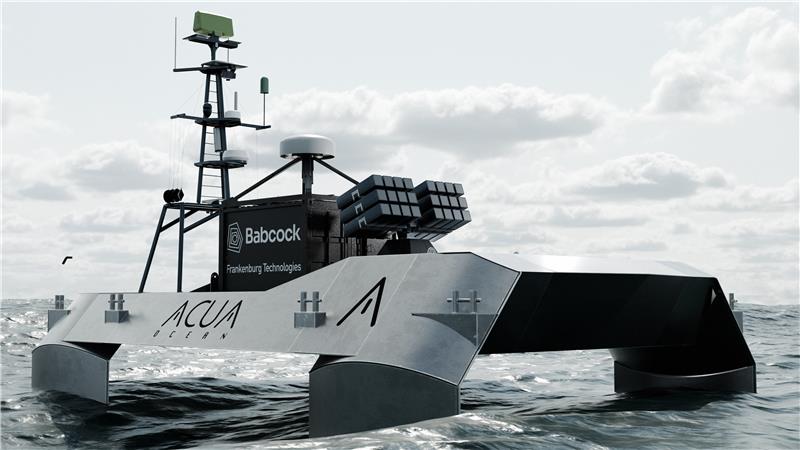
A tripartite agreement signed at Farnborough International Airshow brings together a systems integrator, an uncrewed surface vessel specialist and a precision missile manufacturer to deliver persistent, affordable maritime air defence against the drone threat.
Babcock International Group has signed a Memorandum of Understanding with Plymouth-based marine technology company ACUA Ocean Technologies and missile developer Frankenburg Technologies to advance counter-uncrewed aerial systems solutions in the maritime domain. The agreement, signed at Farnborough International Airshow, combines three distinct but complementary capabilities into an integrated system designed to provide persistent, low-cost defence against the growing threat of one-way attack drones to ships, ports and critical maritime infrastructure.
The partnership builds on a bilateral agreement Babcock signed with Frankenburg in January to explore air defence systems capable of countering the rapid proliferation of attritable drone threats. The addition of ACUA Ocean completes the operational picture, integrating Babcock’s multi-domain launcher system and Frankenburg’s mass-manufacturable precision guided missiles into ACUA’s uncrewed surface vessels – creating a maritime counter-drone solution that is persistent, scalable and capable of operating in conditions that limit conventional systems.
That last point carries operational weight. One of the central challenges in maritime counter-UAS is maintaining continuous coverage in rough sea states, where traditional platforms are frequently forced out of operational limits. ACUA’s Pioneer-class USV addresses this directly. In June, the Pioneer completed more than 100 hours at sea without hands-on intervention, operating continuously 16 to 20 nautical miles offshore – a demonstration of the endurance and stability that makes the platform viable as a persistent, all-weather defence asset. Its hull design maintains sensor and payload operability in high seas where other platforms cannot, which CEO Neil Tinmouth described as essential to countering mass drone attacks that exploit gaps in coverage.
Frankenburg’s contribution addresses the economics of the threat. As one-way attack drones become cheaper and more prevalent, the cost asymmetry between attacker and defender becomes a strategic vulnerability. Mass-manufacturable, low-cost precision guided missiles are designed to shift that equation, making sustained interception viable at the scale that mass drone attacks demand. Integrated with Babcock’s launcher system – which can be fitted to both crewed and uncrewed vessels and scaled quickly – the combined solution is engineered to be producible and affordable as well as effective.
For Babcock, the agreement reinforces its position as a systems integrator shaping the UK’s emerging hybrid navy concept, bringing together sovereign technologies from across the industrial base to underpin next-generation autonomous maritime capability. Sir Nick Hine, Chief Growth Officer at Babcock, described the collaboration as addressing some of the biggest challenges the company’s customers face in today’s defence landscape, with a particular focus on protecting critical national assets and infrastructure.
For the UK defence supply chain
The Babcock-ACUA-Frankenburg partnership is a strong example of how the UK’s autonomous and counter-UAS capability is being built – through collaboration between a major systems integrator and innovative, specialist SMEs, rather than through a single vertically integrated programme. For supply chain businesses, this model creates opportunities at multiple tiers, from platform manufacturing and launcher integration to sensor systems, propulsion, autonomy software, payload development and through-life support. The maritime domain is an increasingly active area of investment across the defence programme, and the trajectory towards hybrid, uncrewed naval capability is generating a growing and accessible pipeline for businesses with relevant expertise.
Join our new expanding community at DPRTE.co.uk – our new Defence Community Platform, creating a single, year-round digital hub for the UK’s defence procurement and supply chain sector.

Post written by: Vicky Maggiani
Vicky has worked in media for over 25 years and has a wealth of experience in editing and creating copy for a variety of sectors.
RELATED ARTICLES

September 10, 2026
Homeland - Why 'Structured Collaboration' is Becoming a Defence Necessity
This week, Stuart John, from the Future Defence Support Services (FDSS) Bid Team at Leidos, examines new research with the

September 7, 2026
Homeland - Government commits £71m to Hemerdon tungsten and tin mine near Plymouth
The National Wealth Fund has committed up to £71 million to Tungsten West to restart the Hemerdon tungsten and tin