



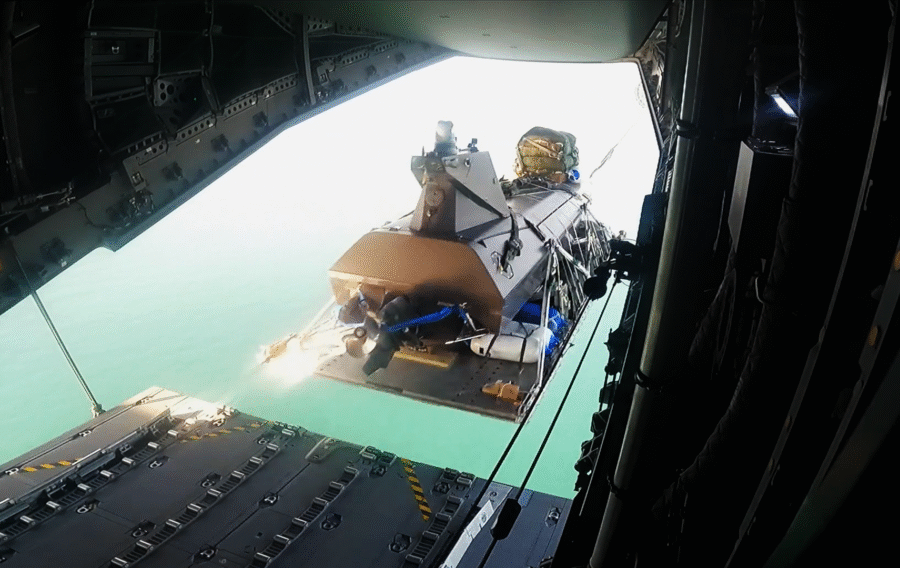
Kraken Technology Group and Capewell, working with the Royal Navy under Project Beehive, have successfully completed the world’s first extracted-load airdrop of an uncrewed surface vessel from an A400M military transport aircraft, demonstrating a new rapid-insertion capability for maritime force projection.
Over a series of trials, a Project Beehive specification K3 SCOUT USV was deployed on Capewell’s Universal Maritime Craft Aerial Delivery System (UMCADS) multiple times from 1,300 feet into waters up to Sea State 4. The demonstrations proved that high-performance uncrewed vessels can be rapidly inserted into contested or difficult-to-access maritime environments by air, entering the water ready for operation. The trials paired Kraken’s K3 SCOUT optional airdrop kit with Capewell’s reconfigurable Type V parachute-based UMCADS platform, and culminated in successful validation of a new IN-Release system, a configurable electro-mechanical release mechanism enabling reliable, synchronised load disconnect across a range of aerial and maritime applications.
The campaign significantly expands the speed, range and flexibility with which uncrewed maritime capabilities, including those being procured for the UK’s Hybrid Navy under Project Beehive, can be deployed. Mal Crease, Founder and CEO of Kraken Technology Group, said the trials demonstrated that “K3 SCOUT can be rapidly deployed directly from a military transport aircraft into contested or difficult-to-access waters ready for operation,” adding that Kraken and its partners “will continue to push boundaries to deliver novel and enhanced operational capabilities with our resilient, modular platforms.” Mark Lavender, Director of Business Development and Training at Capewell, highlighted the pace of the campaign as much as its outcome, noting the team “conducted 4 live airdrops in 6 working days with the same boat and platform,” validating both the payload integration and how easily the UMCADS system can be reconfigured for other maritime or land-based mission equipment.
For the UK defence supply chain, this trial points to a fast-emerging capability area at the intersection of airlift and maritime autonomy. As force projection for uncrewed systems increasingly relies on rapid air insertion rather than ship or shore-based launch, demand is likely to build across aerial delivery hardware, release mechanisms, USV design and payload integration, and the parachute and rigging systems that make these platforms deployable from existing transport fleets like the A400M.
Businesses with relevant capabilities should monitor the following areas as Project Beehive and similar rapid-insertion concepts move forward:
- Aerial delivery systems and parachute-based platforms
- Electro-mechanical release and load-disconnect mechanisms
- Uncrewed surface vessel design for airdrop compatibility
- Maritime payload integration and mission equipment
- Military transport aircraft integration and rigging
- Hybrid Navy and force projection capability development
Join our new expanding community at DPRTE.co.uk – our new Defence Community Platform, creating a single, year-round digital hub for the UK’s defence procurement and supply chain sector.

Post written by: Vicky Maggiani
Vicky has worked in media for over 25 years and has a wealth of experience in editing and creating copy for a variety of sectors.
RELATED ARTICLES

September 10, 2026
Homeland - Why 'Structured Collaboration' is Becoming a Defence Necessity
This week, Stuart John, from the Future Defence Support Services (FDSS) Bid Team at Leidos, examines new research with the

September 7, 2026
Homeland - Government commits £71m to Hemerdon tungsten and tin mine near Plymouth
The National Wealth Fund has committed up to £71 million to Tungsten West to restart the Hemerdon tungsten and tin