



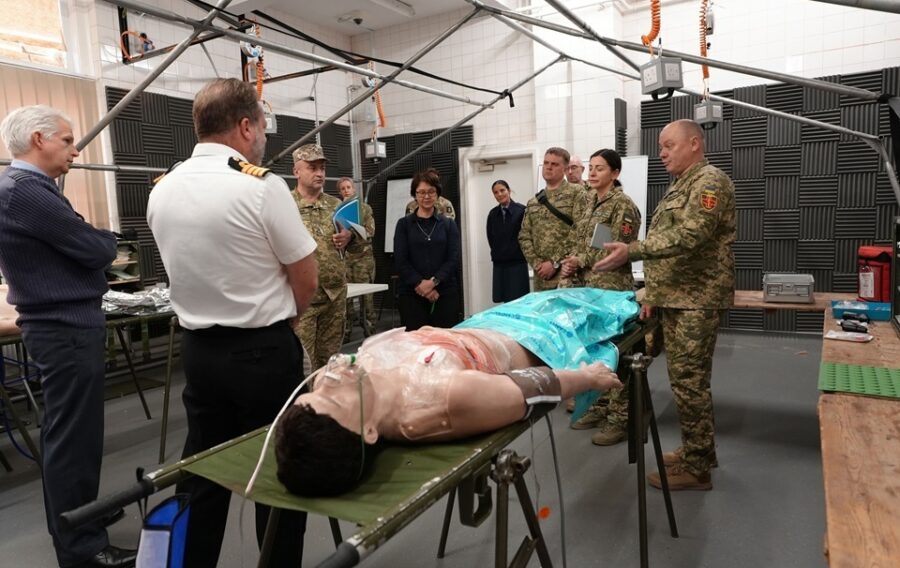
The UK’s Defence Medical Command has hosted the Surgeon General of Ukraine’s Armed Forces for a visit focused on strengthening medical cooperation, sharing frontline lessons from three years of high-intensity warfare, and expanding joint research and training programmes.
Major General Anatolii Kazmirchuk met senior UK defence clinical leaders including Chief of Defence Medical Air Marshal Clare Walton and UK Surgeon General Major General Phil Carter, toured medical facilities including the Royal London Hospital and HMS Dauntless, and agreed new research exchange arrangements that will pair UK Defence Clinical Advisors directly with Ukrainian counterparts.
Drone Warfare Is Rewriting Military Medicine
The most operationally significant discussions centred on the medical challenges created by drone warfare, an area where Ukraine’s experience is without parallel among NATO allies. The nature of drone-inflicted injuries, the complexity of casualty evacuation under persistent aerial threat, and the movement of medical personnel in contested environments where drones can target vehicles and personnel are all presenting challenges that existing military medical doctrine was not designed to address.
For UK Defence Medical and NATO allies, the lessons emerging from Ukraine’s three years of intensive combat are invaluable. Major General Kazmirchuk’s visit is part of a sustained effort to ensure those lessons are systematically captured, shared and applied before allied forces face similar conditions.
What Was Agreed
The visit produced several concrete outcomes. A research exchange programme will pair UK Defence Clinical Advisors with Ukrainian counterparts for ongoing collaboration and shared learning. Major General Kazmirchuk agreed to strengthen research and knowledge-sharing with the Institute of Naval Medicine in Gosport. Both sides reaffirmed their commitment to the Defence Medical Academy’s agreement with the Ukrainian Military Medical Academy, signed last year, covering military medical education, scientific research and joint training.
The visit also included a briefing from the UK Defence Medical innovation team on emerging technologies for front-line medicine, and a visit to the Royal London Hospital where Major General Kazmirchuk saw how the early replacement of lost blood has improved survival rates for severely injured patients, a technique with direct application to battlefield trauma care.
NATO’s Project Renovator
The visit highlighted the UK’s leading role in NATO’s Project Renovator, which supports Ukraine’s rehabilitation capability, helping wounded Ukrainian service personnel return to service or successfully reintegrate into civilian life. Major General Kazmirchuk acknowledged the direct impact of this cooperation: “Thanks to the valuable exchange of experience and knowledge, wounded Ukrainian service personnel are either returning to service or being successfully rehabilitated and reintegrated back into civilian life.”
Implications for Defence Medical Procurement
For the defence supply chain, the deepening of UK-Ukraine medical cooperation points to a growing and increasingly evidence-based demand for battlefield medical innovation. The specific challenges identified during the visit, including casualty evacuation under drone threat, rapid trauma intervention and rehabilitation technology, are areas where UK industry and academia are already active.
Businesses developing remote medical monitoring, autonomous casualty evacuation systems, advanced haemostatic treatments, rehabilitation technology and front-line medical equipment should be aware that the operational evidence base for these capabilities is being actively built through programmes like Project Renovator and the DMA-UMMA partnership, and that procurement demand will follow.
Air Marshal Walton said the UK’s support for Ukraine was “steadfast,” adding: “There is much we can learn from our friends.” UK Surgeon General Major General Phil Carter described the partnership as “actively supporting Ukraine, and strengthening our own military medical capability” simultaneously.
Image: Major General Anatolii Kazmirchuk saw how UK Defence medical capability continues to support the Ukrainian Armed Forces. MOD Crown Copyright.

Post written by: Vicky Maggiani
Vicky has worked in media for over 25 years and has a wealth of experience in editing and creating copy for a variety of sectors.
RELATED ARTICLES

September 10, 2026
Homeland - Why 'Structured Collaboration' is Becoming a Defence Necessity
This week, Stuart John, from the Future Defence Support Services (FDSS) Bid Team at Leidos, examines new research with the

September 7, 2026
Homeland - Government commits £71m to Hemerdon tungsten and tin mine near Plymouth
The National Wealth Fund has committed up to £71 million to Tungsten West to restart the Hemerdon tungsten and tin