


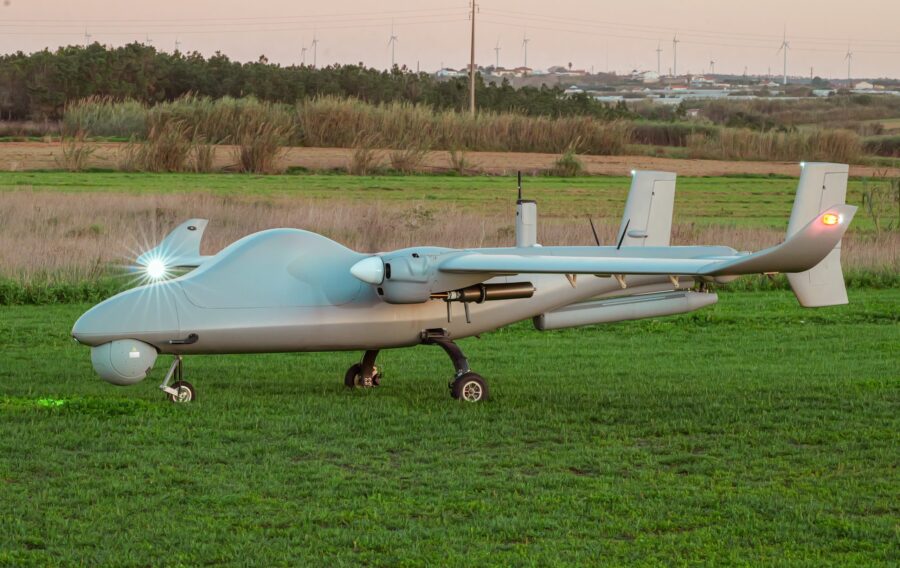
The Ministry of Defence has selected four industry partners and committed £10 million to develop autonomous drone wingmen for the British Army’s Apache attack helicopters, marking a significant milestone in one of the UK’s most closely watched autonomous systems programmes.
Project NYX, delivered in conjunction with UK Defence Innovation (UKDI), is the Army’s concept demonstrator programme to develop Uncrewed Air Systems capable of operating alongside Apache crews across reconnaissance, precision strike, target acquisition and electronic warfare missions in contested environments. The four shortlisted partners are Anduril Industries (UK) Ltd, BAE Systems Operations Ltd, Tekever Ltd and Thales UK Ltd.
What the Drones Will Do
The NYX drones are designed to function as loyal wingmen, flying autonomously alongside Apache helicopters and feeding pilots with information and situational awareness without requiring direct control. The systems will increase the lethality and survivability of Apache crews while reducing risk to personnel by keeping manned platforms further from the most dangerous areas of the battlespace.
The fully autonomous operation extends to all functions short of weapons use. All decisions resulting in the employment of weapons will continue to be made by a human operator, in line with the MoD’s established policy on autonomous weapons systems.
The capability set under development spans reconnaissance, precision strike, target acquisition and electronic warfare, giving Apache crews a significantly expanded operational reach and the ability to prosecute a wider range of missions with greater situational awareness and reduced exposure.
The Competition Structure
All four partners have been offered contracts to develop their drone designs, each bringing different approaches to autonomy, payloads and sensors. The MoD will assess each design over the coming months, with the intention of selecting up to two of the strongest contenders to progress to the next phase.
Up to two companies will be chosen in Autumn 2026 to build prototype designs. If prototypes prove successful, the programme aims to field an operational variant by 2030. The competitive structure, assessing four designs before narrowing to two and then to a final partner, reflects a procurement approach that maintains competitive tension through multiple phases rather than committing early to a single supplier.
Minister for Defence Readiness and Industry Luke Pollard MP described the programme as “British ingenuity at its best,” adding: “The UK isn’t just keeping up with the future of warfare, we’re driving it.”
The Partners
The four shortlisted companies represent a blend of established defence primes and specialist autonomous systems developers. BAE Systems and Thales UK bring deep integration experience with existing British Army platforms and significant autonomous systems development capability. Anduril Industries, the US-founded autonomous systems specialist that has established a significant UK presence, and Tekever, the Portuguese-founded UAS company with a strong UK footprint and proven military surveillance systems, both bring focused uncrewed systems expertise and operational track records.
The selection of all four reflects a genuine competitive field rather than a pre-determined outcome, and the diversity of approaches being assessed suggests the MoD is deliberately keeping its options open on the technical solution.
Procurement and Supply Chain Implications
Project NYX is one of the most significant autonomous air systems procurement programmes currently active in the UK, and its implications extend well beyond the four shortlisted primes. Autonomous wingman systems of this complexity require a broad supply chain spanning advanced sensors, AI and autonomy software, electronic warfare payloads, communications and datalink systems, airframe manufacturing, and integration and test capability.
As the programme moves from concept demonstrator toward prototype and ultimately operational fielding, the supply chain opportunity will grow substantially. Businesses with relevant capability in any of these areas should be monitoring the programme closely and engaging with the shortlisted primes as subcontractor and supplier opportunities develop.
UKDI’s role as delivery agent, providing specialist delivery, commercial, engineering and safety expertise, also signals that the autonomous systems innovation ecosystem is being actively cultivated alongside the primary procurement. Businesses with novel autonomy, sensing or payload technologies that have not yet engaged with UKDI’s funding competitions and challenge programmes should consider doing so.
Image: Tekever

Post written by: Vicky Maggiani
Vicky has worked in media for over 25 years and has a wealth of experience in editing and creating copy for a variety of sectors.
RELATED ARTICLES
August 7, 2026
Air - Thales Secures NSPA Contract for Deployable Air Navigation System in Demonstration of NATO Procurement Route
Thales has been selected by the NATO Support and Procurement Agency to supply a Deployable Tactical Air Navigation system to
August 7, 2026
Air - Royal Navy's Dragon Rider Trials Prove Drone Armada Concept Over 200 Miles of Southern England
A week-long exercise integrating multiple uncrewed systems with Wildcat helicopters, Royal Marines and ship commanders has demonstrated that long-range drone