


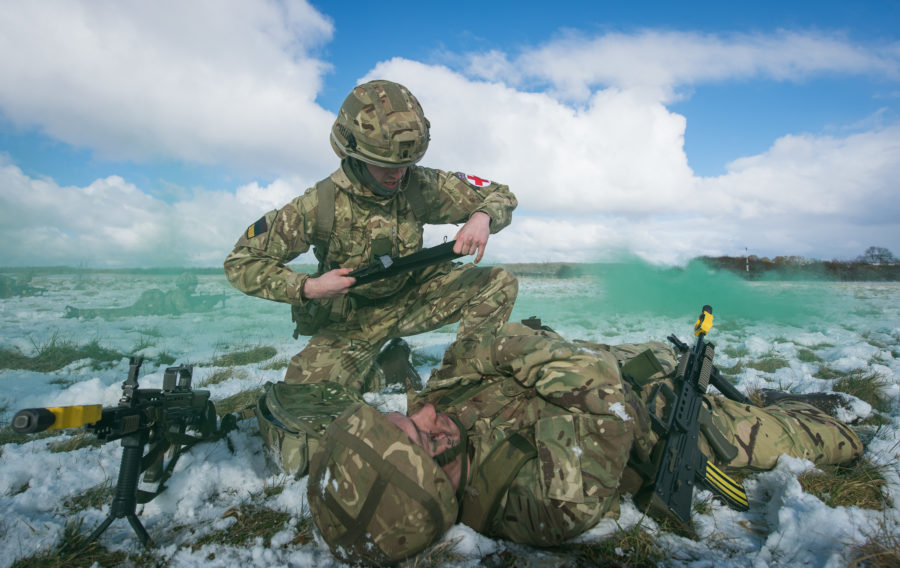
Medics from the Army Medical Services (AMS) have been undergoing training to give life saving care in a battlefield environment.
The AMS are required to deploy at short notice anywhere in the world to provide medical support and are made up of four Corps (The Royal Army Medical Corps, The Royal Army Veterinary Corps, Royal Army Dental Corps and The Queens Alexandra’s Royal Army Nursing Corps) of Regular and Reserve personnel.
Full-time Regulars and spare-time Reservists, including those of Preston-based 3 Medical Regiment, were put to the test on the frozen North Luffenham training area in the Midlands.
A battlefield environment was simulated using blank ammunition and actors, but Combat Medical Technicians know that they might be asked to do it for real.
The ‘care under fire’ scenario is designed to see how medics will react while attending to a casualty under a hail of bullets. Soldiers must apply immediate first aid and carry the wounded, including the casualty’s 40kg of kit, whilst others provide covering fire.
Extra tests staged during the training examined their ability to treat conditions as varied as chest infections and gunshot wounds, all from nothing more than a tent.
Once completed, the exercise qualifies the AMS’ first responders to fulfil their role anywhere in the world.
image © Crown Copyright
If you would like to join our community and read more articles like this then please click here.
AMS Army Medical Services Combat Medical Technicians
Post written by: Matt Brown
RELATED ARTICLES

September 10, 2026
Homeland - Why 'Structured Collaboration' is Becoming a Defence Necessity
This week, Stuart John, from the Future Defence Support Services (FDSS) Bid Team at Leidos, examines new research with the
September 7, 2026
Homeland - Government commits £71m to Hemerdon tungsten and tin mine near Plymouth
The National Wealth Fund has committed up to £71 million to Tungsten West to restart the Hemerdon tungsten and tin