



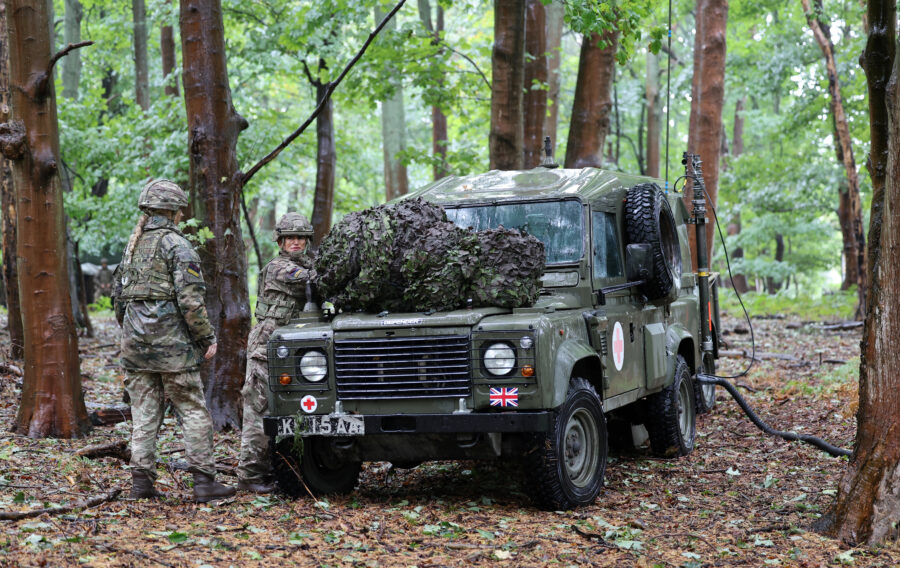
The formal launch of the LMV competition to replace the Land Rover and Pinzgauer fleets opens one of the most significant British Army vehicle procurements in a generation – with a September deadline for participation requests and a notable exclusion of Chinese suppliers under the Procurement Act 2023.
The Ministry of Defence has published the tender for the British Army’s Light Mobility Vehicle programme, marking the formal start of a competitive procurement process for a platform expected to be worth up to £2 billion excluding VAT – or £2.5 billion including it – with a contract running from May 2027 to May 2036 and options to extend to 2047. The LMV will replace the Land Rover Wolf and Pinzgauer fleets, both of which have an out-of-service date of 2030 after service lives already extended well beyond their originally planned 15 years. Requests to participate close on 1 September 2026, with an estimated award decision of 31 May 2027 and vehicle trials planned between October 2026 and January 2027.
The programme is structured around a single Common Base Platform supporting nine variants: a General Purpose Vehicle, Battlefield Ambulance, Tactical Mobility Vehicle, Utility Vehicle, Enhanced Protection Vehicle, Command and Control Vehicle, Equipment Support Vehicle, Troop Carrying Vehicle and Mission Systems Vehicle. DE&S declined to divide the competition into lots, citing the high risk of a mixed fleet from multiple platforms and multiple suppliers – a decision that concentrates the contract value with a single winner but provides that winner with a programme of exceptional scale and duration. Initial purchase options extend to in excess of 9,500 vehicles.
The tender notice carries a significant and unprecedented element: the explicit exclusion of Chinese suppliers under Section 19(3)(b) of the Procurement Act 2023. The provision allows a contracting authority to disregard tenders from suppliers that are not UK or treaty state suppliers – China has never acceded to the World Trade Organization’s Government Procurement Agreement despite applying in 2007 – making the exclusion a trade and market access mechanism rather than a formal national security exclusion. The distinction is legally significant but the practical effect is the same. The exclusion follows a pattern of increasing scrutiny of Chinese involvement in UK defence and critical infrastructure, including the removal of Huawei equipment from 5G networks, restrictions on surveillance equipment from companies subject to China’s National Intelligence Law, and parliamentary concerns about Chinese-manufactured components appearing in vehicle and equipment supply chains. A market interest day held at Warminster in January 2026 had already restricted attendance on national security grounds for nationals of certain listed countries.
The field of likely contenders positioning for the programme is broad and international. AM General, Chevrolet, Toyota in partnership with Babcock, Rheinmetall, Ineos, Thales and Supacat have all been linked to the competition, with varying degrees of UK workshare proposed but most stopping short of full-scale in-country manufacture. The programme’s emphasis on a single platform rationalising a diverse legacy fleet – and the scale of the initial purchase with options beyond 9,500 vehicles – makes it one of the most commercially significant land vehicle opportunities to come to market in the UK in recent years, and one where the through-life support, maintenance and upgrade pipeline extends well into the 2040s.
The LMV is the first of three Category A sub-programmes within the broader Land Mobility Programme, designed to retire vehicles acquired from multiple manufacturers and consolidate the fleet around a common base platform to rationalise maintenance requirements and reduce whole-life costs. It represents one of the clearest wins for the British Army in the Defence Investment Plan, at a moment when several other major land capability programmes – including a potential second batch of Boxer and a Warrior replacement – have faced more uncertain futures.
The tender documentation notes among its known risks obsolescence, unavailability and export control restrictions affecting components, subsystems, software or materials – a clause that reflects the supply chain complexity and geopolitical sensitivity that have become standard considerations in major defence vehicle programmes, and one that has direct relevance to the Chinese supplier exclusion.
For the UK defence supply chain
The LMV programme is a significant and long-duration opportunity across multiple tiers of the land vehicle supply chain. With a contract extending to 2036 and options to 2047, and an initial fleet potentially exceeding 9,500 vehicles across nine variants, the through-life demand for components, systems integration, maintenance, upgrades and support is substantial and sustained. The programme’s single-platform approach means that whichever prime wins the competition will carry significant supply chain requirements – and businesses with relevant capabilities in automotive and light vehicle engineering, protection systems, communications integration, vehicle maintenance and specialist variants should be actively engaging with the competitive landscape now, ahead of award.
UK MOD © Crown copyright 2025
Join our new expanding community at DPRTE.co.uk – our new Defence Community Platform, creating a single, year-round digital hub for the UK’s defence procurement and supply chain sector.

Post written by: Vicky Maggiani
Vicky has worked in media for over 25 years and has a wealth of experience in editing and creating copy for a variety of sectors.
RELATED ARTICLES

September 10, 2026
Homeland - Why 'Structured Collaboration' is Becoming a Defence Necessity
This week, Stuart John, from the Future Defence Support Services (FDSS) Bid Team at Leidos, examines new research with the

September 7, 2026
Homeland - Government commits £71m to Hemerdon tungsten and tin mine near Plymouth
The National Wealth Fund has committed up to £71 million to Tungsten West to restart the Hemerdon tungsten and tin