



Article submitted by Noah Liot.
In 1950 Jean Monnet persuaded Europe that pooling coal and steel would make another Franco-German war almost impossible. The idea was control – own the inputs and constrain the conflict. Steel decided the last century’s wars. This century’s are being decided by semiconductors, yet Europe makes none of the advanced chips on which its weapons, financial system and frontier economy now depend.
That dependency is usually misfiled under competitiveness – innovation grants and industrial strategy. But advanced chips are no longer merely an input to growth; they are the substrate of military power and the digital economy. Europe funds them as commercial goods when they have become strategic.
The dependency that has no substitute
Europe’s first chip problem is visible in Ukraine. Cheap drones rely on commodity parts, radio links and rare-earth magnets made in China. That is a real vulnerability, but mostly one with answers. Europe is strong in mature silicon, and commodity parts can be reshored or bought from allies. The exception is rare-earth magnets, where China controls almost 90 per cent of processing.
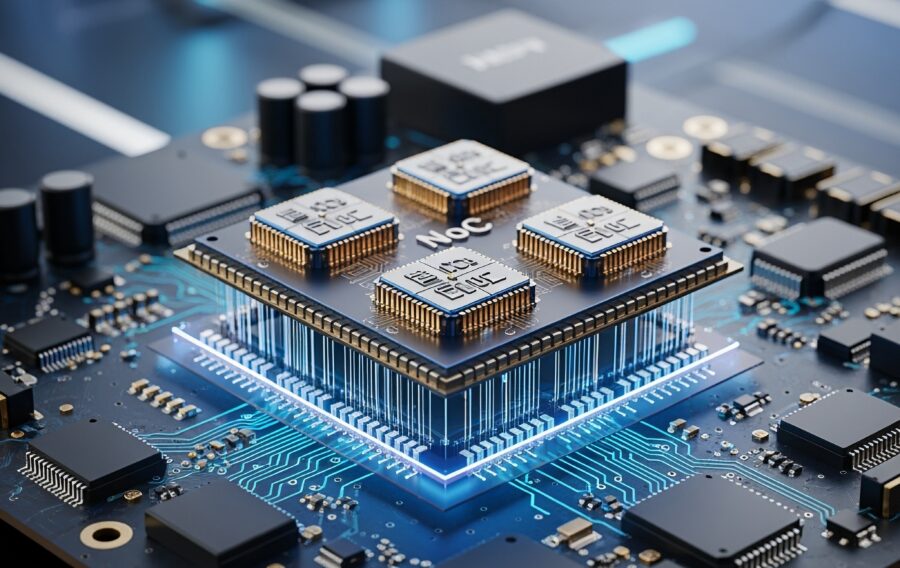
The leading edge is different. The sub-10-nanometre logic behind AI, advanced sensors and demanding computing has, in practice, no second source. TSMC holds circa 67 per cent of the foundry market and makes most of the world’s most advanced chips, almost all in Taiwan, less than 200km from China. Europe produces nothing below 22nm and accounts for only 8 to 10 per cent of global manufacturing while consuming about a fifth of output.
What the leading edge runs
Europe is undertaking its largest military build-up since the Cold War. Readiness 2030 is meant to mobilise up to €800bn. Yet the AI that fuses sensor data, the processors in advanced radar and electronic warfare, secure communications, and the data centres behind command and control all need leading-edge logic. A rearmament plan fabricated on a contested island is less sovereign than its price tag suggests.
Finance is exposed too. The server processors in bank data centres, programmable chips used by high-frequency traders and Broadcom silicon routing payments traffic are, in their leading-edge versions, made by TSMC. A Taiwan shock would not stop the ECB’s T2 system tomorrow; existing machines would keep running. It would choke replacement and expansion. DORA, Europe’s resilience rulebook, covers cloud, data centres and leased hardware, but not where the chips inside them are fabricated.
The same exposure runs through the frontier economy. Current AI accelerators, including Nvidia’s, are made by TSMC, as are high-end processors for data centres, smartphones and advanced systems. Most of the economy still uses mature nodes made in many places, but its frontier layer does not. This is the advanced layer defence, finance and the wider economy increasingly share.
And it can be cut off
That would matter less if the supply were secure. China has spent two years rehearsing operations that could sever Taiwan’s exports. Its 2025 drills ringed the island with aircraft and ships, practised cutting energy imports and later rehearsed blockading main ports. Admiral Samuel Paparo of US Indo-Pacific Command called them “dress rehearsals for forced unification.”
The odds are not negligible. A 2022 CSIS survey found 83 per cent of experts expected no major Chinese military action by 2027; prediction markets put invasion before 2027 in the low teens and invasion or blockade before 2030 at roughly 30 to 37 per cent. No planner should dismiss that, especially when Bloomberg Economics puts the first-year cost of a Taiwan war at $10.6tn.
A defence-scale answer
Europe’s attempt to close the gap shows the misclassification at work. The 2023 EU Chips Act aimed to mobilise €43bn and lift Europe’s share of global production to 20 per cent by 2030; the Commission now forecasts 11.7 per cent, and auditors called the target “essentially aspirational.” Intel walked away from plants in Magdeburg and Poland; a STMicroelectronics-GlobalFoundries factory in Crolles was suspended; and a TSMC venture in Dresden will make chips generations behind the frontier. The Act was built like a subsidy scheme, weighed against jobs and growth, and has behaved like one.
Defence is funded differently. When NATO members commit 2 per cent of GDP to arms, nobody asks about returns, because it is insurance against disaster. The leading edge should be priced the same way. A credible advanced-node capability, at up to €200bn over a decade, would be less than a quarter of the €800bn Europe has earmarked for rearmament, and stop its most advanced defence, finance and industrial systems being switched off at the source.
Monnet’s insight was that interdependence keeps the peace only when it runs both ways. Where one side owns and the other merely consumes the essential input, the relationship is a leash. Europe has spent thirty years building one to a single island it does not control, and is now committing the largest defence budget in its history to a military whose most advanced systems hang from it. Before ministers next argue over tanks and jets, they might answer the question: what is a rearmed Europe worth if the chips it depends on can be cut off by a single event 10,000km away?
Article submitted by Noah Liot.
Noah is the Chief Technology Officer at Aquis. Prior to joining Aquis, Noah held senior positions at AWS, GLIA Ecosystems and Thomson Reuters Financial & Risk.
Join our new expanding community at DPRTE.co.uk – our new Defence Community Platform, creating a single, year-round digital hub for the UK’s defence procurement and supply chain sector.

Post written by: Vicky Maggiani
Vicky has worked in media for over 25 years and has a wealth of experience in editing and creating copy for a variety of sectors.
RELATED ARTICLES
September 17, 2026
Homeland - What Does a Resilient Defence Supply Chain Look Like?
This week, Stuart John, from the Future Defence Support Services (FDSS) Bid Team at Leidos, gives his perspective on what

September 10, 2026
Homeland - Why 'Structured Collaboration' is Becoming a Defence Necessity
This week, Stuart John, from the Future Defence Support Services (FDSS) Bid Team at Leidos, examines new research with the