


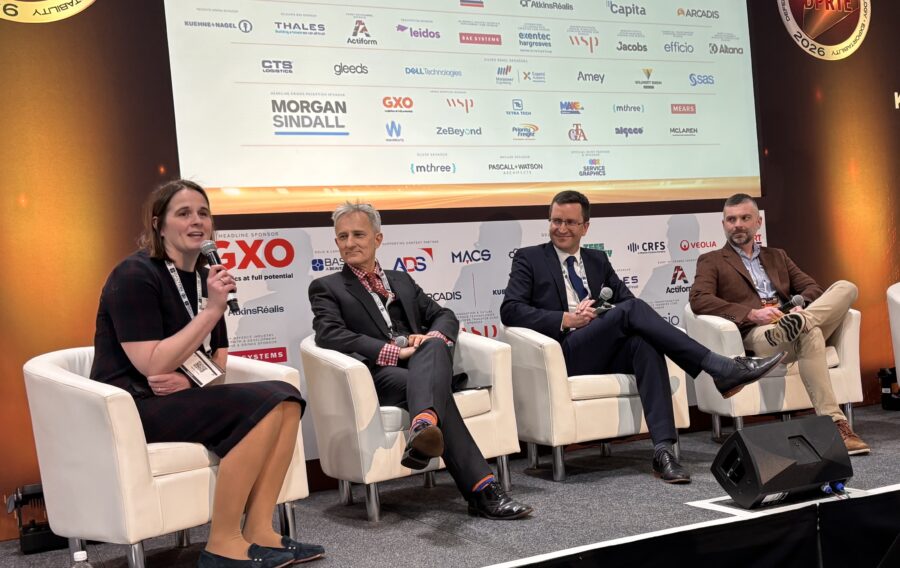
Writing exclusively for the DPRTE Community, Rachel Gilbey, Managing Director, Aerospace and Defence at GXO UK&I reflects on the panel she took part in at DPRTE Expo, which considered collaboration in action and rethinking defence supply chains.
As the UK defence sector responds to increasing complexity and evolving operational demands, it’s becoming more vital than ever that supply chains must grow in resilience, agility and responsiveness. It’s something that Luke Pollard, Minister for Defence Readiness and Industry, addressed at DPRTE when he talked about delivering defence capability as a shared responsibility between government and industry, stating, “It requires you to invest, and to continue innovating to deliver more digitally enabled services, faster”.
However, what’s also apparent is that no single organisation can deliver this alone. The greatest opportunities and valuable outcomes come from bringing together the best of industry, to combine expertise, scale and technology. It’s why, at DPRTE 2026, I joined fellow Torus Defence Supply Chain alliance members to present our latest thinking about how we should respond to this challenge and deliver the right solution. Together, we explored how collaboration in practice is helping to address these current challenges and deliver supply chains that are responsive, integrated and ready to adapt. Here, I take a look at some of the themes that emerged in our discussions about how industry collaboration can transform the UK defence sector.
The Role of Strategic Collaboration
Defence supply chains are inherently complex, spanning multiple domains (land, sea, air and technology), multiple suppliers and partners, and multiple systems and processes. As a consequence, delivery capability requires closer alignment between organisations, integration of capabilities across the supply chain, together with a shared responsibility for outcomes. Collaboration is no longer just an enabler; it is becoming a core capability in its own right. As a result, the Torus Defence Supply Chain alliance provides a practical example of how organisations can come together to:
- combine logistics, digital and engineering expertise
- align operations across the supply chain
- address system-wide challenges in a coordinated way
- deliver a more resilient, agile and integrated support model for the UK defence sector
Enabling Adaptive Capacity Through Collaboration
One of the most critical requirements discussed was the need for adaptive capacity.
This is the ability to expand infrastructure when required, to mobilise workforce at pace, and to access transport capacity quickly. Collaboration enables this by:
- connecting existing networks and assets
- sharing capacity across organisations
- reducing reliance on fixed, standalone infrastructure
Adaptive capacity is delivered through connected capability across organisations, not just capacity within a single organisation. In practice, this means drawing on established capability. For example, a national and global network of sites, access to trained and security-cleared personnel, and transport assets ready to deploy. At GXO in the UK, this translates to:
- 450+ sites in the UK and 1,000 globally
- 60,000 colleagues
- 18,000 transport assets
The Role of Digital in Connecting the Defence Ecosystem
Digital capability is what enables collaboration to operate effectively at scale, as Simon Thacker, Defence Supply Chain Lead at Accenture, highlights: “With technology and data there is huge potential to unlock value across the supply chain. Technology ties us all together to manage readiness, drive decision advantage and enable sovereign resilience.”
Supply chains are evolving from operational support functions into decision-making capabilities that influence outcomes and strengthen defence capability. Technology is able to provide integrated data across organisations and real-time visibility of materials and assets. Examples include:
- tracking and tracing materials across the supply chain
- integrating systems from procurement through to delivery
- using data to inform decisions in real time
- running digital twin scenarios to plan for potential supply chain disruptions
Delivered with awareness of the unique context of UK defence, including cybersecurity, interoperability, and data sovereignty.
Agility Across a Network
As defence supply chains now operate within a global and interconnected environment, it means that disruption can occur across trade routes, supply markets, and operational theatres. Consequently, agility requires visibility across the full network, control over the movement of goods, along with the ability to respond quickly to changing conditions. As Martin Monaghan, Head of Strategic Sales UK&I at Maersk, points out, “We need to keep the world moving from a global trade perspective. For example, with medical supply chains we need readiness in real time. Smart technology is fitted to all supplies which gives us complete live visibility, even at high sea. We can support the defence industry to get the right product, in the right location, to the right people and at the right quality when it arrives.”
Chris Rose, Group Director Logistics and Operational Support at Amentum, says: “Torus Defence Supply Chain blends the commercial excellence of four sector-leading defence, logistics and information technology businesses – Amentum, GXO, Maersk and Accenture. Together, we offer proven, agile, resilient and scalable support, affording strategic advantage for the UK’s armed forces in peacetime and in crisis, worldwide.”
Collaboration, digital connectivity and shared infrastructure are becoming essential in delivering responsiveness, scalability, resilience. In response, defence supply chains are evolving from individual capabilities to integrated, collaborative systems. The Torus Defence Supply Chain alliance can bring together complementary capabilities, including:
- logistics scale and infrastructure
- digital integration and data insight
- engineering and programme expertise
- global movement and transport capability
Collaboration of this type enables end-to-end coordination, faster response to disruption and greater control across complex supply chains. It means agility is delivered through the combined strength of an integrated network. Indeed, the future of defence logistics will be defined by how well industry collaborates to deliver supply chains that are connected, adaptable and ready to respond.
About Torus Defence Supply Chain
The Torus Defence Supply Chain is a strategic alliance of leading organisations designed to enhance logistics systems and data-driven digital transformation. Together we spoke at a panel session at DPRTE on ‘How Supply Chain Transformation Will Make the UK Safer: Secure at Home, Strong Abroad’. The panel was moderated by Rufus McNeil OBE, senior Associate Advisor, Chamois Consultancy, and included: Rachel Gilbey, Managing Director – Aerospace and Defence at GXO UK&I, Chris Rose, Group Director – Logistics and Operational Support at Amentum, Simon Thacker, Defence Supply Chain Lead at Accenture, Martin Monaghan, Head of Strategic Sales UK&I at Maersk.
Post written by: Stephen Donlan
RELATED ARTICLES
August 7, 2026
Air - Thales Secures NSPA Contract for Deployable Air Navigation System in Demonstration of NATO Procurement Route
Thales has been selected by the NATO Support and Procurement Agency to supply a Deployable Tactical Air Navigation system to
August 7, 2026
Air - Royal Navy's Dragon Rider Trials Prove Drone Armada Concept Over 200 Miles of Southern England
A week-long exercise integrating multiple uncrewed systems with Wildcat helicopters, Royal Marines and ship commanders has demonstrated that long-range drone