


President Zelenskyy’s visit to HMS Queen Elizabeth and the conclusion of Exercise Sea Breeze 2026 highlight the Royal Navy’s deepening operational partnership with Ukraine – and the growing demand for mine countermeasures, autonomous maritime systems and naval training capability it is generating.
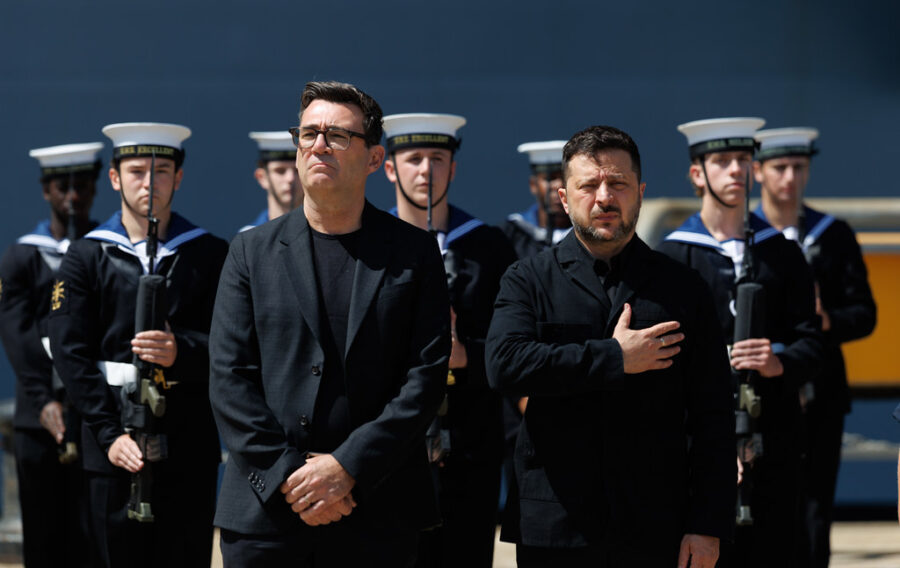
Ukrainian President Volodymyr Zelenskyy visited Portsmouth Naval Base alongside Prime Minister Andy Burnham, boarding HMS Queen Elizabeth for talks with First Sea Lord General Sir Gwyn Jenkins on the UK’s ongoing support for Ukraine’s armed forces and defence industries. The visit coincided with the return of five Ukrainian minehunters to Portsmouth following Exercise Sea Breeze 2026 – the largest mine warfare exercise hosted in the UK in nearly a decade – and provided a highly visible reaffirmation of what Zelenskyy described as the strongest relationship in the entire history of cooperation between Ukraine and the United Kingdom.
The operational substance behind that relationship is significant. Under Operation Interflex, the UK’s programme of support to the Ukrainian Armed Forces, more than 200 Ukrainian sailors have been trained to operate five minehunters over the past three years, with those ships now based and operating out of Portsmouth. The UK leads the Maritime Capability Coalition with Norway, coordinating international support for the Ukrainian Navy across mine countermeasure capabilities and marine training through a regional training hub. The programme represents one of the most concrete and sustained examples of the UK defence sector’s direct contribution to the conflict in Ukraine – and one with clear long-term implications for how the Royal Navy and its allied partners approach mine warfare capability development.
Exercise Sea Breeze 2026 provided the immediate operational context for the visit. Originally staged in the Black Sea before Russia’s illegal invasion, the exercise is now hosted by the UK and concluded last week off the coasts of Devon, Dorset and Hampshire. This year’s edition involved 750 military personnel from 18 nations and ten ships, making it the most significant mine warfare workout the UK has hosted in nearly a decade. Participants cleared a mine-free route stretching more than 85 miles from the English Riviera to the Isle of Wight, locating 17 practice mines using a combination of dive teams, remote-controlled vehicles and live charges – a practical test of the interoperability between Ukrainian and NATO mine countermeasure forces that the entire training programme is designed to build.
For the Royal Navy, Sea Breeze 2026 also served as a meaningful test of HMS Stirling Castle, its specialist minehunting mothership, which demonstrated its capacity not just as a logistics hub but as a platform for remote and autonomous mine countermeasure systems. The exercise culminated in the Ukrainian minehunter Chernihiv rafting alongside Stirling Castle in the Channel for fuel, water and supply transfer – a close-quarters logistics operation that reflects the depth of practical integration between the two navies. Commanding Officer Commander Phil Harper described working with the Ukrainian crews and battlestaff as the highlight of the year, and the exercise included wider maritime warfare training covering damage control, firefighting, gunnery, force protection and task group command.
General Sir Gwyn Jenkins framed the Royal Navy’s contribution as part of a broader allied effort to defend the rules-based order, describing Ukraine’s courage as an inspiration and reaffirming the UK’s commitment to standing with Ukraine as it defends its people and its waters. Zelenskyy’s acknowledgement of UK defence industry alongside its armed forces is a reminder that the operational partnership extends beyond training and into the equipment, technology and supply chain support that sustains Ukraine’s naval capability in the field.
For the UK defence supply chain
The Royal Navy’s deepening mine countermeasure partnership with Ukraine – and its leading role in the Maritime Capability Coalition – signals sustained and growing demand across a specific and technically demanding set of naval capability areas. Mine warfare has seen significant renewed investment across NATO following Russia’s use of mines and maritime threats in the Black Sea and Baltic, and the UK’s position as the leading nation for Ukrainian naval training places British industry at the centre of a long-term capability development programme with both domestic and export dimensions. Autonomous and remote mine countermeasure systems, demonstrated operationally through HMS Stirling Castle at Sea Breeze, are an area of particular and growing interest.
Image: Royal Navy Crown Copyright
Join our new expanding community at DPRTE.co.uk – our new Defence Community Platform, creating a single, year-round digital hub for the UK’s defence procurement and supply chain sector.

Post written by: Vicky Maggiani
Vicky has worked in media for over 25 years and has a wealth of experience in editing and creating copy for a variety of sectors.
RELATED ARTICLES
August 7, 2026
Air - Thales Secures NSPA Contract for Deployable Air Navigation System in Demonstration of NATO Procurement Route
Thales has been selected by the NATO Support and Procurement Agency to supply a Deployable Tactical Air Navigation system to
August 7, 2026
Air - Royal Navy's Dragon Rider Trials Prove Drone Armada Concept Over 200 Miles of Southern England
A week-long exercise integrating multiple uncrewed systems with Wildcat helicopters, Royal Marines and ship commanders has demonstrated that long-range drone