


Minister for Defence Readiness and Industry Luke Pollard MP has delivered a wide-ranging keynote address at the Global Air and Space Chiefs’ Conference in London, unveiling the name of the UK’s new autonomous combat aircraft programme and setting out how the Defence Investment Plan’s £27.8 billion commitment to air and space will transform the Royal Air Force into Europe’s first sixth generation air force.
The speech, delivered to an audience of air chiefs and industry leaders from across the UK’s allied and partner nations, covered the full breadth of the UK’s air and space ambition, from sovereign combat air and autonomous systems to space capabilities, international partnerships, and the industrial base needed to sustain it all.
Storm Fighter: The UK’s Autonomous Combat Aircraft
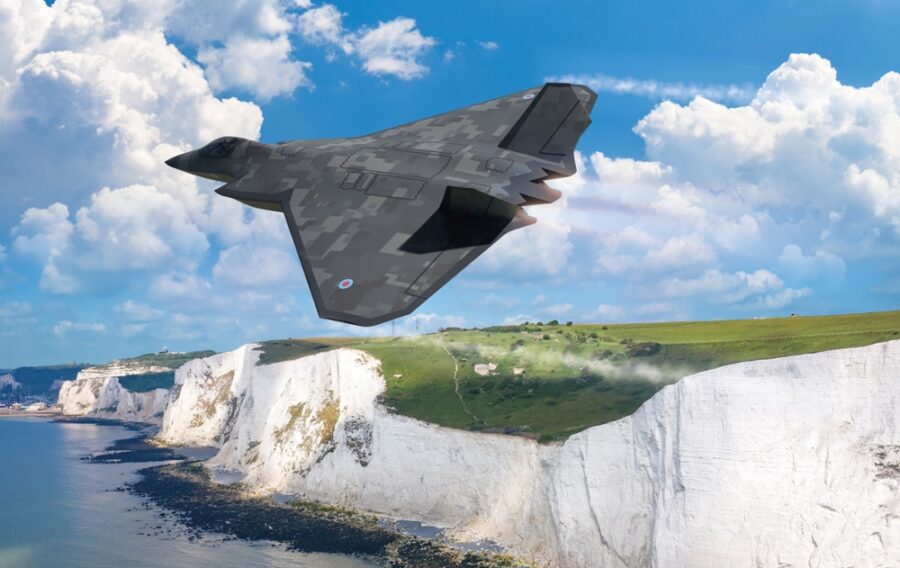
The most significant announcement of the speech was the naming of the UK’s Collaborative Combat Aircraft programme as Storm Fighter. Building on the Storm Shroud autonomous system revealed last year, Storm Fighter will develop autonomous jets in the UK designed to operate alongside crewed platforms, providing new levels of lethality and survivability for Typhoon, F-35, and future Tempest jets.
Pollard described Storm Fighter as acting as “both guardian angel and an attack dog” for the RAF’s crewed fleet, maximising air power in a future combat environment expected to be characterised by drone swarms, sixth generation fighters, and rapidly evolving electronic warfare capabilities. The programme forms part of a £5 billion investment in drone innovation and capabilities, up from the £4 billion previously announced.
Tempest and GCAP
The Global Combat Air Programme, the trilateral sixth generation combat jet being developed with Italy and Japan, received further confirmation of momentum with the announcement that a £4.6 billion contract has been awarded to the Reading-based Edgewing Consortium, comprising BAE Systems, Leonardo, and partners from the Japan Aircraft Industrial Enhancement Company, to lead the design and test phase of the programme.
Over the next four years alone, £8.6 billion has been allocated to fund GCAP’s design and testing phase. A further £1.1 billion will upgrade and sustain the Typhoon combat force well into the 2040s, and more than £2 billion has been committed to lay the ground for the UK’s first F-35As, which will enable the RAF to join NATO’s tactical nuclear mission.
Space, Sovereignty, and New Offensive Capabilities
The speech placed significant emphasis on the growing importance of space as a warfighting domain. The government has established a new Space Systems Group under the National Armaments Director to deliver additional capabilities across all domains. In a UK first, Pollard confirmed the development of offensive space capabilities, to be operated by six new specialist space squadrons trained at the Defence Space Academy alongside allies and international partners.
The Borealis Space Awareness System, delivered by CGI and supporting SMEs including Space Flux, went operational this year, six months ahead of schedule. Space Flux has provided the UK’s first images from Noctis One, the UK’s new military space telescope, giving the UK sovereign eyes to monitor and defend its critical space infrastructure.
Operations, Partnerships, and the Alliance in Action
The speech provided a striking operational snapshot of the RAF’s activity over the past twelve months. RAF F-35s conducted over 1,000 joint air exercise sorties during the 2025 Carrier Strike Group deployment to the Indo-Pacific, working with partners from Portugal to Australia via Qatar, Oman, the UAE, India, Malaysia, Singapore, the Philippines, Korea, and Japan.
In the Middle East, as Iran targeted its neighbours following US and Israeli strikes, the RAF flew over 3,000 hours of defensive missions, intercepting more than 100 drones and missiles. On NATO’s eastern flank, RAF Typhoons have flown the service’s first ever air defence sorties over Poland and continue to fly over Romania, while HMS Prince of Wales and its F-35s conducted the alliance’s first ever air policing operations launched from a European carrier.
The RAF has now teamed up with 45 nations for exercises and operations over the past twelve months, a figure Pollard described as a reflection of an air force that is “international by design.”
Skills, Industry, and the Defence Industrial Base
The speech closed with a strong message to industry. Pollard acknowledged that nations have been too slow to build close bonds with their industrial partners and committed to reversing that through sustained investment in both capability and workforce.
A £182 million skills package includes five new Defence Technical Excellence Colleges, with two located in the aerospace heartlands of Yeovil and Blackpool. The ambition, in Pollard’s words, is to make the UK “the best place in the world to grow a defence business.”
Export was also highlighted as a growing priority. BAE Systems and its British supplier ecosystem have benefited from legacy capability partnerships including a Türkiye Typhoon deal, a Ukraine GRIPEN deal, and various F-35 arrangements set to benefit thousands of UK workers who manufacture between 15% and 37% of those platforms by value. A new Defence Export Strategy, due later this year, will focus on the full range of UK industrial strengths across platforms, components, and services.
What This Means for UK Defence Industry
The scale of ambition set out in the speech has direct and immediate implications for the UK defence supply chain. From autonomous systems and drone technology to space capabilities, deep strike innovation, and advanced training, the programmes announced and confirmed represent a substantial and sustained pipeline of procurement activity across prime contractors, mid-tiers, and SMEs alike.
For companies across the UK’s aerospace, advanced manufacturing, digital, and technology sectors, the direction of travel is unambiguous. The RAF’s transformation is industrial as much as it is military, and the government is explicitly linking defence investment to economic growth, job creation, and reindustrialisation across all four home nations.
Image: RAF

Post written by: Vicky Maggiani
Vicky has worked in media for over 25 years and has a wealth of experience in editing and creating copy for a variety of sectors.
RELATED ARTICLES
August 7, 2026
Air - Thales Secures NSPA Contract for Deployable Air Navigation System in Demonstration of NATO Procurement Route
Thales has been selected by the NATO Support and Procurement Agency to supply a Deployable Tactical Air Navigation system to
August 7, 2026
Air - Royal Navy's Dragon Rider Trials Prove Drone Armada Concept Over 200 Miles of Southern England
A week-long exercise integrating multiple uncrewed systems with Wildcat helicopters, Royal Marines and ship commanders has demonstrated that long-range drone