



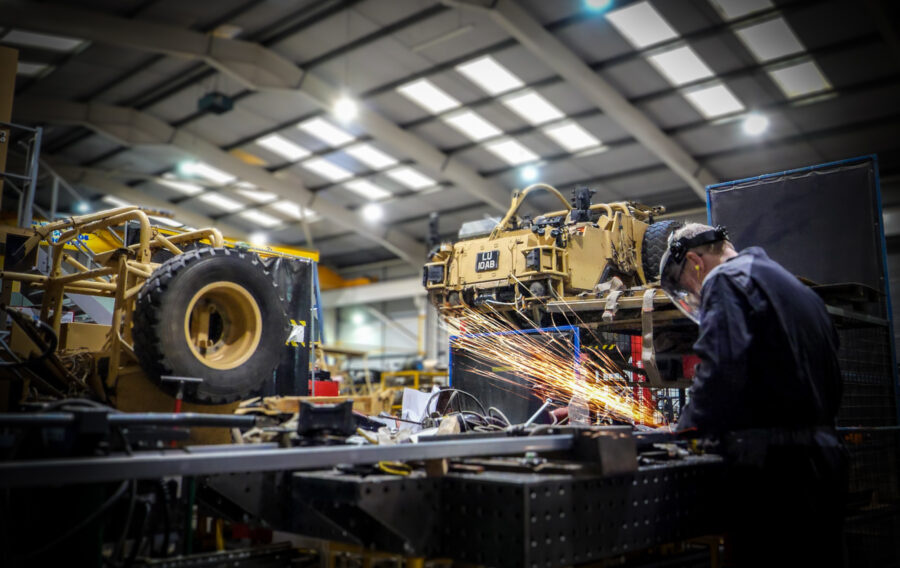
When Supacat first integrated an Allison transmission into its High Mobility Transporter (HMT) platform at the turn of the millennium, the company had no particular expectation it would still be specifying the same drivetrain solution more than two decades later. The fact that it is speaks to what actually matters when engineering vehicles for defense duties.
Supacat, based in Devon, UK, manufactures specialist military vehicles for defense customers worldwide. Its best-known product is the HMT – known within the British Army as the Jackal – an open, highly mobile platform used for reconnaissance and long-range patrol. The Jackal’s primary operational requirement is straightforward to state and extremely demanding to deliver: get soldiers deep into hostile terrain and bring them back again.
The Drivetrain Decision
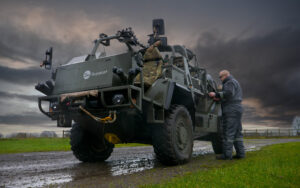
Toby Cox, Head of Sales at Supacat, is clear about what the drivetrain selection process comes down to. “Two key characteristics,” he says. “Firstly, sufficient power to give it the ability to move across country – to climb hills and cross deep water, for example. The second is reliability. Those vehicles are out on patrol. They need to get soldiers to the point where they can carry out their role, but just as importantly, bring them home safely.”
Supacat’s engineers defined the power and torque envelope the vehicle needed, then down-selected both engine and transmission accordingly. The combination that emerged – a Cummins six-cylinder engine close-coupled to an Allison 2500 Series transmission – has been the constant at the heart of the HMT ever since.
The relationship has been supported throughout by Mitchell Powersystems, Allison’s UK authorized distributor, which provided the technical integration support from the earliest proof-of-concept driveline work and has continued to supply and prepare the transmissions for each new production run.
Automatic Transmission in an Off-Road Context
For anyone unfamiliar with defense vehicle engineering, the case for a fully automatic transmission in this application is worth spelling out. Cox is unambiguous: “A manual gearbox does not cut it in an off-road vehicle.”
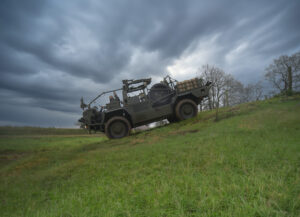
The reasoning is functional rather than a matter of driver preference. When a vehicle is crossing complex terrain – rocky, uneven, unpredictable – the driver’s attention needs to be on route selection, not gear changes. An automatic transmission removes that task entirely, allowing the driver to concentrate on identifying the right line through the terrain and responding to what’s ahead. The gearbox selects the appropriate ratio based on speed and throttle input, delivering the torque where it’s needed without demanding driver intervention.
In a defense context, where situational awareness can be a matter of survival, that is not a small consideration.
Two Decades, Doubled Weight
One of the more telling details in Supacat’s operational experience with the Allison transmission is what has happened to the vehicle itself over time. The original HMT entered service at around six and a half tons. The current variants run to approximately 12 tons – growth driven by evolving mission requirements, additional armor, and equipment fit.
The Allison 2500 has absorbed that change without requiring a transmission switch. Cox describes this as a demonstration of “the growth potential within the transmission and how unstressed it is in our vehicles” – meaning the unit has been running well within its operational limits even as the platform around it has grown significantly heavier.
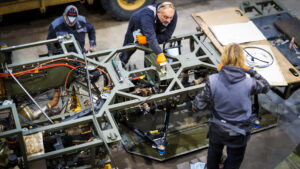
Supacat has adapted certain elements over the years – the torque converter specification has been adjusted to suit the progressively heavier vehicle – but the core transmission has remained. That kind of platform longevity matters enormously in defense procurement, where the British Army’s typical expectation for equipment service life runs to 20–30 years.
The Reliability Case in Practice
Cox references the British Army’s operations in Mali to illustrate what transmission reliability actually means at the operational level. The Army was conducting patrols lasting up to 20 days – a duration that was only feasible because crews had confidence in the vehicles. That confidence directly shaped tactical planning: it enabled forces to approach areas of interest from unexpected directions, spend more time on the ground, and reduce reliance on fixed bases.
“They were spending more time on the ground and less time in camp,” Cox notes. The transmission’s role in this is indirect but real. Unreliable kit constrains operational ambition. Reliable kit expands it.
Operational needs require constant monitoring. For example, on occasions where the vehicle is driven through deep water, beyond the wade line, water ingress can occur. To address this, Supacat developed an extended breather tube, which allows the transmission to ‘breath’ under submerged water: a simple but essential transmission modification.
The Long View
Supacat’s position on continued specification of the Allison transmission is uncomplicated. “We are planning to continue using the Allison transmission for as long as Allison makes it available to us,” Cox says. “Why would we introduce any risk by wanting to change the transmission? It does everything we need it to, and it helps us deliver a world-class product.”
For a company whose vehicles are trusted to operate for weeks at a time in remote and hostile environments, that kind of settled confidence in a drivetrain component is the result of operational evidence accumulated over more than 20 years – not marketing language.

Post written by: Vicky Maggiani
Vicky has worked in media for over 25 years and has a wealth of experience in editing and creating copy for a variety of sectors.
RELATED ARTICLES

September 10, 2026
Homeland - Why 'Structured Collaboration' is Becoming a Defence Necessity
This week, Stuart John, from the Future Defence Support Services (FDSS) Bid Team at Leidos, examines new research with the

September 3, 2026
Homeland - How Can Defence Programmes Unlock More Value from SMEs?
Stuart John, from the Future Defence Support Services (FDSS) Bid Team at Leidos, looks at the opportunities presented to SMEs