


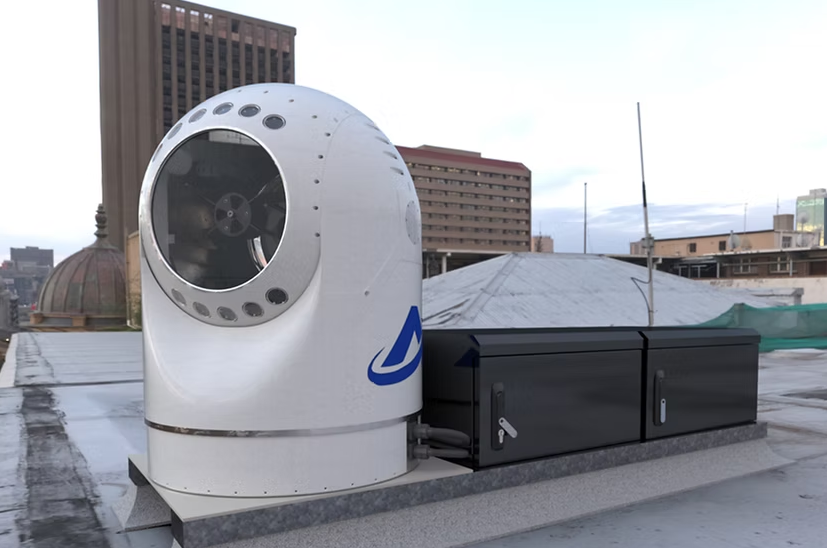
The UK has crossed a significant threshold in defence communications capability, with Dstl and Oxford-based SME Archangel Lightworks completing the country’s first successful download of data from space using a deployable laser communications ground station.
During a 90-second satellite pass over the Mediterranean, many gigabits of data were transmitted from a low Earth orbit (LEO) satellite to a ground station – a demonstration described by Dstl as the equivalent of moving from very slow internet to superfast fibre broadband.
What the Technology Does
Free space optical communications – laser comms – transmit data using narrow, low-power beams of non-visible light rather than radio waves. The shorter wavelength allows far greater volumes of data to be sent per second. Critically for military applications, the beams are extremely difficult to detect or intercept, and the narrow transmission reduces the risk of interference with other systems in an increasingly contested electromagnetic environment.
The capability is directly relevant to Intelligence, Surveillance and Reconnaissance (ISR) missions, where large volumes of data must be moved quickly to give UK forces an operational advantage. It could also form part of the UK’s digital targeting web and is designed to be interoperable with the US Space Development Agency standard.
An SME at the Centre of a Sovereign Capability
Archangel Lightworks, the Oxford SME that developed and delivered the TERRA-M optical ground station used in the trial, is a notable example of the kind of specialist, sovereign industrial capability the Defence Industrial Strategy is seeking to grow and sustain.
The company recently completed a Series A funding round that included investment from the National Security Strategic Investment Fund (NSSIF), and manufactures its systems at a facility in Oxford — positioned to scale production for UK deployment, sale or export.
Dstl Chief Executive Dr Paul Hollinshead was clear on the wider significance: “Our collaborative partnerships with industry catalyse innovation and enable Defence to be an engine for growth, supporting jobs and creating commercial opportunities.”
Supply Chain Relevance
The laser comms demonstration sits at the intersection of several of the fastest-moving areas in the current defence investment landscape: space, digital, sovereign capability and SME-led innovation. The technology will be exploited across multiple capability areas within the MOD, with significant scope for supply chain involvement in manufacturing, integration, deployment and sustainment as the programme scales.
For businesses in advanced engineering, photonics, optical systems, space ground infrastructure and secure communications, this milestone marks the beginning of a procurement journey, not the end of one.
Image: Archangel Lightworks

Post written by: Vicky Maggiani
Vicky has worked in media for over 25 years and has a wealth of experience in editing and creating copy for a variety of sectors.
RELATED ARTICLES
August 7, 2026
Air - Thales Secures NSPA Contract for Deployable Air Navigation System in Demonstration of NATO Procurement Route
Thales has been selected by the NATO Support and Procurement Agency to supply a Deployable Tactical Air Navigation system to

August 7, 2026
Air - Royal Navy's Dragon Rider Trials Prove Drone Armada Concept Over 200 Miles of Southern England
A week-long exercise integrating multiple uncrewed systems with Wildcat helicopters, Royal Marines and ship commanders has demonstrated that long-range drone