


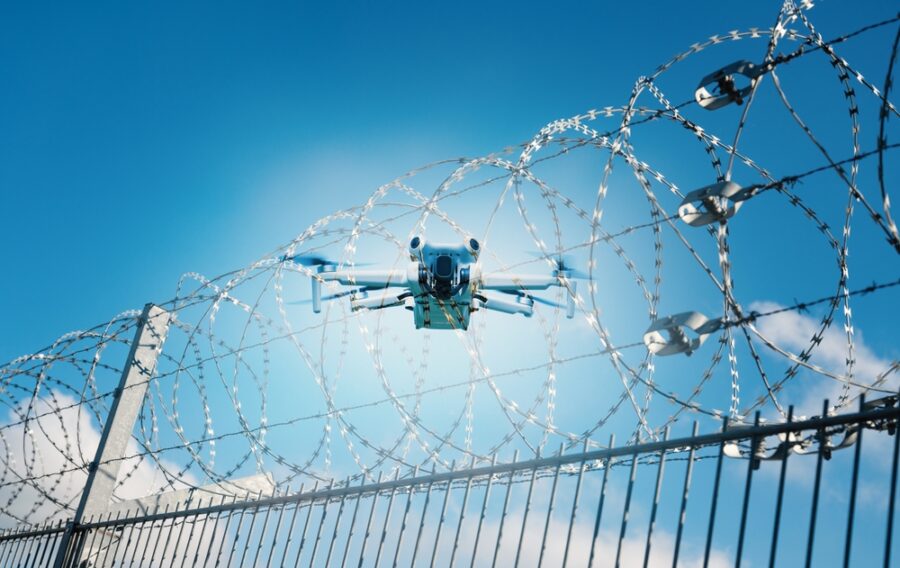
In December 2018, reports of unauthorised drone activity above Gatwick Airport brought the UK’s second-busiest airport to a standstill. That incident was an early warning of a new, global problem.
Since 2021, the US Federal Aviation Administration has logged over 2,000 drone incursions near airports, and nearly two-thirds of near mid-air collisions at America’s 30 busiest airports involve drones. In September 2025, Oslo and Copenhagen airports suspended operations after multiple unidentified drones entered restricted airspace.
Airports, once responsible solely for managing aircraft and passengers, are now forced to contend with an uninvited swarm of drones. The lesson from recent conflicts, from Ukraine’s Spiderweb operations to Israel’s Rising Lion campaign, is clear: inexpensive drones can deliver strategic impacts far beyond their size and scope.
Counter-UAS (C-UAS) technology, a field scrambling to keep pace with this new threat, and the growing role of artificial intelligence (AI) and machine learning (ML). AI and ML are transforming C-UAS systems from reactive defences into adaptive, predictive shields, helping airports see, classify, and respond to drone threats faster and more precisely than ever before.
Detection: Spotting the Unwelcomed Guest
Detecting a small drone in an airport’s metallic clutter and radio cacophony is the first major challenge. Traditional radar and radio frequency (RF) sensors alone are often overwhelmed by noise.
The key here is a layered system. Each layer in a C-UAS airport architecture serves a distinct purpose, building upon one another to create a clearer, more reliable picture of the airspace. AI now provides the ‘glue’ between these systems. Machine learning models are trained on vast datasets of radar reflections, RF signatures, and acoustic patterns, allowing them to distinguish drones from birds and spot unwanted guests in real-time.
To enhance human monitoring, AI-driven systems continuously learn what ‘normal’ airport activity looks like and can automatically flag anomalies that deviate from expected patterns. Although there may be false alarms in a high-risk environment, precision is secondary to the probability of detection; the immediate goal is to sound an alert and narrow the search area for subsequent layers.
Tracking and Classification: Making Sense of the Swarm
Once a potential drone is detected, the next challenge is confirming what it is and where it is going. Here, machine learning is invaluable in combining multiple sources of data and information into a single coherent picture.
Typical technologies used to track and classify drones include radar, which details the target’s speed, size, and movement; RF signals that can help identify specific drone models; and acoustic beamforming, which enhances the accuracy of detecting the drone’s location. Here, AI can sift through the incoming flood of multi-sensor data, analysing radar, RF signals, and sound signatures, to extract and highlight key characteristics, helping build a more complete profile of the drone in question.
Each incident enriches the system’s knowledge base. Over time, AI models build a growing library of drone ‘fingerprints’, continually refining classification accuracy and improving the speed and reliability of future detections.
Response: Disable, Disrupt, Neutralise
Once an unauthorised drone is confirmed, what then? Detection is only half the battle when it comes to protecting airports from unauthorised drones.
The options for mitigation strategies are fraught with difficulty. Grounding all flights is financially and reputationally ruinous. In the 2018 incident at Gatwick Airport, both runways were shut for 36 hours, resulting in 1,000 flights being cancelled, 110,000 passengers being stranded, and significant financial damage, with easyJet alone reporting a £15 million loss. Yet the alternative of a drone colliding with an aircraft is unthinkable. The goal here is precise intervention that doesn’t disrupt airport operations.
Although there are numerous neutralisation technologies available, each has its own drawbacks in a sensitive airport ecosystem. For example, drone capture systems fire nets to capture flying drones, but come with the risk of falling debris. Kinetic C-UAS solutions, such as kamikaze interceptor drones, also pose a high risk of collateral damage. Electronic warfare, such as RF jamming or cyberattacks, requires precise targeting and intelligence to avoid crippling aircraft navigation and communication systems.
Here again, AI is key. Machine learning models can simulate and rank these mitigation options based on factors such as real-time risk, proximity to aircraft, and environmental factors. This reduces decision latency while still providing human operators with the final decision in authorising a response.
An Ever-Evolving Aerial Arms Race
Looking ahead, the cat-and-mouse game between drone and C-UAS capabilities will continue. As drones grow more autonomous and RF-silent, AI and machine learning will make detection smarter and responses more autonomous, maintaining airspace integrity. The challenge for airports is clear: to invest, adapt, and collaborate.
Article submitted by Nick Sherman, Chief Growth Officer at Mind Foundry.
If you would like to join our community and read more articles like this then please click here

Post written by: Vicky Maggiani
Vicky has worked in media for over 25 years and has a wealth of experience in editing and creating copy for a variety of sectors.
RELATED ARTICLES

March 27, 2026
Land - British engineering firm Rowden hosts the British Army to explore frontline Techcraft
British engineering firm Rowden hosted a visit by British Army Sergeant Majors to explore how collaboration between engineers and soldiers helps shape
March 27, 2026
Air - DroneShield Expands C2 Interoperability
DroneShield, a global leader in counter-unmanned systems (C-UxS) solutions, today announced interoperability between DroneSentry-C2 command-and-control software, and optical sensing technologies from OpenWorks Engineering. The partnership strengthens DroneShield’s ability to unify multi-domain sensor inputs