


The Royal Navy has formally announced the attainment of Initial Operating Capability (IOC) for the Sea Venom missile system integrated onto the Wildcat HMA2 helicopter fleet. This milestone marks a significant maturation of the Future Anti-Surface Guided Weapon (FASGW) programme, validating the UK’s long-range anti-surface warfare (ASuW) capability and confirming a sustained through-life requirement for the industrial partners involved in its delivery and support.
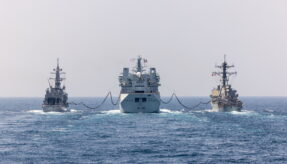
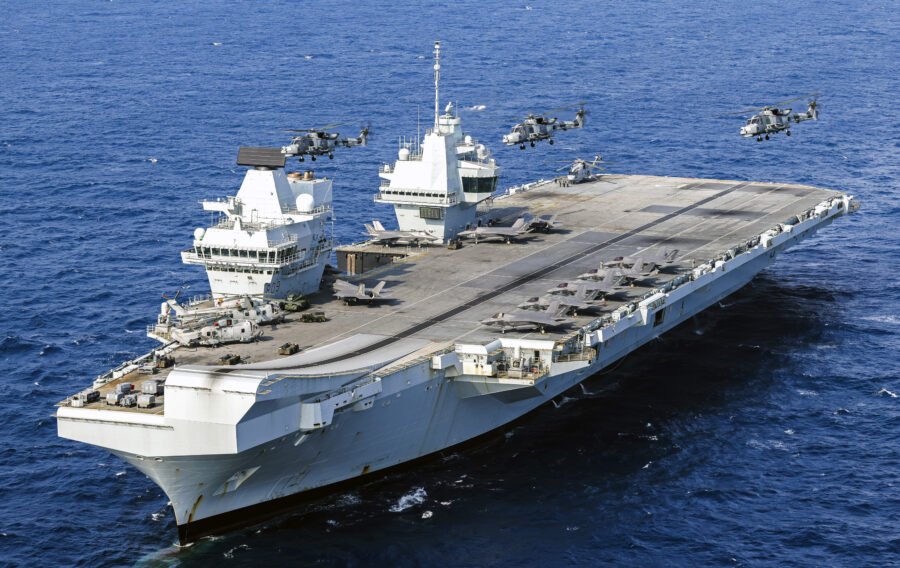
The operational debut and IOC declaration were achieved during Operation Highmast, the Royal Navy’s major global deployment to the Indo-Pacific region, led by the flagship HMS Prince of Wales. Four Wildcat helicopters from 815 Naval Air Squadron are currently armed with the system across the Carrier Strike Group, distributed among the carrier, the Type 45 destroyer HMS Dauntless, and the allied frigate HNoMS Roald Amundsen. This integration confirms the system’s readiness for front-line duties and its compatibility within a multi-national task group environment.
The Sea Venom provides a substantial increase in lethality and reach, complementing the existing, shorter-range Martlet missile system. Where the Martlet is designed to counter asymmetric threats such as fast attack craft and boat swarms, the Sea Venom is engineered to deliver sufficient destructive power to neutralise larger naval assets, including corvettes and patrol vessels. Each Wildcat airframe can carry up to four Sea Venoms, enabling a single sortie to engage multiple targets or concentrate firepower against high-value assets.
Technologically, the system incorporates an advanced ‘operator-in-the-loop’ capability, a critical feature for reducing collateral damage in complex operational theatres, such as coastal or littoral zones. This functionality permits the aircrew to receive real-time infra-red imagery transmitted simultaneously from up to four weapons during flight, allowing for precise mid-course trajectory adjustments and final target confirmation. This sophisticated control mechanism requires sustained technical support across secure data links, sensor integration, and mission system software, representing persistent opportunities for specialist sub-contractors within the defence technology sector.
The successful transition to IOC, described by Commander Andrew Henderson of the Wildcat Maritime Force as ensuring crews are equipped to meet the challenges of a multi-domain environment, now shifts industry focus toward sustainment and future upgrades. For businesses operating across the UK defence supply chain, this signifies a defined programme of work encompassing spares provision, maintenance contracts, platform integration support, and ongoing technical evolution of both the Sea Venom and Martlet components. The maturity of the long-range ASuW capability underpins the strategic readiness of the Fleet Air Arm, ensuring continued requirement for an innovative and responsive industrial base.
Image: MOD Crown Copyright
If you would like to join our community and read more articles like this then please click here

Post written by: Vicky Maggiani
Vicky has worked in media for over 25 years and has a wealth of experience in editing and creating copy for a variety of sectors.
RELATED ARTICLES

October 30, 2025
Homeland - A UK-Ukraine Model For Defence Innovation – Research Paper
The war in Ukraine has triggered a fundamental shift in the global defence landscape. Not only has it exposed critical