


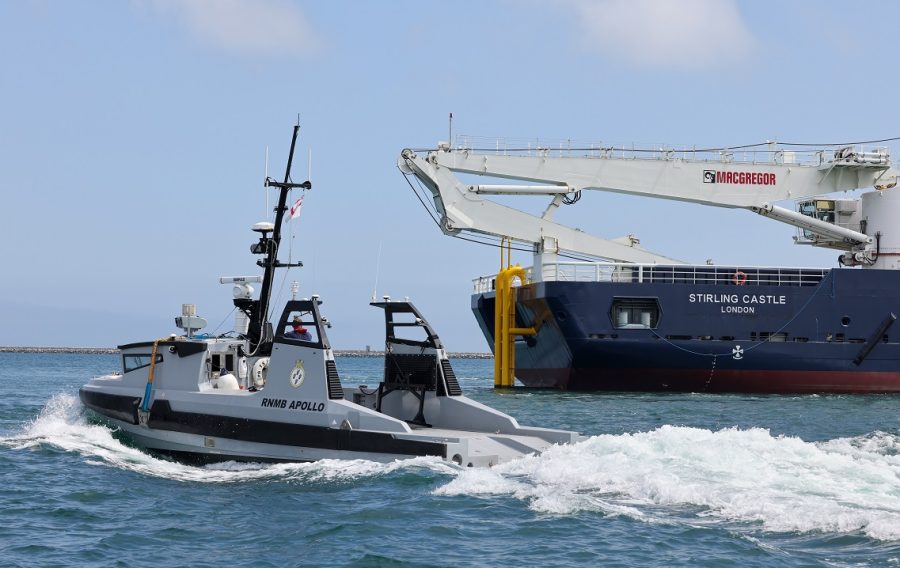
A new minehunting ‘mothership’ and its drone companions, have been trialled together for the first time.
In a milestone first for the Royal Navy, the ship and autonomous vessels worked together in an exercise to test the effectiveness of this combination and ability of the mothership – RFA Stirling Castle, to host the drones and eventually controlled/remotely-piloted from the ship.
The ship and autonomous vessels have been procured by DE&S to address the rapidly evolving threat posed by naval mines.
Andy Lapsley, DE&S Mine Hunting Capability (MHC) Team Leader, said: “This is an important step in the incremental development of maritime autonomous systems, exploiting new technology to increase performance and reduce risk to sailors.
“This event was a truly collaborative endeavour across various DE&S departments, the Royal Navy, the Royal Fleet Auxiliary and industry partners. It paves the way for significant advances in the global deployment of this capability.”
Rear Admiral Ivan Finn, Director Navy Acquisition, added: “These trials marks a key milestone in the delivery of the Royal Navy’s Mine Hunting Capability programme.
“Following her rapid procurement and delivery at the start of the year, RFA Stirling Castle has now embarked her first autonomous mine countermeasures systems.
“This has been achieved through the hard work of her ship’s company, the Maritime Autonomous System Trials Team, the Defence Equipment and Support delivery team, and our industry partners.
“We can now look forward to having Maritime Autonomous Systems permanently embarked and ready for operations over the coming months.”
Stirling Castle joined the Royal Auxiliary Fleet to act as a ‘mothership’ for autonomous minehunting systems. When operational, the ship will launch and recover the vessels, as well as analyse the data they gather while scouring home waters for mines and underwater explosive devices.
In doing so, the ship and the autonomous boats will begin to replace traditional mine countermeasures vessels, instead exploiting a series of advanced payloads such as towed sonars and remotely-operated neutralisation systems from a Remote Command Centre.
The trials in Portland are the latest in the wider Royal Navy’s Mine Hunting Capability Programme. It follows on from separate work to develop the Maritime Mine Counter Measure’s primary systems – amounting to a technological leap for the future of mine hunting operations.
Image: DE&S
If you would like to join our community and read more articles like this then please click here
autonomous vehicles drones minehunting Royal Auxiliary Fleet Royal Navy

Post written by: Vicky Maggiani
Vicky has worked in media for over 25 years and has a wealth of experience in editing and creating copy for a variety of sectors.
RELATED ARTICLES

October 21, 2025
Maritime - Newest Royal Navy Submarine Achieves First Underwater Milestone at Barrow
BAE Systems’ Barrow-in-Furness site has marked a major achievement in the UK’s submarine programme as the latest Royal Navy Astute-class

February 19, 2025
Land - UK-Ukraine TechExchange identifies recommendations to improve efficiency within landmine clearing
A new whitepaper from UK-Ukraine TechExchange, a collaborative forum around the key issues affecting the war in Ukraine and its future