



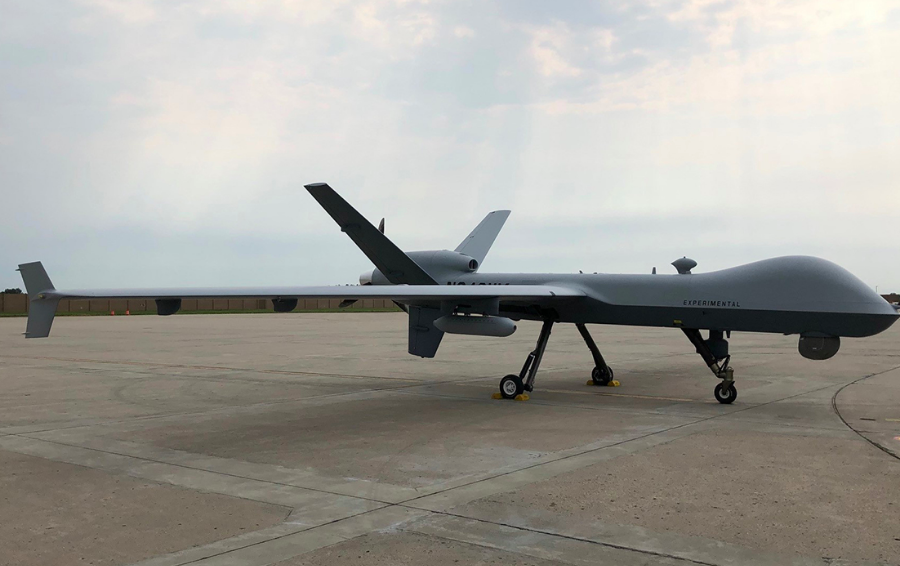
General Atomics Aeronautical Systems, Inc.(GA-ASI), with the support of SRC Inc., has successfully integrated and flew the Air Force Research Laboratory’s (AFRL) Agile Condor Pod on an MQ-9 Remotely Piloted Aircraft (RPA) at GA-ASI’s Flight Test and Training Center in Grand Forks, North Dakota.
The Agile Condor Pod provides on-board high-speed computer processing coupled with machine learning algorithms to detect, correlate, identify, and track targets of interest. With this capability, the MQ-9 is able to identify objects autonomously utilising its on-board Electro-optical/Infrared (EO/IR) sensor and GA-ASI’s Lynx Synthetic Aperture Radar (SAR).
High-powered computing at the edge enables autonomous target detection, identification and nomination at extended ranges and on-board processing reduces communication bandwidth requirements to share target information with other platforms. This is an important step towards greater automation, autonomous target detection, and rapid decision-making. GA-ASI will continue to work with AFRL to refine the capability and foster its transition to operational constructs that will improve warfighters’ ability to operate in contested or denied environments.
GA-ASI President David R. Alexander, said: “Computing at the edge has tremendous implications for future unmanned systems. GA-ASI is committed to expanding artificial intelligence capabilities on unmanned systems and the Agile Condor capability is proof positive that we can accurately and effectively shorten the observe, orient, decide and act cycle to achieve information superiority. GA-ASI is excited to continue working with AFRL to advance artificial intelligence technologies that will lead to increased autonomous mission capabilities.”
image courtesy of GA-ASI
If you would like to join our community and read more articles like this then please click here.
ai artificial intelligence GA-ASI
Post written by: Matt Brown
RELATED ARTICLES

February 19, 2025
Land - UK-Ukraine TechExchange identifies recommendations to improve efficiency within landmine clearing
A new whitepaper from UK-Ukraine TechExchange, a collaborative forum around the key issues affecting the war in Ukraine and its future

January 20, 2025
Why AI must support not supplant human decision-making in defence
There is a fundamental difference between human and machine intelligence. But, increasingly, organisations look at artificial intelligence (AI) as an