


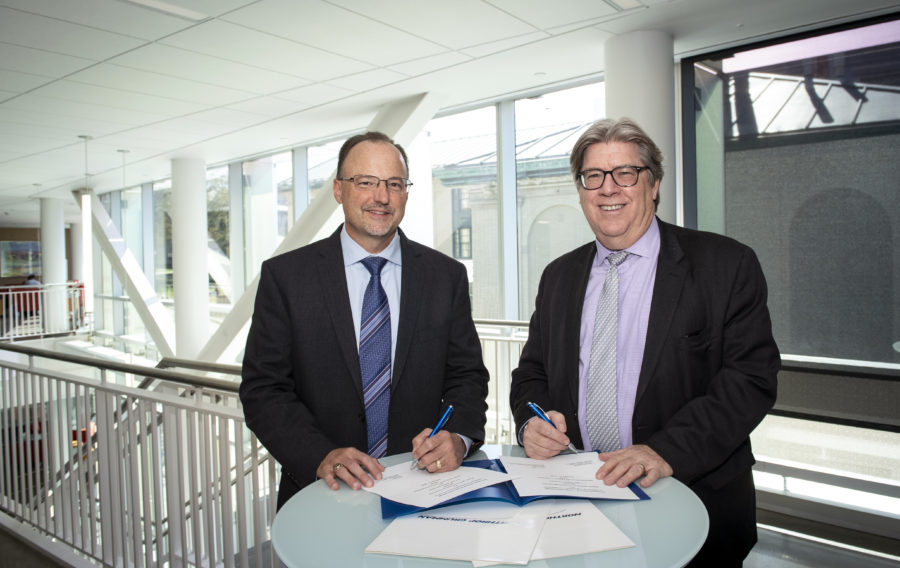
Northrop Grumman and Carnegie Mellon University have formally signed a master research agreement (MRA) that will help foster innovation between the two organisations.
The signing also initiated the kick off of several projects at Carnegie Mellon University (CMU) related to strategic, operational, and tactical emergency operations. Northrop Grumman will be supporting CMU research focused on decision-making, robotics, human-machine teaming and autonomy.
“This research agreement will allow us to move faster to initiate research projects across the breadth of the combined experience of Northrop Grumman and CMU,” said Vern Boyle, Vice President, Advanced Technologies, Northrop Grumman.
The research agreement will accelerate the Company’s ability to sponsor research projects with CMU. Five of those projects are aligned to CMU’s support of the Joint Artificial Intelligence Center’s National Mission Initiative priority areas with an initial focus on humanitarian aid and disaster relief.
“The projects are about getting the right information to the right person at the right time,” said Karen Metzler, Strategic Director, Northrop Grumman. “Human-machine teamed first responders can optimise their decision-making and information flow across dynamic environments through a variety of platforms.”
The Company has been funding university research at CMU since September 2010, when CMU joined as an inaugural member of the Northrop Grumman Cybersecurity Research Consortium (NGCRC). As part of the NGCRC, CMU has been conducting leading edge research for over 25 Northrop Grumman sponsored projects in critical cybersecurity domains including network and data security, Internet-of-Things (IoT), wireless and cellular communications security, visualisation of system anomalies, software security, blockchain, artificial intelligence and machine learning security and other important areas.
“Having companies like Northrop Grumman sponsor research at CMU is an important component of how industry and universities partner to support the nation’s vibrant innovation ecosystem,” said J. Michael McQuade, CMU’s vice president for research. “Working together, we can accelerate the transformation of knowledge learned through basic research into applied commercial products.”
If you would like to join our community and read more articles like this then please click here.
Post written by: Matt Brown
RELATED ARTICLES
August 7, 2026
Air - Thales Secures NSPA Contract for Deployable Air Navigation System in Demonstration of NATO Procurement Route
Thales has been selected by the NATO Support and Procurement Agency to supply a Deployable Tactical Air Navigation system to
August 7, 2026
Air - Royal Navy's Dragon Rider Trials Prove Drone Armada Concept Over 200 Miles of Southern England
A week-long exercise integrating multiple uncrewed systems with Wildcat helicopters, Royal Marines and ship commanders has demonstrated that long-range drone