



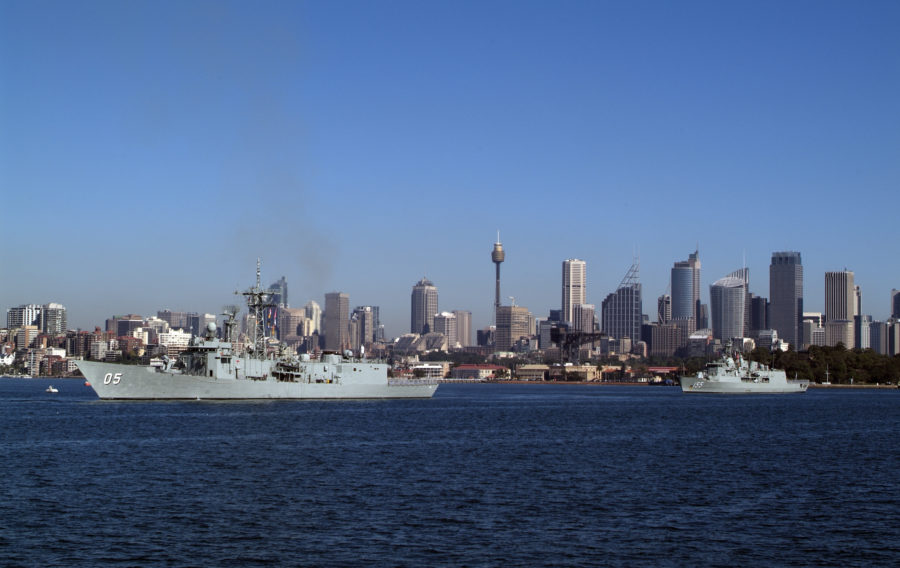
The Talisman Sabre joint exercise concluded aboard the USS Wasp with the US and Australian armed forces representatives conducting the ceremony.
Talisman Sabre, a joint exercise coordinating the US and Australian forces, concluded aboard the Wasp Expeditionary Strike Group (ESG) flagship, the USS Wasp. During the eighth Talisman Sabre, the US also worked with forces from Canada, New Zealand, and Japan, improving interoperability and coordinated responses.
The Wasp ESG, comprised of Wasp, USS Green Bay (LPD 20), USS Ashland (LSD 48), USS McCampbell (DDG 85), and USCGC Stratton (WMSL 752), conducted manoeuvring schemes and practised command and control with partner nations. Forces from India and South Korea were also present as observing nations.
Rear Adm. Fred Kacher, commander, Expeditionary Strike Group 7 said: “Australia and the United States are Pacific nations who have served and fought alongside each other in both peace and war and share a steadfast commitment to the Indo-Pacific region. With every iteration, Talisman Sabre becomes more valuable, more realistic, more challenging and that makes all of us better.”
“This year’s Talisman Sabre was the culmination of months of planning spent preparing a challenging scenario and examining how, working together, we would respond to a tough and well-equipped adversary.”
Talisman Sabre ‘19 emphasised developing short-notice contingency response operations between the joint U.S-Australian forces through landing craft, air cushion (LCAC) operations, amphibious assault vehicle (AAV) deployments, and extensive F-35B Joint Lightning II Joint Strike Fighter and MV-22 sorties. At the same time as Talisman Sabre, Marines from the embarked 31st Marine Expeditionary Unit (MEU) conducted training and preparation culminating in a simulated joint amphibious assault, providing participants with the experience of a beginning-to-end scenario.
This year’s operation was the first time Australian ships HMS Adelaide and Canberra operated in cooperation in a full tactical scenario. the aim of the operation was to allow the different nations to understand each other’s capabilities and prepare to respond to them with interagency forces from land, air, and sea, in future real-world scenarios.
If you would like to join our community and read more articles like this then please click here.
Australian Navy Canadian Army ESG Japan New Zealand Training US Navy

Post written by: Vicky Maggiani
Vicky has worked in media for over 25 years and has a wealth of experience in editing and creating copy for a variety of sectors.
RELATED ARTICLES
January 27, 2025
Maritime - BAE Systems awarded $85M contract
NTCDL enhances situational awareness and tactical battlefield advantage of the US Navy through real-time and simultaneous networked operations. In 2024, the
December 9, 2024
Land - Babcock’s innovative training product makes USA debut at I/ITSEC
Babcock has demonstrated its new immersive training product at the annual Interservice/Industry Training, Simulation and Education Conference (I/ITSEC) in Orlando,