



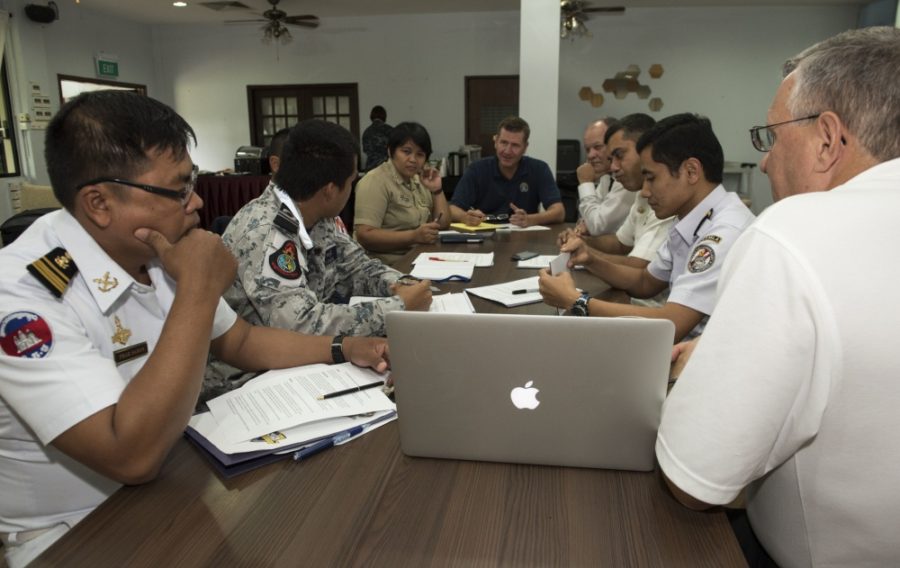
The 15th annual Southeast Asia Cooperation and Training (SEACAT) exercise commenced at the Republic of Singapore Navy’s Multinational Operations and Exercises Centre (MOEC) on 22nd August.
SEACAT focuses on regional cooperation to address shared maritime security challenges like smuggling, piracy and other illicit activities at sea by bringing together liaison officers (LNOs) from Singapore, Brunei, Indonesia, Malaysia, the Philippines, Thailand, Bangladesh, Cambodia, and the United States to collaborate and execute practical maritime responses to multiple realistic scenarios.
During the five-day command post exercise, liaison officers will receive simulated reports of suspect vessels in the Straits of Singapore and Malacca, the Andaman Sea or the South China Sea. After sharing information from all available sources, such as Singapore’s Information Fusion Centre, Malaysia’s International Maritime Bureau, or the Philippines’ Coast Watch System, the LNOs will develop and implement response plans during a concurrent field training exercise. Based on the situation, aircraft and ships from participating navies and coast guards will investigate and conduct on-scene boardings as necessary.
SEACAT 2016 continues the trend of increasing complexity and increased participation in the exercise. This year, coast guard personnel from the US, the Philippines, Bangladesh, Indonesia, and the Malaysian Maritime Enforcement Agency are also participating in the exercise.
Also participating in SEACAT for the first time is USNS Montford Point (T-ESD 1), which was re-designated by Secretary of the Navy Ray Mabus as an expeditionary transport dock. ESDs are part of the new Expeditionary Support class of ships and can be utilised for various scenarios in expeditionary logistics, as well as maritime security platforms for exercises and operations.
Other US assets participating in SEACAT 16 include fleet replenishment oiler USNS Walter S. Diehl (T-AO 193), two P-8A Poseidon aircraft, and staff from Task Force 73 and Destroyer Squadron 7.
Commander, Task Force 73 and Destroyer Squadron 7 staff conduct advanced planning, organise resources and directly support the execution of maritime exercises such as SEACAT, the bilateral Cooperation Afloat Readiness and Training (CARAT) exercise series, and the Naval Engagement Activity (NEA) with Vietnam.
Rear Adm. Don Gabrielson, Commander, Task Force 73, said: “SEACAT enables nations to work through complex maritime security challenges in a cooperative and inclusive environment. Sharing ideas, innovation and experience allows us to learn from each other and capture best practices to prepare for real-world contingencies.”
If you would like to join our community and read more articles like this then please click here
Commander Task Force 73 International liaison officers LNOs MOEC Multinational Operations and Exercises Centre Navy Rear Adm. Don Gabrielson Republic of Singapore SEACAT Southeast Asia Cooperation and Training
Post written by: Domhnall MacInnes
I am a features writer for MOD DCB magazine and Defence Online and a Content Marketing Executive with BiP Solutions.
RELATED ARTICLES
September 3, 2024
Maritime - Defying drones: DASA funded anti-drone sensor is purchased by the Royal Navy
Cheap, accessible commercial-off-the-shelf drones present a serious challenge to defence and security. This is exacerbated by their limited radar signature,
August 29, 2024
Maritime - Warship and submarine readiness boost by small British businesses
Small British businesses are to benefit from a new warship and submarine agreement, Defence Minister Maria Eagle has announced. The agreement,