



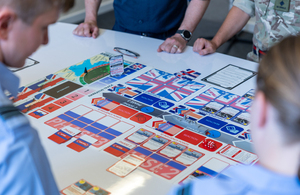
The Defence Science and Technology Laboratory has developed a wargame based on the 2021 HMS Defender incident to teach strategic communications principles to military personnel and NATO allies. The boxed version requires no facilitator and is now rolling out across the MOD and 15 NATO nations.
New wargame focuses on HMS Defender and information warfare
The Defence Science and Technology Laboratory (Dstl) has launched ‘Defending Defender – Battle for the narrative’, a wargame centred on Russia’s 2021 attempt to disrupt HMS Defender’s passage through Crimean waters and the subsequent information campaign. Developed in collaboration with the Joint Information Activities Group (JIAG), part of the UK MOD’s Defence Academy, the game educates players on strategic communications principles through simulation of that real incident.
JIAG trialled an initial prototype with approximately 1,500 users across training courses. Following that success, Dstl developed a boxed version designed to be played without a facilitator, broadening its reach across the defence and allied communities.
Game design and deployment
The wargame accommodates 2 to 8 players representing UK and Russian positions, each with distinct challenges. Play runs across three phases totalling around 45 minutes, requiring participants to make time-pressured decisions that expose how different real-world actors operate under different constraints and reveal the risk of unintended consequences. No prior wargaming or strategic communications experience is required to participate.
Dstl has begun rolling the boxed version out within the MOD and across 15 NATO nations and institutions in Australia, published 8 September 2026.
Strategic rationale and leadership perspective
Colin, Dstl Chief Wargamer and Head of the Defence Wargaming Centre, stated: “Dstl has the largest number of professional wargamers in the MOD, and we’ve used wargaming to prepare thousands of members of the armed forces for the challenges they will face and the decisions they will have to make on operations. Influence in conflict can be as important as physical force, so by developing impactful, value-for-money wargames that factor in influence effects, such as strategic communications, we will help our warfighters to achieve mission success.”
Lieutenant Colonel Faye Johnson, Commanding Officer of JIAG, added: “It can be challenging for students to grasp the principles of effective strategic communications with just a lecture in the classroom. This game allows students to understand the broader impact of their choices for good and bad by exploring a complex case study in detail. In our experience, players find the game very relevant, engaging and enjoyable. It gets across the principles of strategic communications in a simple but memorable fashion which makes it a powerful tool in the classroom.”
Captain Vince Owen, who commanded HMS Defender during the 2021 incident, observed: “The 2021 HMS Defender incident demonstrated that modern competition is fought simultaneously at the tactical, operational, and strategic levels. It highlighted the importance of understanding and shaping the information environment, because tactical success alone is not sufficient to achieve strategic objectives. The Defending Defender wargame provides a unique opportunity to explore how military actions, communications and decision-making combine to influence outcomes in an era where owning the narrative can be as important as events themselves.”
Dstl wargaming portfolio
Dstl’s wargaming team develops and deploys wargames and tabletop exercises to support policy, force development, planning, education and training decisions across the MOD and international partners. Over the past 12 months, the Defence Wargaming Centre has delivered exercises spanning crisis response, national security, Defence Investment Plan force structure testing, counter-uncrewed air systems, uncrewed systems development, coalition maritime capability, technology integration, and deterrence analysis.
For the UK Defence Supply Chain
The launch of a facilitation-free, portable wargame format signals the MOD’s push to embed strategic communications training across defence organisations and allied militaries through scalable, cost-effective means. This pattern suggests demand for organisations specialising in serious game design, interactive training media production, learning experience development, and educational scenario design to support military professional development. Suppliers will need to demonstrate accreditation in instructional design, experience in defence education environments, security clearance where applicable, and the ability to work to MOD learning outcomes frameworks. The initiative reflects broader MOD strategy to develop workforce capability in the information environment—a declared priority under integrated deterrence and multi-domain operations doctrine.
Image Source: www.gov.uk
Post written by: Alastair Roberts
RELATED ARTICLES

September 9, 2026
Countdown Continues Towards DPRTE Defence Summit as UK Defence Industry Marks Pivotal Year
With six weeks to go, the DPRTE Defence Summit returns to Manchester at a critical moment for UK defence —

September 8, 2026
Air - UK Government Launches £7.8bn Space Strategy Through 2030 for Defence and Growth
The UK government has published a new space strategy backed by £7.8 billion in funding through 2030, integrating defence, security