



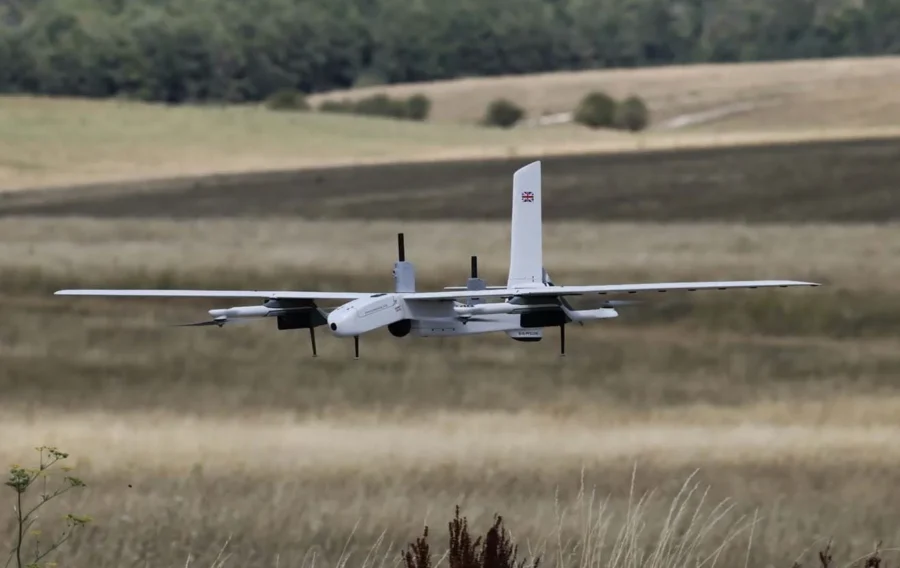
A week-long exercise integrating multiple uncrewed systems with Wildcat helicopters, Royal Marines and ship commanders has demonstrated that long-range drone network operations are ready for Royal Navy use now – and signals the next phase of UK hybrid maritime capability development.
The Royal Navy has completed a landmark series of trials demonstrating that multiple uncrewed aerial and surface systems can operate seamlessly alongside traditional crewed air and sea platforms over considerable distances, bringing the Hybrid Navy concept materially closer to operational reality. Exercise Dragon Rider, conducted by the Maritime Aviation Strike Operational Advantage Group across more than 200 miles of southern England – from the Lizard peninsula in Cornwall to Somerset and Salisbury Plain – proved that a fleet of drones scouting ahead of the main body of helicopters, jets and ships is no longer a theoretical ambition but a deployable capability.
The exercise used a specially modified Wildcat maritime strike helicopter fitted with additional sensors at RNAS Yeovilton to relay data from multiple drones flying across southern England to operators in a central hub. In doing so, Dragon Rider solved one of the most significant operational constraints on drone integration with maritime forces: range. Previously limited by how far radio signals could reach from a ship or helicopter, the exercise proved that drones can now operate far ahead of a task group with their data and control routed back through the Wildcat as an airborne relay node. Participants interacted with real-time video feeds from multiple drones simultaneously, practised target identification and sent secure messages across the network – and operators successfully took remote control of drones over the network, confirming that true long-range control is now operationally viable.
The technology enabling this leap in capability is a battle-tested mesh communications system known as a Mobile Ad-hoc Network, or MANET, which has already been proven in combat conditions in Ukraine. The system is designed to outfox jamming attempts and self-repair by finding alternate data routes through any available transmitter on the network, ensuring information reaches its destination even if individual relays are knocked out. It is the kind of resilient, low-cost communications architecture that defines the difference between a concept that works in benign conditions and one that can be relied upon in a genuinely contested electromagnetic environment.
Lieutenant Commander Rhydian Edwards, who has been leading the integration of drone technology with the Wildcat force, described the trial as proving that this low-cost system is ready for the Royal Navy to use right now – a statement that carries significant weight given the system’s origins in Ukraine and its performance across a demanding operational geography. The ability to keep human crews safer by letting drones handle dangerous tasks further ahead of the main force, while simultaneously increasing the number of units that can be fielded, addresses two of the most pressing operational requirements across modern maritime operations.
Dragon Rider builds directly on the initial Eagles Eye trial held in Cornwall in January, during which drones shared live data with Wildcat crews for the first time, enabling targeting of a moving vehicle – a capability subsequently taken to Norway on Exercise Tamber Shield. The scale of Dragon Rider vastly expands that foundation, extending range, increasing the number of systems operating simultaneously and introducing the ground element with Royal Marines as part of the integrated network. The next development step is the introduction of satellite communications, which will ultimately allow commanders to control fleets of drones anywhere in the world from a secure location at home – removing the final constraint on the concept’s global applicability.
The trials were conducted alongside a number of small and medium-sized UK, US and Norwegian companies operating at the leading edge of drone and network-enabled technologies – an industrial engagement model that reflects both the pace at which this capability is being developed and the deliberate inclusion of innovative SMEs as technology partners rather than legacy prime contractors.
For the UK defence supply chain
Dragon Rider is one of the most operationally significant Royal Navy capability demonstrations of the year, and its implications for the supply chain extend well beyond the platforms and systems directly involved. The combination of MANET communications, drone relay architectures, long-range control systems and multi-domain sensor fusion points to a set of capability requirements that are actively being shaped for procurement – and the explicit involvement of UK SMEs alongside US and Norwegian partners in the trial signals that the technology development pathway is open to innovative smaller businesses, not just established primes. The progression from Eagles Eye in January to Dragon Rider in August, with satellite communications integration already identified as the next step, also indicates a development pace that will generate procurement activity relatively quickly.
Image: Royal Navy

Post written by: Vicky Maggiani
Vicky has worked in media for over 25 years and has a wealth of experience in editing and creating copy for a variety of sectors.
RELATED ARTICLES
August 7, 2026
Air - Thales Secures NSPA Contract for Deployable Air Navigation System in Demonstration of NATO Procurement Route
Thales has been selected by the NATO Support and Procurement Agency to supply a Deployable Tactical Air Navigation system to
August 7, 2026
Land - Cambridge Pixel Validates SAPIENT-Compliant Radar Processing at NATO Counter-UAS Exercise in Romania
A successful demonstration at NATO’s first Layered Counter-UAS Initiative exercise underlines the growing operational importance of open standards in counter-drone