


Exercise Lanternfish marks a significant step in allied undersea warfare integration – moving from theory and testing to live operational activity and demonstrating the growing demand for autonomous underwater systems, seabed surveillance technology and critical infrastructure protection capability.
The Royal Navy has completed a six-week trilateral exercise with Australian and American naval forces to test technologies and develop common operating procedures for the protection of critical undersea infrastructure. Exercise Lanternfish, conducted across Virginia and Washington in the United States and waters off the southwestern coast of Australia, saw Royal Navy divers and hydrographic experts operate remotely-controlled and autonomous underwater systems alongside AUKUS partners in realistic operational conditions – marking a deliberate shift from theoretical development to live, integrated activity.
The exercise was conducted under AUKUS Pillar 2, the trilateral framework between Australia, the UK and the United States focused on the collaborative and accelerated deployment of advanced military capabilities. Its focus on critical undersea infrastructure protection reflects one of the most urgent and growing security challenges facing allied navies. The threat posed by foreign state actors to subsea cables, pipelines and other critical infrastructure has become a live and documented concern – underlined by the covert operations of a Russian submarine in and around UK waters earlier this year, and by a pattern of suspected hostile subsea activity across allied waters that has driven significant investment in detection, monitoring and response capability.
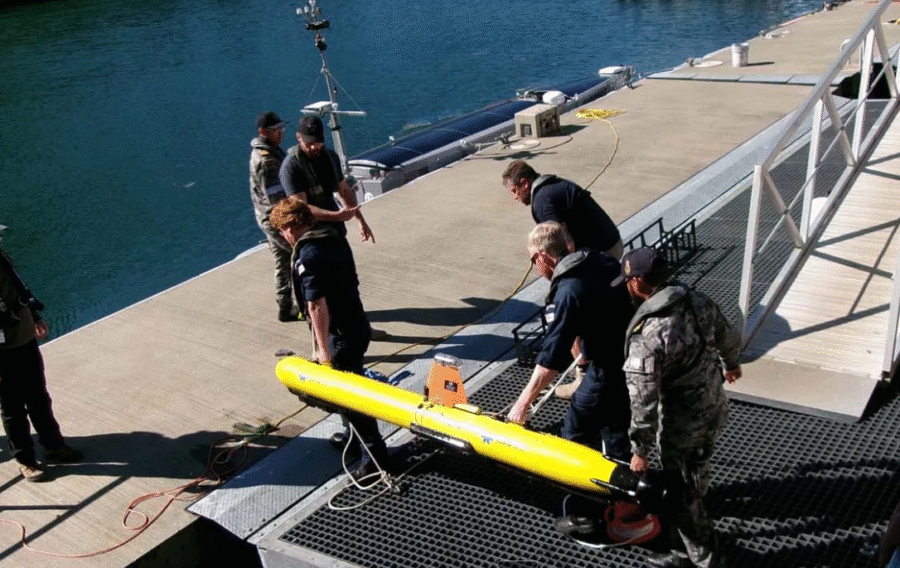
The Royal Navy’s contribution to Lanternfish drew on two specialist units. The Diving and Threat Exploitation Group deployed the VideoRay Defender, a small remotely-operated submersible used to locate mines and underwater explosive devices. Hydrographic eXploitation Group experts from Devonport launched the Teledyne Gavia, an Autonomous Underwater System whose modular sensor design enables it to be configured for varied AUKUS missions depending on operational requirements. Both systems were used to conduct surveillance of critical undersea infrastructure and rehearse responses to potential hostile activity, operating as part of a wider ecosystem of sensors and underwater vehicles designed to build a comprehensive picture of the subsea environment.
The exercise delivered measurable operational outcomes alongside the interoperability development. HXG completed multiple Gavia missions including acoustic calibration, night-time and independent unaided operations. Lt Cdr Mark Wilton from HXG described true integration with AUKUS partners, including the seamless use of Royal Australian Navy equipment when required – a practical demonstration of the interoperability that Lanternfish was explicitly designed to build and validate. Commodore Marcus Rose, Deputy Director Defence Underwater, described the exercise as providing the opportunity to test interoperability in a real-world setting and iterate capabilities at pace – language that reflects the operational urgency now attached to seabed warfare development across allied navies.
Lanternfish also reflects the Royal Navy’s broader transition towards a Hybrid Navy model, in which crewed and uncrewed capabilities work alongside each other to enhance operational effectiveness rather than operating as separate capability streams. The integration of autonomous underwater vehicles into a wider sensor ecosystem – alongside human divers and hydrographic specialists – illustrates how that hybrid model is being operationalised in the seabed domain. Planning is already underway for the next AUKUS Pillar 2 operational exercise, which will extend allied and partner integration across maritime, air, cyber and space domains simultaneously.
For the UK defence supply chain
Exercise Lanternfish signals a seabed warfare capability development pipeline that is accelerating in both investment and operational ambition. The combination of AUKUS Pillar 2 funding, rising allied concern about critical undersea infrastructure threats and the Royal Navy’s explicit transition towards hybrid uncrewed capability creates sustained and growing demand for the technologies demonstrated in Lanternfish and the wider seabed surveillance ecosystem they sit within. For UK businesses operating in underwater systems, autonomous vehicles, sensors, hydrography and subsea technology, this is an area of active operational development with direct procurement implications.
Join our new expanding community at DPRTE.co.uk – our new Defence Community Platform, creating a single, year-round digital hub for the UK’s defence procurement and supply chain sector.

Post written by: Vicky Maggiani
Vicky has worked in media for over 25 years and has a wealth of experience in editing and creating copy for a variety of sectors.
RELATED ARTICLES

August 4, 2026
Homeland - TechUK Welcomes MoD SME Action Plan but Warns on Accountability and Pace of Delivery
The UK’s leading technology trade association has given a cautious welcome to the MoD’s long-awaited SME Action Plan – but
August 4, 2026
Maritime - Navantia UK's Seahorse Barge Highlights the Value of Local Supply Chain Expertise
The delivery of the Seahorse transport barge at Methil – designed with Scottish naval architecture expertise and built on budget