



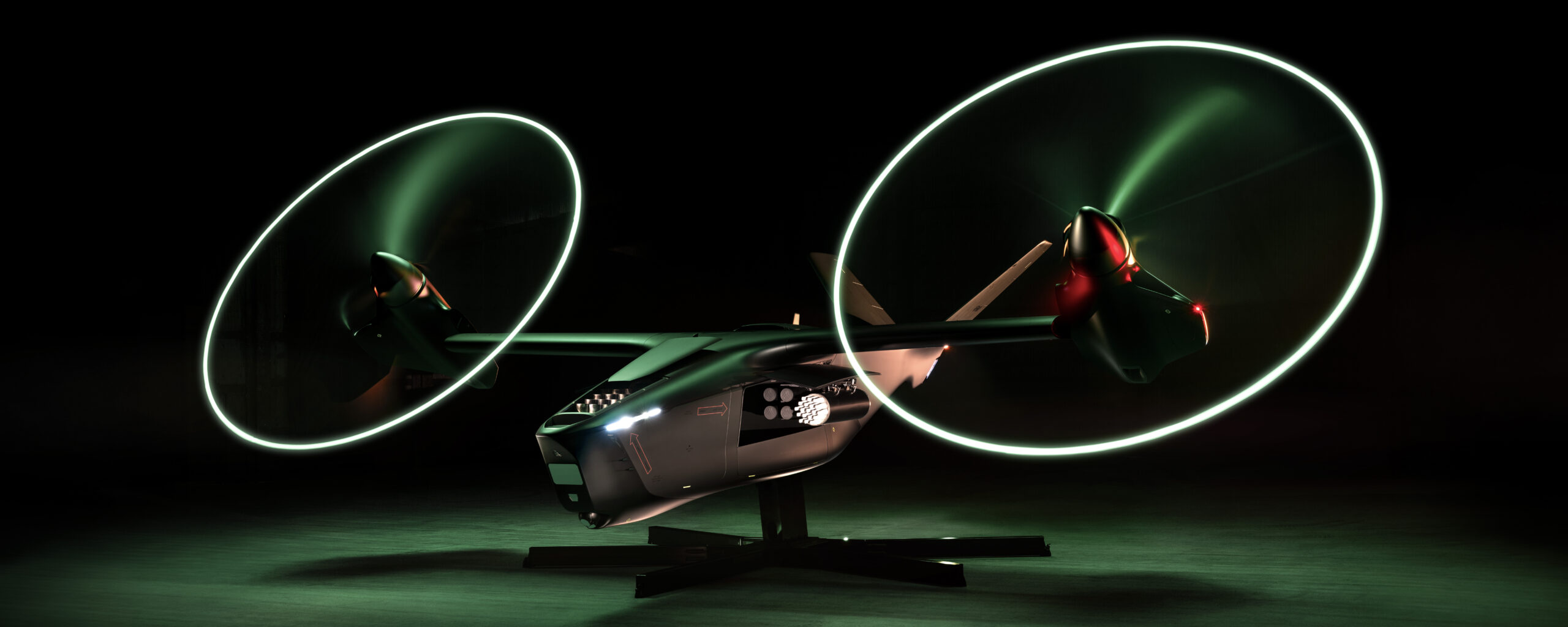
Unveiled at Farnborough International Airshow, Thunder represents a significant step in the maturation of autonomous combat aviation – and signals a growing market for the technologies and supply chain capabilities that will underpin it.
Anduril Industries has unveiled Thunder, a Group 5 autonomous attack rotorcraft designed to multiply the combat power and survivability of crewed attack and assault aircraft. The announcement at Farnborough International Airshow marks one of the most significant developments in autonomous combat aviation to date, with Thunder designed not as a standalone uncrewed platform but as a trusted autonomous wingman capable of teaming directly with aircraft such as the Apache at machine speed and at scale.
The platform’s tiltrotor configuration combines vertical takeoff and landing with efficient wingborne cruise, enabling runway-independent operations from austere locations across extended ranges. Developed in partnership with Archer Aviation, Thunder draws directly on the commercial advanced air mobility sector’s rapid advances in electric propulsion and rotor design, with a series hybrid-electric powertrain and Optimum-Speed Tiltrotor technology providing both the range required for deep operations and a reduced acoustic signature for low-altitude ingress. The aircraft can also be packed into a standard shipping container for transport by air, road, rail or sea – a logistics flexibility that significantly broadens its operational reach.
At the heart of Thunder’s capability, however, is its software. Anduril’s Lattice for Mission Autonomy platform delivers the formation behaviours, separation management and flight logic required for Thunder to operate predictably and safely alongside crewed aircraft, translating pilot intent into machine-speed routing, tasking and deconfliction decisions without requiring direct manual control. A multi-modal sensor suite combining passive and selective active sensors with onboard computer vision and edge compute enables Thunder to navigate, detect threats and maintain situational awareness in GPS-degraded and communications-denied environments – precisely the conditions that define the modern near-surface battlespace.
Thunder’s modular payload architecture gives the platform considerable operational flexibility. The main and nose payload module bays can be configured for precision strike – carrying combinations of Hellfire, JAGM or Barracuda-100M missiles, 70mm rockets, air-launched effects such as the Altius-600, electronic warfare payloads, counter-UAS effectors or contested logistics. Paired with Apache in a three-to-one ratio, a single Combat Aviation Brigade could achieve a threefold increase in available munitions without placing additional crews at risk – a step change in combat mass that reflects the core logic behind Thunder’s design.
Anduril has already completed multiple test flights using full-scale surrogate aircraft, with Thunder’s first flight planned for 2027. The platform is co-developed with a team of industry partners and is explicitly designed with producibility and affordability in mind, with the dual-use commercial baseline intended to drive economies of scale and broaden the supply chain needed for large-scale production.
For the UK defence supply chain
Thunder’s unveiling reflects a broader acceleration in the autonomous and uncrewed systems market that is reshaping procurement priorities across NATO and allied nations. For UK suppliers, the trajectory of platforms like Thunder points to growing demand across a range of specialist capability areas – from autonomy software and machine perception to advanced propulsion, precision manufacturing, payload integration and counter-UAS systems. The emphasis on open architecture, modular payload bays and rapid integration of future mission systems also signals ongoing opportunities for technology insertion and through-life capability development as these platforms mature and enter service.
Organisations with capabilities relevant to autonomous combat systems, advanced aviation and the wider uncrewed technology market should be tracking this pipeline closely. Relevant capability areas include:
- Autonomous systems software, AI and mission management
- Electric and hybrid-electric propulsion and power systems
- Advanced sensors, computer vision and edge compute
- Precision manufacturing and lightweight structures
- Modular payload and weapons integration
- Counter-UAS systems and electronic warfare
- Logistics, containerisation and multi-modal transport solutions
- Through-life support and sustainment for uncrewed platforms
Join our new expanding community at DPRTE.co.uk – our new Defence Community Platform, creating a single, year-round digital hub for the UK’s defence procurement and supply chain sector.

Post written by: Vicky Maggiani
Vicky has worked in media for over 25 years and has a wealth of experience in editing and creating copy for a variety of sectors.
RELATED ARTICLES

July 23, 2026
Homeland - Ministers Set Out Golden Age Vision for UK Defence Industry at Farnborough International Airshow
Lord Coaker and Minister for Defence Readiness and Industry Luke Pollard used keynote speeches at Farnborough to deliver the clearest
July 22, 2026
Air - UK Commits €300 Million to Deliver Gripen Fighter Jets to Ukraine
Prime Minister Keir Starmer has announced a €300 million UK investment to help deliver a full squadron of advanced Swedish