


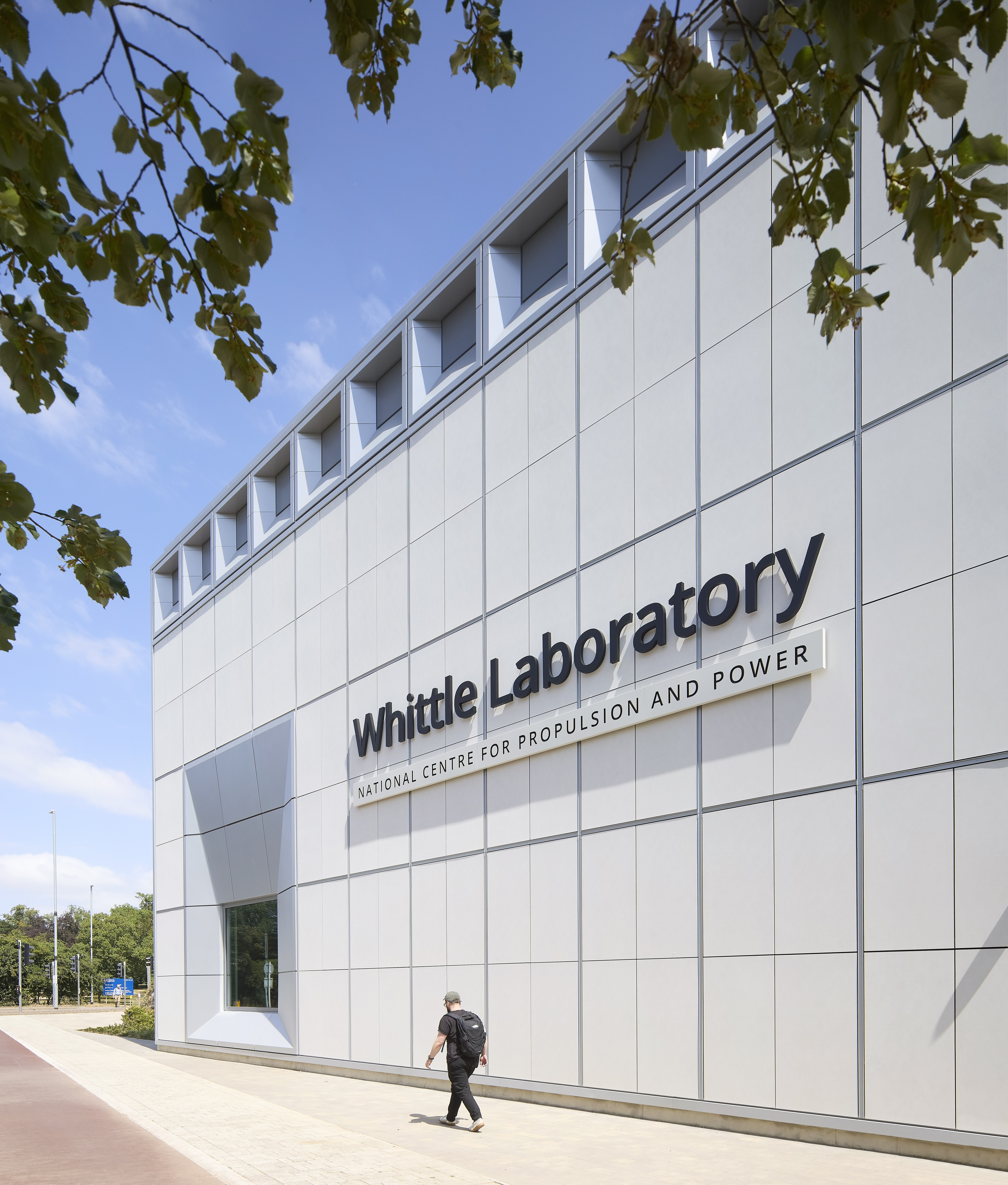
The University of Cambridge’s Whittle Laboratory has officially opened a new £58 million facility and hosted the Frank Whittle Summit, bringing together executives from Rolls-Royce, Airbus, Boeing, Mitsubishi Heavy Industries, Siemens Energy, and leading AI firms alongside senior government and military officials to launch a new mission-led approach to hardware innovation across aerospace, energy, and defence.
The summit, timed to coincide with the Farnborough International Airshow, marks the beginning of an ambitious programme that aims to generate up to £30 billion of economic value and create as many as 10,000 skilled jobs in the UK over the coming decade.
What the New Whittle Laboratory Delivers
The new facility encompasses two distinct elements. The Bennett Innovation Lab is a mission capability designed to launch 20 to 30 innovation missions over a decade, each intended to build or transform a UK industry. The National Centre for Propulsion and Power is a rapid test capability that dramatically cuts the time required to test technologies at real operating conditions, compressing timelines from years to weeks.
Small teams of elite engineering talent will work in a culture that promotes risk-taking and provides access to Formula 1-style rapid fabrication and testing, taking breakthrough ideas from concept to execution at a pace that traditional development cycles cannot match.
Professor Rob Miller, Director of the Whittle Laboratory, said: “AI is dramatically accelerating hardware innovation across the aerospace, energy and defence sectors. Britain has the capacity and the audacity to compete and win in a global race. What’s missing is a bold new approach that champions rapid iteration over incremental improvement. That’s why we’ve established the Bennett Innovation Lab, a sovereign mission capability designed to launch transformative new missions, each of which is designed to build or transform a UK industry.”
Proof of Concept: A Novel Cryogenic Jet Engine
The summit coincides with the completion of a successful pilot mission funded by philanthropists Lord Sainsbury of Turville and Peter Bennett, with support from Rolls-Royce. The mission resulted in the development of a novel cryogenic jet engine, described as representing the biggest shift in jet engine design since Frank Whittle’s original invention, and generated nine new patents. Rolls-Royce plans to use the learnings to accelerate technology development for future narrowbody engine applications.
Simon Burr, Group Director of Engineering, Technology and Safety at Rolls-Royce, said: “We’re excited by the Bennett Innovation Lab’s mission-led approach, as our teams accelerate innovation, develop and validate new technologies. By doing so we will strengthen the capabilities needed to pursue Rolls-Royce’s future narrowbody ambitions and deliver significant UK economic growth.”
Defence and Security at the Core
The summit’s significance for defence is substantial. Air Chief Marshal Sir Richard Knighton, Chief of the Defence Staff, said: “At the Whittle Lab, artificial intelligence and robotics will be used to conduct experiments to design, manufacture and test new engine technology. This offers the opportunity to vastly increase the rates of progress and development of new engine technology.”
The NATO Innovation Fund is also closely engaged. Patrick Schneider-Sikorsky, Partner at the NATO Innovation Fund, said: “The Bennett Innovation Lab’s goal of commercialising and driving the adoption of cutting-edge aerospace and propulsion technologies is closely aligned with NATO Innovation Fund’s mission to foster NATO’s technological edge. I look forward to seeing scalable spinout investment opportunities and supporting the lab in building a key pillar of the defence, security and resilience ecosystem.”
A National Network of Innovation
The Whittle Laboratory is not operating in isolation. The summit brought together Britain’s leading innovation clusters and research institutions, including the Henry Royce Institute, the Advanced Manufacturing Research Centre, the Harwell Campus, the Silverstone Technology Cluster, and the Manufacturing Technology Centre. The ambition is to build a genuinely national mission capability, with Cambridge as its hub and the UK’s leading clusters as its partners.
Lord Vallance, Minister for Science, Innovation, Research and Nuclear, said: “The New Whittle Laboratory is an excellent example of how we can turn world-class research into innovation and growth, and I look forward to seeing the pioneering technologies that will be developed here.”
Professor Julia Sutcliffe, Chief Scientific Adviser at the Department for Business and Trade, added: “To remain internationally competitive and at the forefront of critical industries for the UK economy, including aerospace, energy and defence, we must find new models to move much faster. We believe the mission-led approach being pioneered through the New Whittle Laboratory will be transformative in delivering this.”
What This Means for UK Defence Industry
For the UK defence supply chain, the Whittle Laboratory represents something genuinely new: a sovereign, mission-led rapid innovation capability with direct defence application and the industrial partnerships to translate breakthroughs into contracted programmes. The combination of AI-accelerated testing, elite engineering talent, and close links to primes like Rolls-Royce and Boeing creates a pipeline from fundamental research to industrial deployment that has historically been one of the UK’s most persistent weaknesses.
For SMEs and technology companies operating at the intersection of advanced manufacturing, propulsion, energy, and defence, the Bennett Innovation Lab’s mission model creates a structured pathway into collaboration with major industrial partners and government programmes that could prove transformative.
Image: ©Hufton+Crow

Post written by: Vicky Maggiani
Vicky has worked in media for over 25 years and has a wealth of experience in editing and creating copy for a variety of sectors.
RELATED ARTICLES

August 7, 2026
Air - Thales Secures NSPA Contract for Deployable Air Navigation System in Demonstration of NATO Procurement Route
Thales has been selected by the NATO Support and Procurement Agency to supply a Deployable Tactical Air Navigation system to

August 7, 2026
Air - Royal Navy's Dragon Rider Trials Prove Drone Armada Concept Over 200 Miles of Southern England
A week-long exercise integrating multiple uncrewed systems with Wildcat helicopters, Royal Marines and ship commanders has demonstrated that long-range drone