


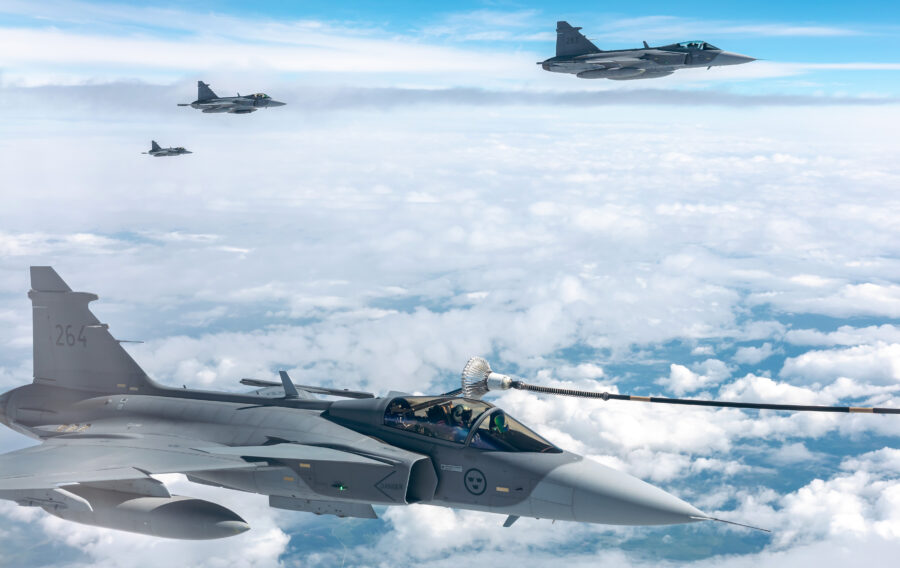
Prime Minister Keir Starmer has announced a €300 million UK investment to help deliver a full squadron of advanced Swedish Gripen E fighter jets to Ukraine, strengthening Ukrainian air defences against Russian attacks while supporting 5,000 highly skilled jobs across more than 50 UK-based companies.
The announcement was made during the Prime Minister’s visit to Ukraine to meet President Volodymyr Zelenskyy and forms part of the UK’s £3 billion military support package to Ukraine this year. The funding will help deliver 16 Gripen E aircraft to Ukraine by 2029, alongside pilot and engineer training, simulators, spare parts, and the wider equipment needed to get the jets to the frontline.
British Industry at the Heart of the Programme
The investment has a direct and significant industrial dividend for the UK. From Saab UK in Fareham to Leonardo UK in Edinburgh, British companies play a substantial role across the global Gripen supply chain, with UK-based suppliers supporting the programme across more than 50 businesses. The 5,000 jobs supported by the investment span advanced manufacturing, systems integration, electronics, and specialist engineering, demonstrating how Ukraine support and domestic industrial growth are increasingly two sides of the same coin.
Prime Minister Starmer said: “Today’s investment will help put advanced Gripen fighter jets in Ukrainian skies, strengthening their ability to defend their country while supporting thousands of skilled jobs here at home. From British engineers to Ukrainian pilots, this is our partnership in action, building Ukraine’s long-term security, strengthening Britain’s defence industry, and showing Putin that we are not going anywhere.”
Defence Secretary Dan Jarvis MBE MP added: “These fighter jets will help give Ukraine the air power needed to deter Putin, and this investment supports thousands of good jobs across our nation.”
Why Gripen for Ukraine
The Gripen E is well suited to Ukraine’s operational requirements. The aircraft has low maintenance demands, can be operated by small ground crews, and is highly interoperable with NATO forces, having operated alongside RAF aircraft during NATO’s air policing mission in Poland last summer. Capable of air-to-air combat, ground strike missions, and reconnaissance, the Gripen will help Ukraine build a modern, NATO-compatible air force capable of defending against the sustained Russian aerial campaign that has caused widespread destruction across the country.
The announcement builds on the Prime Minister’s existing commitment to deliver 150,000 drones and thousands of air defence missiles to Ukraine this year, and comes as the UK continues to co-lead the Ukraine Defence Contact Group.
Supply Chain Implications
For the UK defence supply chain, the Gripen programme is a strong illustration of how international collaboration and export-linked defence investment generates domestic industrial activity. The breadth of UK companies involved across a programme centred on a Swedish platform underlines the extent to which modern defence programmes draw on specialised capabilities from across allied nations, and the importance of UK companies maintaining their positions in those global supply chains.
The programme also reinforces the government’s broader ambition, articulated this week in the Defence Export Strategy announcement and the Global Air and Space Chiefs’ Conference speech, to pivot UK defence exports beyond platforms alone and toward components, systems, and services that can reach more markets and support more allies simultaneously.
Image: Crown Copyright

Post written by: Vicky Maggiani
Vicky has worked in media for over 25 years and has a wealth of experience in editing and creating copy for a variety of sectors.
RELATED ARTICLES
August 7, 2026
Air - Thales Secures NSPA Contract for Deployable Air Navigation System in Demonstration of NATO Procurement Route
Thales has been selected by the NATO Support and Procurement Agency to supply a Deployable Tactical Air Navigation system to
August 7, 2026
Air - Royal Navy's Dragon Rider Trials Prove Drone Armada Concept Over 200 Miles of Southern England
A week-long exercise integrating multiple uncrewed systems with Wildcat helicopters, Royal Marines and ship commanders has demonstrated that long-range drone