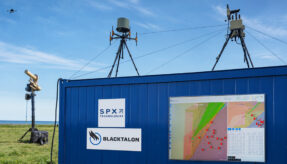




The Ministry of Defence has awarded £3.16 million to three UK SMEs to develop low-cost interceptors capable of shooting down drones, making the UK the first of five European partner nations to award contracts under a new joint air defence programme.
The Low-Cost Air Defence Effectors (LCADE) programme is being delivered by the National Armaments Director Group as part of the wider European Low-Cost Effectors and Autonomous Platforms (LEAP) initiative, which brings together the UK, Poland, France, Italy and Germany to develop affordable effectors and autonomous systems. Each nation is running its own national competition ahead of a multilateral phase, aimed at stimulating growth across the European defence industry and speeding up delivery of solutions to allied warfighters. The urgency behind the programme is stark: in March 2026, Russia launched the equivalent of more than 200 drones per day into Ukraine, a scale that traditional, more expensive air defence systems struggle to counter cost-effectively.
The three successful companies, Frankenberg Technologies, Greenjets and Cambridge Aerospace, are all small or medium-sized businesses with a UK presence, and each has committed to building manufacturing capability in the UK, supporting jobs in Cambridge, Milton Keynes, Bristol and Stevenage. Cambridge Aerospace was only recently identified to the MOD, which the department points to as evidence of the value in widening access to new market entrants. The contracts were delivered by Commercial X, the NAD Group team tasked with accelerating procurement and reducing barriers to entry for smaller companies, which has also recently signed contracts worth up to £4 million with 13 future British “unicorns.”
National Armaments Director Rupert Pearce said the awards demonstrate “the powerful, low-cost capabilities we can deliver when we open up Defence and collaborate with some of the UK’s most agile, innovative companies.” Anmol Manohar, CEO of Greenjets, said the company was “extremely proud” to demonstrate the role innovative British businesses can play in strengthening national defence capability, with demonstration trials due later this year. Steven Barrett, CEO of Cambridge Aerospace, called the contract “a significant step” in delivering low-cost, high-scale interceptors to the UK and Europe, while Dan Hallett, Managing Director of Frankenburg Technologies, said the contract would let the company develop low-cost, mass-manufactured missiles in the UK to counter the mass drone threat. The next phase will focus on identifying solutions that can be produced at scale across all five partner nations, requiring strong manufacturing capacity and reliable supply chains.
For the UK defence supply chain, this programme is a clear signal that low-cost, mass-manufacturable capability is now a genuine procurement priority, not just a research interest, and that MOD is actively lowering barriers for SMEs and new entrants to compete for this work.
Businesses with relevant capabilities should monitor the following areas as LCADE and LEAP move into their next phase:
- Low-cost interceptor and effector design
- Mass-manufacturable missile and munition production
- Counter-drone sensing and guidance systems
- Autonomous platform development
- Cross-border manufacturing capacity and supply chain scaling
- Rapid procurement routes for SMEs and new market entrants
Image credit: Dmytro Larin / Shutterstock.com
Join our new expanding community at DPRTE.co.uk – our new Defence Community Platform, creating a single, year-round digital hub for the UK’s defence procurement and supply chain sector.

Post written by: Vicky Maggiani
Vicky has worked in media for over 25 years and has a wealth of experience in editing and creating copy for a variety of sectors.
RELATED ARTICLES
August 7, 2026
Air - Thales Secures NSPA Contract for Deployable Air Navigation System in Demonstration of NATO Procurement Route
Thales has been selected by the NATO Support and Procurement Agency to supply a Deployable Tactical Air Navigation system to
August 7, 2026
Air - Royal Navy's Dragon Rider Trials Prove Drone Armada Concept Over 200 Miles of Southern England
A week-long exercise integrating multiple uncrewed systems with Wildcat helicopters, Royal Marines and ship commanders has demonstrated that long-range drone