



General Sir Gwyn Jenkins, First Sea Lord, has unveiled a landmark transformation strategy for the Royal Navy, committing to a “Hybrid Navy” that integrates crewed, uncrewed, and autonomous platforms to meet escalating global threats.
Speaking at the Royal United Services Institute (RUSI), Sir Gwyn outlined a blueprint to dramatically increase the Royal Navy’s mass and lethality by 2029. Central to this vision is the “Atlantic Fleet Series,” a trio of programs – Bastion, Shield, and Strike – designed to protect critical infrastructure, provide integrated air defense, and enhance long-range strike capabilities.
Drawing lessons from the conflict in Ukraine – where maritime drones have disabled a third of Russia’s Black Sea fleet – the First Sea Lord argued that the Royal Navy must abandon the “mentality of ever more expensive and larger platforms.”
The speech highlighted “Project Beehive” as the new standard for speed, with 20 uncrewed vessels delivered to the Royal Marines in just months. Sir Gwyn noted that the goal is to cut procurement-to-delivery times to as little as three months for certain systems.
Key Announcements:
- The “Northern Navies” Initiative: Sir Gwyn confirmed the signing of a Statement of Intent with Northern European naval chiefs to create a multinational maritime force. This alliance will focus on interchangeability and collective defense in the North Atlantic and High North.
- Project Beehive: The Royal Navy has taken delivery of its first 20 uncrewed vessels from UK-based company Kraken. These assets were procured in months, signaling a shift toward agile procurement.
- Success in Wargaming: Recent Navy-wide wargames at Southwick Park demonstrated that the Hybrid Navy model triples missile capacity and significantly increases mission success rates in the North Atlantic.
- Operational Milestones: RFA Lyme Bay has been converted into a “mothership” for autonomous mine hunting. Sir Gwyn also confirmed plans to launch a jet-powered drone from a carrier by next year and deploy uncrewed escort ships within two years.
“Just maintaining the ‘capable status quo’ is simply not good enough,” said Sir Gwyn Jenkins. “We are shifting mindsets to ensure we can lead, fight, and win. The pace of technological change will never be as slow as it is today; we must embrace agility to stay ahead of our adversaries.”
The First Sea Lord emphasised that the transition is a direct response to increased Russian activity, noting that Russian incursions into UK waters have risen by nearly a third in the last two years.
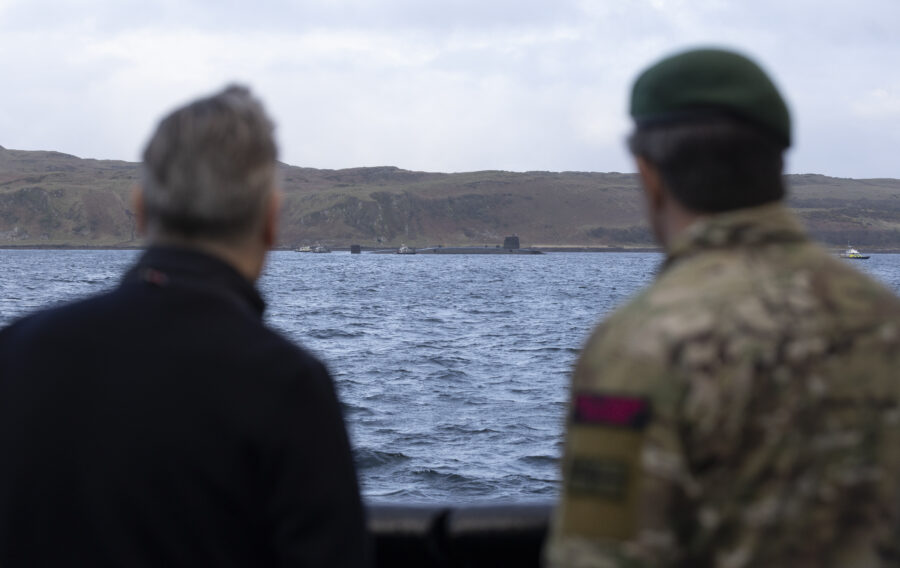
Image: Crown Copyright – Prime Minister Keir Starmer and First Sea Lord, General Sir Gwyn Jenkins KCB OBE ADC looking at a Vanguard Class Submarine.

Post written by: Vicky Maggiani
Vicky has worked in media for over 25 years and has a wealth of experience in editing and creating copy for a variety of sectors.
RELATED ARTICLES

August 7, 2026
Air - Thales Secures NSPA Contract for Deployable Air Navigation System in Demonstration of NATO Procurement Route
Thales has been selected by the NATO Support and Procurement Agency to supply a Deployable Tactical Air Navigation system to

August 7, 2026
Air - Royal Navy's Dragon Rider Trials Prove Drone Armada Concept Over 200 Miles of Southern England
A week-long exercise integrating multiple uncrewed systems with Wildcat helicopters, Royal Marines and ship commanders has demonstrated that long-range drone