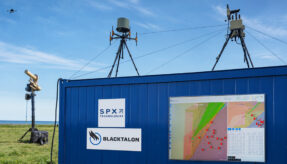



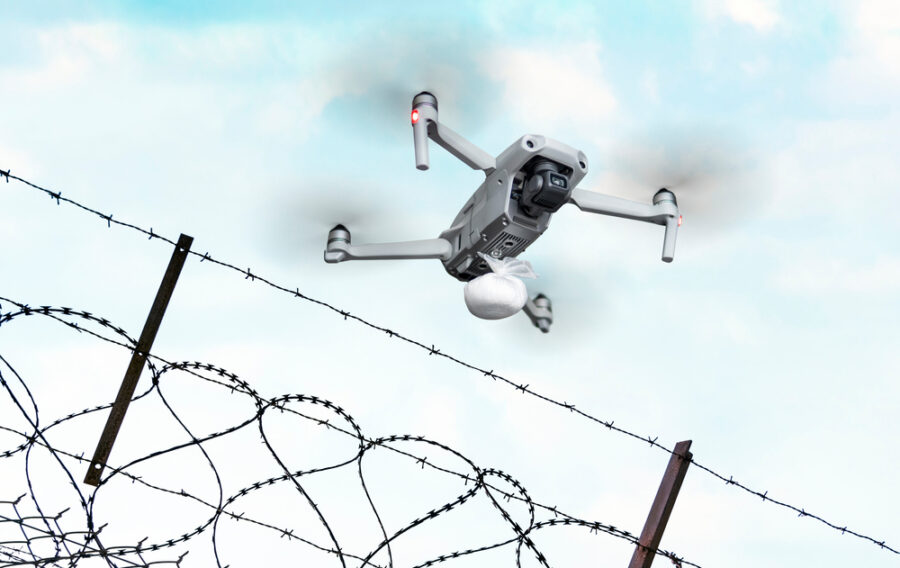
UK Defence Innovation (UKDI), on behalf of the Ministry of Justice (MOJ), has launched a new themed competition to tackle the illegal use of drones around prisons.
The ‘Countering illegal use of UAS around prisons and sensitive sites’ competition is looking for practical, low‑collateral technologies that can safely stop hostile drones once they breach secure prison airspace.
Up to £1.85 million is available, with funding expected to support several projects across two challenge areas.
The competition is delivered by UKDI on behalf of the MOJ, working with His Majesty’s Prison and Probation Service (HMPPS) and wider UK security partners including the Home Office, Police, NDA, Ministry of Defence, Innovate UK and others.
Criminal groups are increasingly using drones to deliver contraband into prisons, carry out surveillance and disrupt operations. These drones are cheap, easy to use and difficult to stop – creating a direct risk to prison safety and wider national security.
Traditional counter‑drone methods, such as kinetic interceptors or wide‑area jamming, are often unsuitable in custodial and urban environments. They can carry unacceptable risks to people, infrastructure and communications.
This competition focuses on last‑line‑of‑defence solutions – technologies that can safely neutralise a drone after other protective measures have failed, without causing unnecessary disruption or harm.
MOJ are seeking solutions that:
- Act as a last line of defence once a drone has entered a secure area
- Can be used within the powers available to prison officers
- Neutralise drones with minimal risk to people, buildings and communications
- Are safe to use in prisons, urban areas and near critical national infrastructure
- Can be deployed quickly by a small team, without specialist training
- Are legally and ethically compliant, with clear consideration of operational constraints
Integrated detect, track and identify capabilities are welcome, but this competition is focused on defeating drones – not detection alone.
Challenge 1: Higher‑readiness solutions
- Must reach Technology Readiness Level (TRL) 7 by project end
- Project length: 3-6 months
- Expected to demonstrate a working prototype in an operational environment
- Clear route towards deployment
Challenge 2: Medium‑readiness concepts
- Must reach TRL 4 or 5 by project end
- Project length: up to 12 months
- Focused on ideas with strong potential for future capability
Key dates
- Competition closes: 12:00 midday (BST), 31 March 2026
- Launch webinar: Tuesday 17 February 2026 (register via Eventbrite)
- Projects start: Expected early July 2026
If you would like to join our community and read more articles like this then please click here

Post written by: Vicky Maggiani
Vicky has worked in media for over 25 years and has a wealth of experience in editing and creating copy for a variety of sectors.
RELATED ARTICLES
August 7, 2026
Air - Thales Secures NSPA Contract for Deployable Air Navigation System in Demonstration of NATO Procurement Route
Thales has been selected by the NATO Support and Procurement Agency to supply a Deployable Tactical Air Navigation system to
August 7, 2026
Air - Royal Navy's Dragon Rider Trials Prove Drone Armada Concept Over 200 Miles of Southern England
A week-long exercise integrating multiple uncrewed systems with Wildcat helicopters, Royal Marines and ship commanders has demonstrated that long-range drone