


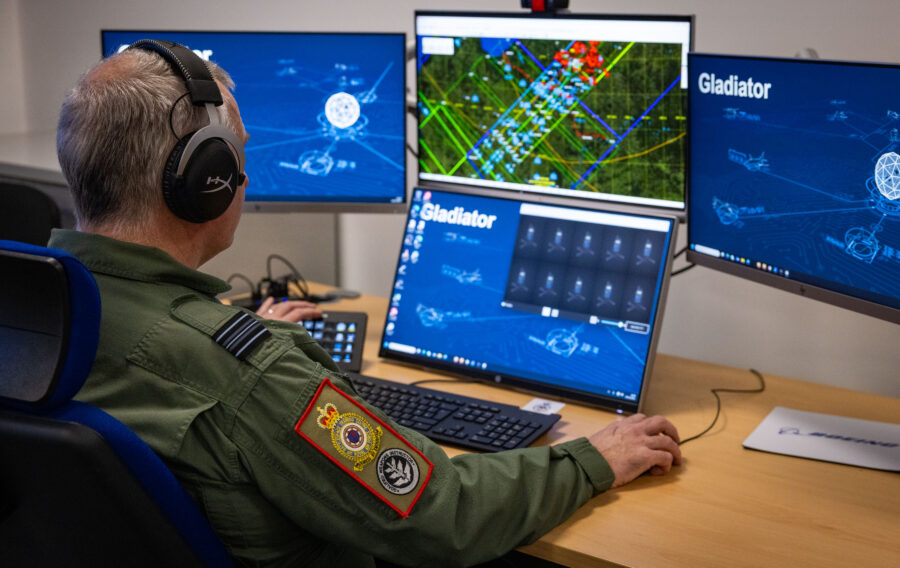
Boeing Defence UK has secured a £16.9 million contract extension to provide continued support for the Royal Air Force’s (RAF) Gladiator synthetic training environment.
This two-year bridging contract ensures the maintenance of this critical multi-domain training capability until 2028, aligning with the strategic ambitions set forth in the recent Strategic Defence Review. Gladiator facilitates high-fidelity, collective operational training within a secure, virtual landscape, allowing aircrews and command-and-control aviators to simulate complex combat scenarios that are increasingly difficult or cost-prohibitive to replicate in live-fly exercises. Operated from the Air Battlespace Training Centre at RAF Waddington, the system is managed through a “whole force” model comprising service personnel, civil servants, and industry partners.
This extension is pivotal for the integration of several frontline platforms into the synthetic battlespace, including the F-35 Lightning, Typhoon, and advanced Air Command and Control systems. As a spiral development programme, Gladiator’s roadmap includes future expansions to incorporate the E-7 Wedgetail, P-8 Poseidon, and Protector, alongside potential support for the Air Mobility Force and Joint Aviation Command. For the UK defence supply chain, this iterative development process presents ongoing opportunities for sub-contractors specialising in simulation, software integration, and secure networking. The programme’s reliance on high-fidelity data and networked interoperability requires a robust tier of specialist suppliers to maintain the system’s operational advantage.
Beyond air-centric capabilities, the programme acts as a catalyst for broader multi-domain integration. It has already demonstrated efficacy within the Ground Based Air Defence community and is currently facilitating close collaboration with the Royal Navy as it develops its own collective training environment, SPARTAN. Boeing Defence UK has emphasised that the system utilises an open-source solution, developed in partnership with a variety of UK technology suppliers. This collaborative approach not only supports over 50 highly skilled jobs across the country but also ensures the system remains adaptable to emerging threats and rapid technological shifts.
The continued investment in Gladiator underscores the Ministry of Defence’s commitment to synthetic-first training methodologies to enhance mission readiness and build interoperability with partner nations. For businesses seeking to enter or expand within the defence sector, the programme’s emphasis on open-source architecture and multi-platform integration highlights a clear pathway for participation in the UK’s evolving synthetic training infrastructure. This contract serves as a critical bridge, ensuring the RAF and its joint partners can operate as a cohesive force under contested conditions while providing a stable framework for future industrial involvement.
Image courtesy RAF
If you would like to join our community and read more articles like this then please click here

Post written by: Vicky Maggiani
Vicky has worked in media for over 25 years and has a wealth of experience in editing and creating copy for a variety of sectors.
RELATED ARTICLES
August 7, 2026
Air - Thales Secures NSPA Contract for Deployable Air Navigation System in Demonstration of NATO Procurement Route
Thales has been selected by the NATO Support and Procurement Agency to supply a Deployable Tactical Air Navigation system to
August 7, 2026
Air - Royal Navy's Dragon Rider Trials Prove Drone Armada Concept Over 200 Miles of Southern England
A week-long exercise integrating multiple uncrewed systems with Wildcat helicopters, Royal Marines and ship commanders has demonstrated that long-range drone