


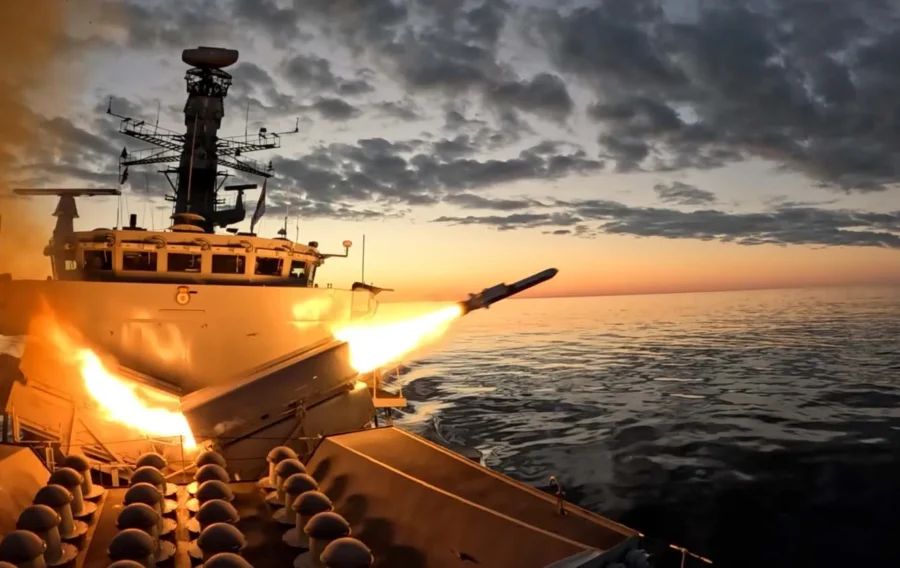
The Royal Navy has successfully completed the first live firing of the Naval Strike Missile (NSM), marking a key milestone in the modernisation of its surface fleet. HMS Somerset, a Type 23 frigate based in Plymouth, carried out the trial at the Andøya test range in Norway during Exercise Aegir 25, working alongside Norwegian and Polish partners.
The NSM, manufactured by Kongsberg Defence & Aerospace, is a new-generation precision strike capability able to engage both naval and land targets at ranges exceeding 100 miles. At 400kg, the missile is a significant upgrade on the legacy Harpoon system, offering extended range, advanced guidance, and reduced detectability through low-altitude sea-skimming flight. The weapon has been integrated onto Royal Navy Type 23 frigates and Type 45 destroyers, with HMS Richmond, HMS Somerset and HMS Portland now equipped.
The programme is being delivered at an accelerated pace. The Ministry of Defence confirmed that the UK achieved first ship installation of NSM within 12 months of business case approval, in what has been described as unprecedented for a complex weapons programme. This rapid rollout has been enabled through close cooperation with Norway, which hosts the firing trials, and with Kongsberg engineers who supported integration and testing on board HMS Somerset.
Defence Minister for Readiness and Industry, Luke Pollard, described the missile as one of the most advanced in the naval inventory, emphasising that its introduction strengthens maritime deterrence while demonstrating the Government’s commitment to investing in leading-edge technologies. The capability is viewed as a vital step in closing the gap ahead of the introduction of the Future Cruise Anti-Ship Weapon, which will be deployed on next-generation Type 26 and Type 31 frigates through the Mk41 vertical launch system.
The successful firing follows extensive planning, alignment work, and sea acceptance trials carried out by the ship’s company and the wider defence enterprise. The NSM is already in service with the Norwegian, US and Polish navies, and the UK’s adoption underlines the importance of multinational cooperation in delivering advanced capabilities at speed. Exercise Aegir 25, which continues until the end of September, is also enabling further allied firings from land-based systems and Norway’s Coastal Ranger Command.
For the defence supply chain, the NSM programme demonstrates ongoing demand for integration, test, and support services across the Royal Navy’s surface fleet, as well as opportunities for UK industry to contribute to the wider ecosystem of future complex weapons programmes in partnership with international primes.
Image: Royal Navy