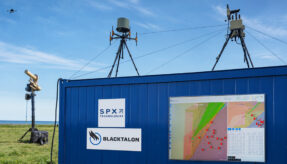




New safety containment technology for autonomous Uncrewed Aerial Systems (UAS) has been successfully proven in a demonstration as part of the Royal Air Force (RAF) Rapid Capabilities Office (RCO) Project CURBER.
Project CURBER is a joint venture between the RAF RCO and industry to advance autonomous capabilities through testing and evaluating use cases. The demonstration’s success helps to ensure safe autonomous flight and operational flexibility in complex environments and improve the resilience of essential military assets.
The CURBER autonomy containment technology was developed over 18 months. BlueBear – a Saab company, in collaboration with Frazer-Nash Consultancy (FNC), then integrated their cutting-edge systems (Centurion™, SmartConnect, and SmartNav, with FNC’s SkyPath) for a flying demonstration to evidence safe UAS containment and intra-swarm deconfliction.
These integrated systems were demonstrated on BlueBear’s Believer and Terrier UASs, showcasing the project’s advancements in autonomous capabilities.
Containment and deconfliction ensures a UAS remains within a safe and predefined area during flight, even in cases of technical malfunctions or unexpected circumstances.
The demonstration was led by an expert consortium from FNC, BlueBear, Safety Airworthiness & Engineering, and Osprey Consulting Services. The data gathered will help to mature autonomous capability for the RAF as well as wider Defence.
Andy Fraser, Group Managing Director, Saab UK, said: “BlueBear’s successful demonstration for Project CURBER highlights the power of autonomous technologies in defence. This trial has proven their effectiveness in enhancing operational capabilities and force protection, bringing us a step closer to safeguarding Britain’s future security.”
The recent Strategic Defence Review 2025 highlighted a major shift towards autonomous UAS as part of the UK’s defence modernisation. The RAF’s Autonomous Collaborative Platforms strategy also outlines how the RAF plans to integrate autonomous systems into frontline service over the next decade.
An RAF spokesperson, said: “Autonomous UAS provides distinct operational advantage and enhances protection for our forces. The recent trial for Project CURBER gives us the proven approaches we need to advance a robust and effective future capability.”
Image: Saab/BlueBear

Post written by: Vicky Maggiani
Vicky has worked in media for over 25 years and has a wealth of experience in editing and creating copy for a variety of sectors.
RELATED ARTICLES
August 7, 2026
Air - Thales Secures NSPA Contract for Deployable Air Navigation System in Demonstration of NATO Procurement Route
Thales has been selected by the NATO Support and Procurement Agency to supply a Deployable Tactical Air Navigation system to
August 7, 2026
Air - Royal Navy's Dragon Rider Trials Prove Drone Armada Concept Over 200 Miles of Southern England
A week-long exercise integrating multiple uncrewed systems with Wildcat helicopters, Royal Marines and ship commanders has demonstrated that long-range drone