



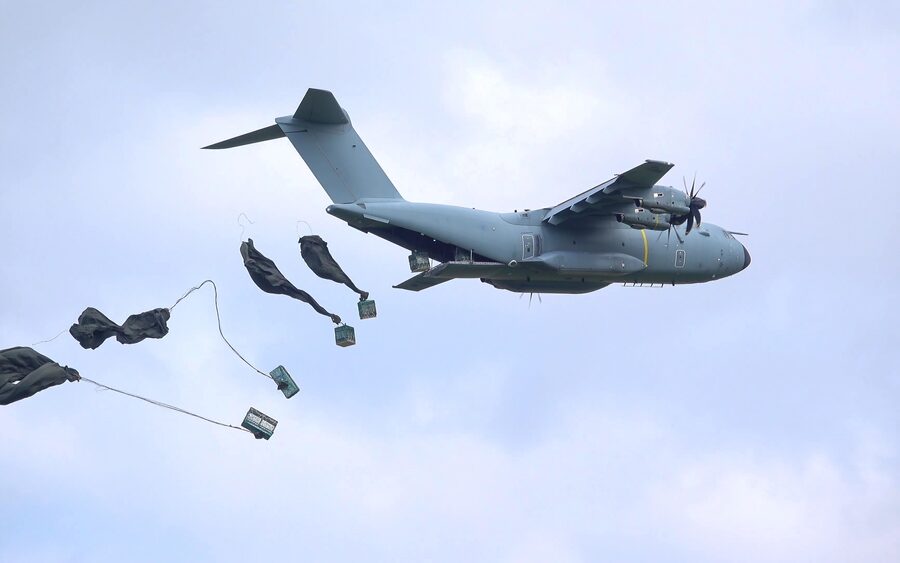
The UK Ministry of Defence has successfully advanced its aerial delivery capabilities through a rapid development project aimed at enhancing the precision and safety of military air drops.
The Joint Air Delivery Test and Evaluation Unit (JADTEU) identified a critical requirement for more accurate predictions regarding the descent of personnel and machinery in combat and crisis zones. Current methodologies rely heavily on physical trials, which are resource-intensive, costly, and susceptible to the complex variables associated with cargo aerodynamics and load behaviour.
To address these challenges, the Accelerated Capability Environment (ACE) facilitated a rapid commissioning process that resulted in the selection of Applied Data Science Partners (ADSP) as the lead supplier. This procurement, initiated over the Christmas period, underscores a shift in the Ministry of Defence’s approach to innovation, prioritising agility and the integration of specialist external expertise to overcome traditional procurement barriers.
Over a condensed nine-week development phase, ACE and ADSP produced a proof of concept for a sophisticated aerial transport load analysis system. This digital solution utilises sensor integration to capture high-fidelity physical data during live drops, including G-force, oscillation, and descent patterns. The system is managed via a web-based interface, allowing users to configure and analyse key variables such as parachute type, payload weight, and aircraft specifications. This proof of concept has been acknowledged as a significant improvement over existing manual and reactive testing methods, providing a working tool ready for immediate application in live flight trials.
The project is now transitioning into a real-world flight trial phase. Subject to successful data capture and evaluation, a subsequent phase is planned to develop a predictive modelling engine. This future iteration will leverage machine learning techniques to simulate drop outcomes based on specific load parameters and parachute configurations. Such a transition from reactive testing to proactive validation is expected to significantly reduce the necessity for repeated live tests, thereby accelerating operational decision-making and improving safety.
For the UK defence supply chain, this development highlights the increasing demand for data science, sensor integration, and machine learning expertise within the aerospace sector. It demonstrates a viable pathway for small and medium-sized enterprises to engage with complex Ministry of Defence requirements through accelerated timelines. Contractors specialising in predictive analytics and digital twin technologies should note the planned expansion of this predictive modelling engine as the Ministry of Defence continues to invest in data-driven operational tools. This initiative serves as a benchmark for how the UK military intends to modernise its logistics and delivery infrastructure through targeted digital innovation.
If you would like to join our community and read more articles like this then please click here

Post written by: Vicky Maggiani
Vicky has worked in media for over 25 years and has a wealth of experience in editing and creating copy for a variety of sectors.
RELATED ARTICLES

March 26, 2026
Maritime - Serco wins contract to support British Army’s marine assets fleet
Serco, the international provider of critical government services, has been awarded a seven-year contract to provide in-service support for the British

March 26, 2026
Homeland - Positioning SMEs at the centre of defence procurement
The Ministry of Defence has unveiled a comprehensive strategic framework designed to integrate small and medium-sized enterprises (SMEs) more deeply