



A new £3.8 million facility dedicated to the development and testing of next-generation satellite propulsion systems has opened at the Harwell Science and Innovation Campus in Oxfordshire.
The Disruptive Experimental Electric Propulsion (DEEP) Lab, established by space technology firm Magdrive, provides the UK’s defence and commercial space sectors with specialist infrastructure for electric propulsion. This technology is increasingly critical for satellite operations, enabling precise manoeuvring, orbital maintenance, and extended mission lifespans with significantly lower fuel requirements than traditional chemical systems.
The project was funded through a £1.8 million grant from the UK Space Agency’s Space Clusters Infrastructure Fund (SCIF), complemented by £2 million in private investment from Magdrive. While Magdrive is the primary operator, the 10,000-square-foot laboratory is intentionally designed as a shared resource for the wider UK space and defence supply chain. It offers start-ups, established aerospace prime contractors, and academic researchers access to high-specification testing capabilities that were previously difficult to secure domestically.
The laboratory’s technical infrastructure includes a 2-metre diameter vacuum chamber for comprehensive thruster validation, cleanroom assembly areas, and a mechanical prototyping workshop equipped with 5-axis machining and 3D printing capabilities. A significant innovation within the lab is the adaptation of plasma diagnostic tools typically used in the fusion industry, which allow for high-resolution imaging and monitoring of plasma evolution during engine testing. To facilitate rapid iteration for sub-contractors and SMEs, the facility employs a full-time machinist and offers rental models designed to cover operational costs rather than generate profit. Enhanced security protocols are also in place to ensure that proprietary technology remains protected during shared use of the facilities.
Since its launch in 2023, the UK Space Agency’s SCIF has awarded more than £45.6 million to 13 infrastructure projects, leveraging over £43.8 million in match funding to generate nearly £90 million in total public-private investment. This broader investment strategy is expected to create 50 highly skilled jobs at the DEEP Lab alone while addressing a identified gap in the UK’s national space infrastructure. For businesses operating within the UK defence supply chain, the opening of this laboratory offers a clear opportunity to accelerate the development of sovereign propulsion technologies. By providing the tools necessary for prototyping and testing at scale, the facility strengthens the UK’s position as a lead innovator in satellite technology and ensures that domestic firms are well-positioned to meet the requirements of future government and commercial space missions.
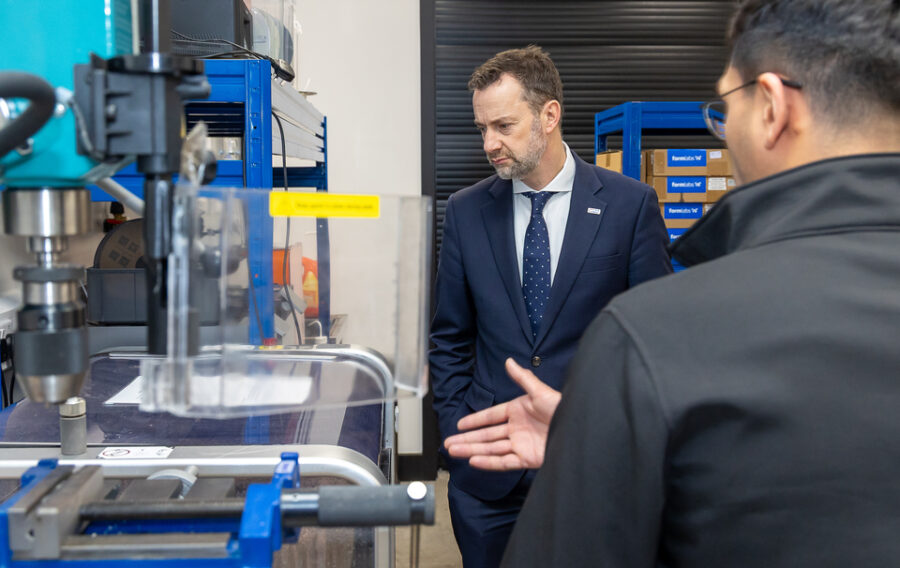
Images UK Space CEO Dr Paul Bate at Magdrive. Credit: Stuart Harrison / Magdrive
If you would like to join our community and read more articles like this then please click here

Post written by: Vicky Maggiani
Vicky has worked in media for over 25 years and has a wealth of experience in editing and creating copy for a variety of sectors.
RELATED ARTICLES

April 2, 2026
Homeland - UK and Ireland Sign Refreshed Defence MoU to Enhance Joint Procurement and Maritime Security
UK and Ireland Sign Refreshed Defence MoU to Enhance Joint Procurement and Maritime Security The UK Ministry of Defence and the

April 2, 2026
Homeland - MOD Initiates £9 Billion Housing Strategy with RAF Brize Norton Development
The Ministry of Defence has announced the commencement of the first new-build service family housing project in nearly a decade,