


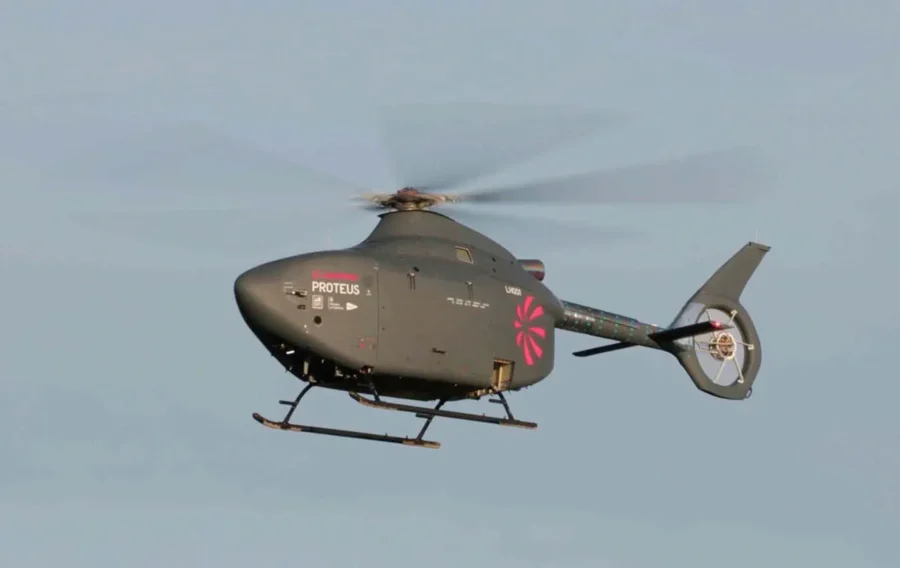
The Royal Navy has reached a pivotal milestone in its transition toward a hybrid fleet with the successful maiden flight of the Proteus, the United Kingdom’s first full-scale autonomous helicopter.
Developed by Leonardo under a £60 million technology demonstrator programme, the aircraft completed its initial flight trials at Predannack airfield in Cornwall. This development directly supports the UK Government’s Strategic Defence Review, which outlines the creation of a ‘New Hybrid Navy’ where uncrewed systems operate alongside crewed platforms to enhance operational reach and maritime security.
For the UK defence supply chain, the Proteus programme represents a significant investment in sovereign autonomous capabilities and advanced aerospace engineering. The project is headquartered at Leonardo’s Yeovil facility – the United Kingdom’s primary hub for rotary-wing manufacturing – and currently supports 100 highly skilled engineering and technical roles. The successful flight follows comprehensive ground-based trials of the vehicle’s systems, sensors, and engines. For businesses operating in the sector, the programme signals a clear shift in Ministry of Defence (MoD) procurement toward autonomous systems and software-defined platforms, offering potential sub-contracting opportunities in sensor integration, flight control software, and data processing.
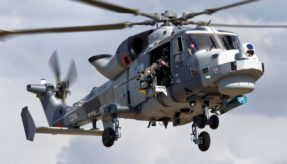
The strategic utility of the Proteus is centered on the ‘Atlantic Bastion’ programme, an MoD initiative focused on securing the North Atlantic against evolving undersea and surface threats. With a payload capacity exceeding one tonne, the platform is designed to conduct intensive maritime missions, including anti-submarine warfare (ASW) and persistent surveillance, in high sea states and challenging weather conditions. By delegating high-endurance or high-risk tasks to autonomous systems, the Royal Navy aims to optimize the use of its crewed assets, such as the Wildcat and Merlin fleets, for more complex multi-mission sorties.
The Proteus serves as a critical testbed for the software and sensor suites required for future hybrid air wings. The aircraft utilises advanced onboard processing to interpret its environment and make real-time operational decisions independently of a human pilot. According to the Ministry of Defence, such machines will be central to defending the UK and NATO allies, enabling the Navy to find, track, and act against adversaries across vast areas of ocean with increased effectiveness. As the programme moves into its next phase of testing, it will focus on integrating with a network of allied ships, submarines, and detection systems, providing a forward-looking roadmap for the integration of uncrewed technology into the UK’s broader defence architecture.
If you would like to join our community and read more articles like this then please click here

Post written by: Vicky Maggiani
Vicky has worked in media for over 25 years and has a wealth of experience in editing and creating copy for a variety of sectors.
RELATED ARTICLES
March 26, 2026
Maritime - Serco wins contract to support British Army’s marine assets fleet
Serco, the international provider of critical government services, has been awarded a seven-year contract to provide in-service support for the British

March 26, 2026
Homeland - Positioning SMEs at the centre of defence procurement
The Ministry of Defence has unveiled a comprehensive strategic framework designed to integrate small and medium-sized enterprises (SMEs) more deeply