


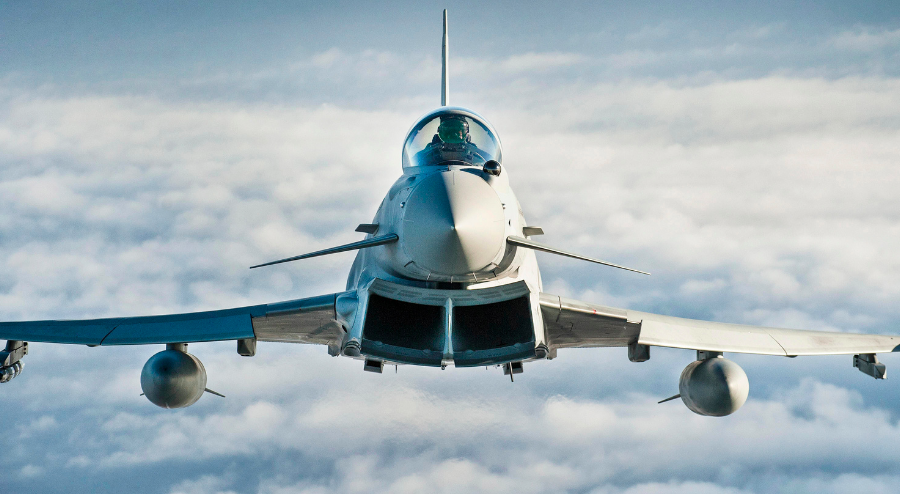
The UK Government has announced a combined investment exceeding £650 million to upgrade the Royal Air Force (RAF) Typhoon fighter jet fleet, a move designed to secure over 1,500 highly skilled jobs and reinforce the UK’s sovereign combat air capability.
This funding, confirmed during a visit by Defence Secretary John Healey to Leonardo UK’s facility in Edinburgh, aligns with the Strategic Defence Review’s commitment to maintaining the Typhoon as a central component of Britain’s air defence and NATO commitments.
The largest portion of this investment is a £453 million contract awarded to a consortium of UK industrial partners, including BAE Systems, Leonardo UK, and Parker Meggitt. This contract focuses on the manufacture and integration of the European Common Radar System (ECRS) Mk2. This advanced radar system provides the RAF with sophisticated electronic surveillance and electronic attack capabilities, enabling pilots to detect, identify, and track multiple targets simultaneously on the ground and in the air, while providing high-powered jamming functions in contested environments. The production of these 40 radar systems will sustain approximately 300 roles in Edinburgh, 120 in Lancashire, and 100 in Luton, supporting a wider supply chain that encompasses more than 330 UK-based companies.
In addition to the radar manufacture, a £205 million contract has been awarded to QinetiQ for long-term specialist engineering support. This agreement ensures the continued airworthiness and safety of the Typhoon weapon system, sustaining an additional 250 jobs across the UK. For sub-contractors and businesses within the defence supply chain, these contracts provide long-term stability and a clear signal of continued government expenditure on the Typhoon platform, which is expected to remain in service until at least the 2040s.
The Ministry of Defence has framed this investment as part of a broader strategy to utilise defence spending as a catalyst for national economic growth. This is further supported by the government’s commitment to increase defence spending to 2.6% of GDP by 2027. The Typhoon programme currently supports over 20,000 jobs nationally, and recent export successes, such as the £8 billion deal secured with Türkiye in late 2025, suggest a robust future for the platform’s international presence. For UK industry, these developments offer significant opportunities for technological innovation and long-term participation in one of Europe’s most critical aerospace programmes, ensuring the RAF maintains its operational advantage against evolving global threats.
If you would like to join our community and read more articles like this then please click here

Post written by: Vicky Maggiani
Vicky has worked in media for over 25 years and has a wealth of experience in editing and creating copy for a variety of sectors.
RELATED ARTICLES

March 27, 2026
Land - British engineering firm Rowden hosts the British Army to explore frontline Techcraft
British engineering firm Rowden hosted a visit by British Army Sergeant Majors to explore how collaboration between engineers and soldiers helps shape

March 27, 2026
Air - DroneShield Expands C2 Interoperability
DroneShield, a global leader in counter-unmanned systems (C-UxS) solutions, today announced interoperability between DroneSentry-C2 command-and-control software, and optical sensing technologies from OpenWorks Engineering. The partnership strengthens DroneShield’s ability to unify multi-domain sensor inputs