


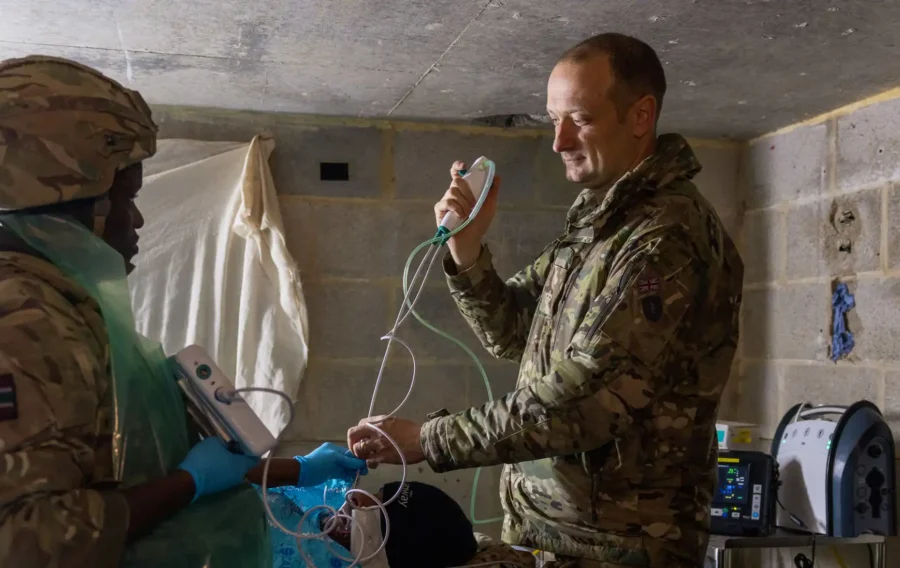
British Army reservists from the 215 (Scottish) Multirole Medical Regiment (215MMR), part of the Second Medical Group, have concluded Exercise Paieon Cyclone, a significant trial of a dispersed, underground field hospital concept. Conducted at the Fighting In Built Up Area (FIBUA) training facility on Salisbury Plain, Wiltshire, the exercise marks a strategic shift in battlefield medical care, prioritising survivability and concealment within contested urban environments.
The traditional model of large, tent-based medical facilities marked with the Red Cross is increasingly viewed as vulnerable to modern battlefield threats, including unmanned aerial systems (UAS), long-range artillery, and precision rocket systems. By decentralising medical departments into subterranean locations and simulated damaged structures, the Army aims to minimise the electromagnetic and visual signature of medical assets. This ensure operational continuity and reduces the risk of collateral damage during large-scale combat operations. For the UK defence supply chain, this transition indicates a burgeoning requirement for modular, ruggedised, and highly portable medical infrastructure that can be deployed within existing urban footprints.
The trial highlighted several critical engineering and logistical challenges inherent in “sub-optimal” environments. Personnel reported difficulties regarding basement flooding, the necessity of maintaining sterile conditions in improvised settings, and the logistical strain of transporting casualties through non-standard access points, such as windows. These factors suggest a clear demand for advanced water mitigation systems, portable power solutions safe for use in confined or damp environments, and innovative patient handling equipment designed for tight, unconventional spaces. Furthermore, the shift toward dispersed operations necessitates enhanced secure communication technologies to coordinate clinical care across multiple clandestine nodes.
International interoperability was a key component of the exercise, with 17 personnel from the US Army’s 519th Hospital Centre attending to observe British medical doctrines. This collaboration ensures that future procurement and operational strategies remain aligned with NATO allies, particularly regarding large-scale combat operations. Major Iain MacArthur, Executive Officer of 215MMR, noted that the exercise aligns with the Commander Field Army’s priorities to enhance survivability, manoeuvrability, and clinical capacity.
For businesses and sub-contractors, this modernisation effort represents an opportunity to provide technologies that facilitate “manoeuvre medicine.” As the British Army seeks to increase its lethality and resilience, the demand for adaptable, high-capacity clinical tools that do not rely on established infrastructure is expected to grow. Suppliers capable of addressing the hygiene, power, and transport challenges identified during Exercise Paieon Cyclone will be well-positioned to support the MoD’s evolving medical requirements.
Image: Courtesy British Army – British Army medics have trialled setting up an underground field hospital.
If you would like to join our community and read more articles like this then please click here

Post written by: Vicky Maggiani
Vicky has worked in media for over 25 years and has a wealth of experience in editing and creating copy for a variety of sectors.
RELATED ARTICLES

April 1, 2026
Homeland - £3.9m Solar Project Commences at Bassingbourn Barracks
The Defence Infrastructure Organisation (DIO) has commenced construction on a new £3.9 million solar array at Bassingbourn Barracks, marking a
April 1, 2026
Land - UK and US Defence Agencies Conduct Advanced AI Trials for Battlefield Medical Triage
The Defence Science and Technology Laboratory (Dstl) has entered a strategic collaboration with the US Defense Advanced Research Projects Agency