



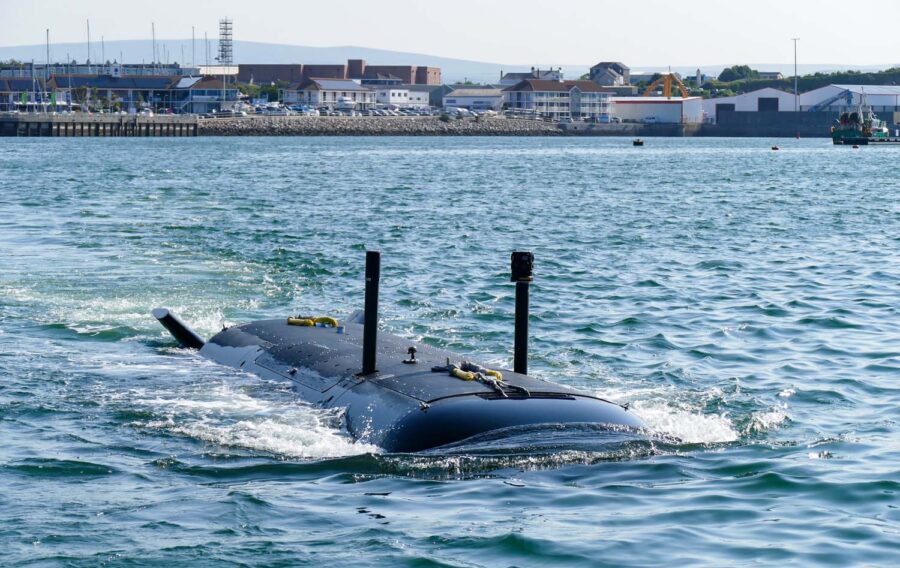
In a significant development for UK underwater capabilities, the Royal Navy has successfully trialled a quantum optical atomic clock at sea aboard the XV Excalibur, an extra-large uncrewed underwater vessel (XLUUV).
This milestone marks the first instance of such technology being operated on an underwater vessel, signalling a new phase in the pursuit of precise navigation and timing (PNT) in GPS-denied environments. The trial was a collaborative effort between the Royal Navy, the Submarine Delivery Agency’s Autonomy Unit, and industry partners Infleqtion and MSubs.
The experiment centred on the integration of Infleqtion’s Tiqker quantum clock onto the XV Excalibur, a testbed platform manufactured by MSubs. The successful sea trial demonstrated the clock’s ability to provide a highly stable and accurate time reference, a critical requirement for prolonged underwater operations where access to satellite-based navigation is unavailable. Unlike conventional microwave-based clocks, which can drift over time and degrade navigational accuracy, quantum-based systems offer superior stability. This technological advantage allows an underwater vessel to remain submerged and covert for extended periods, significantly enhancing its operational envelope and stealth characteristics.
According to officials, the trial is a critical first step towards understanding how quantum clocks can be deployed on operational platforms. The ability to maintain an accurate internal time source is fundamental not only for navigation but also for the effective functioning of other mission-critical systems, including sonar, secure communications, and fire control. The successful operation of the Tiqker clock throughout multiple dives confirmed its resilience and reliability in a demanding, real-world defence environment.
This achievement aligns with the Royal Navy’s strategic commitment to integrating advanced capabilities, such as autonomous systems and artificial intelligence, to maintain a technological advantage. Commodore Marcus Rose, Deputy Director Underwater Battlespace Capability, highlighted the trial’s importance in demonstrating the ability to rapidly develop and integrate sophisticated payloads onto uncrewed platforms. This emphasis on modularity and swift integration presents clear opportunities for businesses in the defence supply chain, particularly those specialising in quantum technologies, sensor systems, and autonomous platform integration. The programme indicates a growing demand for innovative solutions that can enhance the precision, endurance, and operational effectiveness of the UK’s future naval assets.
Image: Royal Navy – The Royal Navy worked with Infleqtion for quantum navigation trials on XV Excalibur
If you would like to join our community and read more articles like this then please click here

Post written by: Vicky Maggiani
Vicky has worked in media for over 25 years and has a wealth of experience in editing and creating copy for a variety of sectors.
RELATED ARTICLES

March 31, 2026
Maritime - Boost to British jobs with £283.5m Maintenance Contracts
The Ministry of Defence has announced the award of contracts totalling £283.5 million to provide comprehensive support and maintenance for

March 31, 2026
Homeland - MOD Outlines Strategic Procurement Reform and SME Growth Targets at DPRTE 2026
At the opening of the DPRTE 2026 conference in Farnborough, Minister for Defence Readiness and Industry Luke Pollard MP detailed