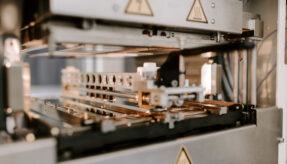



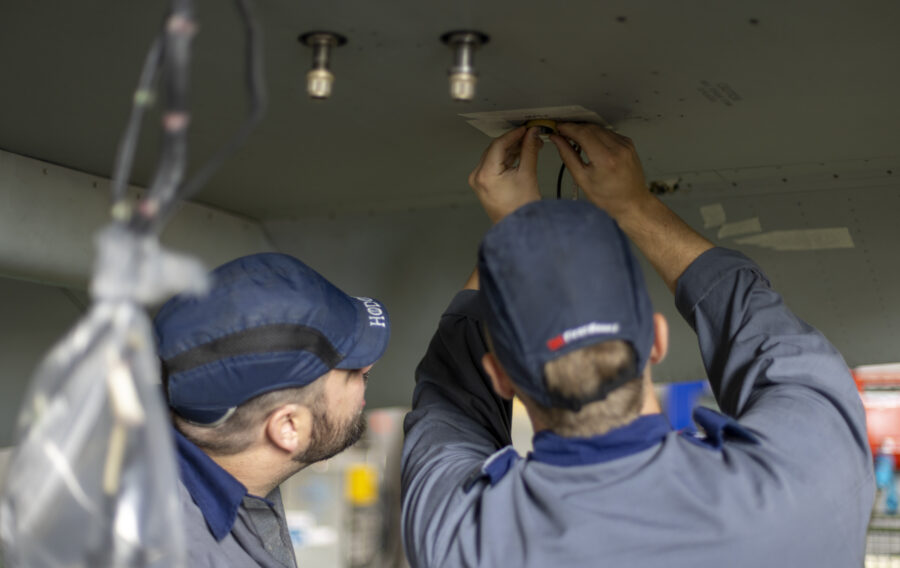
The Royal Air Force has advanced its operational maintenance capabilities by fitting an in-house 3D-printed metallic component to a Typhoon fighter jet at RAF Coningsby.
This development marks a significant milestone for the RAF’s Advanced Manufacturing, exploitation (RAF AM-X) programme, demonstrating the viability of additive manufacturing (AM) in reducing aircraft downtime and increasing fleet availability for front-line duties, including Quick Reaction Alert.
The successful installation of a temporary pylon assembly part highlights a new, agile approach to component replacement. The process involves precision-scanning an existing part and using the data to design and print an intermediate solution, enabling an aircraft to return to service while a permanent replacement is procured through established supply chains. Air Vice-Marshal Shaun Harris, Director Support at HQ Air, noted that without this technology, the aircraft would have been unusable for many months, underscoring the operational impact of the RAF AM-X initiative as a key warfighting enabler.
Originally established as Project Warhol, the RAF AM-X programme has evolved into a core capability within the Support Force. Its scope has now expanded to produce both polymer and metallic components for a range of platforms, including the F-35 Lightning, A400M Atlas, and Chinook helicopter. Further opportunities for industry collaboration are emerging as the programme matures, with current development work including a safety case to certify a 3D-printed metallic chaff and flare dispenser for Apache, Wildcat, and Shadow aircraft.
To accelerate the integration of this technology, the RAF is collaborating with the Manufacturing Technology Centre, part of the High Value Manufacturing Catapult, and engaging with Five Eyes and NATO partners to shape how AM supports Agile Combat Employment strategies. Group Captain Justin Blackie, the Programme Director for RAF AM-X, stated that the capability will generate significant operational advantage, increase supply chain resilience, and mitigate obsolescence.
The RAF plans to release a comprehensive white paper in early 2026, which will outline the full additive manufacturing portfolio and provide strategic guidance for future development. This document will offer industry partners valuable insight into the long-term direction and procurement opportunities related to the RAF’s commitment to embedding AM as a critical component of its sustainment strategy.
Image: RAF
If you would like to join our community and read more articles like this then please click here

Post written by: Vicky Maggiani
Vicky has worked in media for over 25 years and has a wealth of experience in editing and creating copy for a variety of sectors.
RELATED ARTICLES

March 18, 2026
Collaboration is the UK’s competitive edge
At this year’s Munich Security Conference, collaboration and innovation were recurring themes against a backdrop of European leaders united in

March 18, 2026
Homeland - UK and Germany meet to advance deep precision strike missile programme
The United Kingdom and Germany have advanced their bilateral collaboration on the development of Deep Precision Strike missiles, following a