



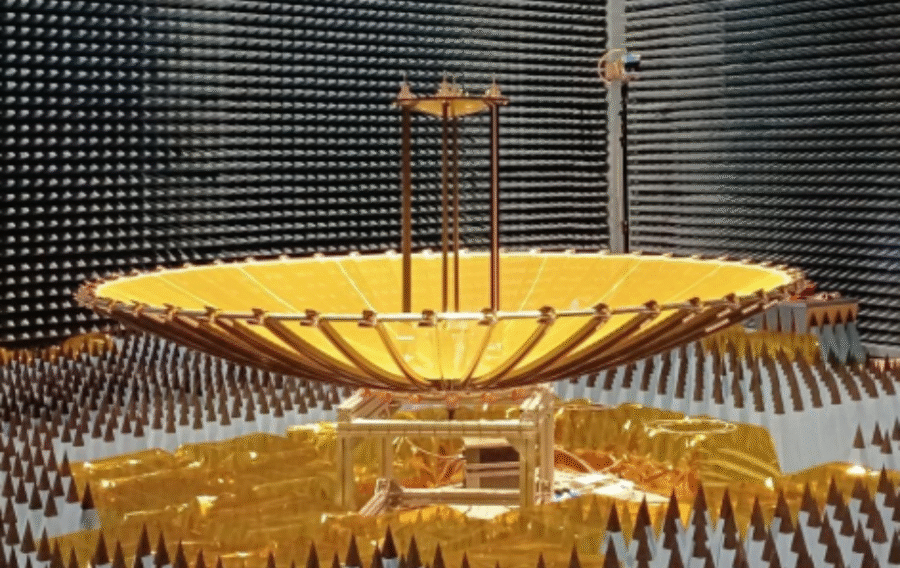
How DASA funding and Dstl support helped transform a deployable antenna concept into critical UK defence space capability.
In the vastness of space, a miniaturised satellite about the size of a domestic washing machine unfurls a dish antenna with millimetre precision while delivering a 16-fold increase in area.
Within seconds, this compact satellite package transforms into a sophisticated synthetic aperture radar (SAR) that can take detailed, high-resolution pictures of Earth from space. This breakthrough represents Oxford Space Systems’ revolutionary approach to space technology.
Enabled by the Defence and Security Accelerator’s (DASA) strategic investment and technical expertise from the Defence Science and Technology Laboratory (Dstl), the innovative technology offers not just technical advancement, but also significant economic and strategic value. Traditional SAR missions often need platforms that are around the size of a double-decker bus and can cost tens or even hundreds of millions of pounds to launch. In contrast, Oxford Space Systems’ deployable antenna technology enables the same capability on smaller platforms that cost just a fraction of that, potentially allowing multiple satellites to work together to provide better coverage and more regular updates to boost space capabilities.
Founded in 2013 at Harwell Campus, Oxford Space Systems began with a unique challenge to the market: why launch massive, expensive spacecraft when you could pack large antenna capabilities into small, affordable platforms?
“We specialise in taking antenna technology that would normally only fly on car-sized spacecraft and putting it onto something the size of a domestic appliance,” explains Chris Bee, Business Development Director at Oxford Space Systems. “By bringing down launch costs and enabling constellation approaches, we’re completely changing how defence organisations think about space capabilities.”
The company’s unique approach combines traditional space engineering while also drawing on expertise from unexpected sectors such as Formula One engineering and textiles, to create antennas that deploy using stored spring energy rather than complex mechanical systems.
DASA’s investment in Oxford Space Systems developed through multiple phases, with each stage building upon previous achievements to evolve the concept into operational capability, supported throughout by Dstl technical partners.
Oxford Space Systems first secured DASA funding to develop the parabolic antenna technology in 2019, providing crucial early-stage funding when the company was still refining the core concept. This initial investment enabled the team to develop their signature wrapped rib antenna manufacturing processes and establish in-house mesh knitting capabilities, while further investment in 2022 and 2023 secured the flight jointly with Surrey Satellite Technology Ltd (SSTL), based in Guildford.
A parallel DASA funded project that same year focused on enabling reductions in satellite size, mass, power and cost through a different technology to deploy pillar-like helical antennas designed to generate narrow communication beams, demonstrating DASA’s comprehensive approach to supporting the company’s technological development across multiple space technology solutions.
Using experience gained in subsystem testing, including thermal vacuum to simulate space, at the company’s own facilities, these initial projects culminated in an engineering model that demonstrated the feasibility of large deployable antennas for defence applications, at the full antenna level with sophisticated RF tests to confirm performance.
Proving the Technology: Defence Innovation Loans
Building on this solid foundation, subsequent DASA funding in 2022 & 2023 through the DASA Defence Innovation Loans scheme supported the crucial next step: getting the antenna hardware into space. The loan enabled Oxford Space Systems to develop and launch their first in-orbit demonstration – a critical milestone in an industry where credibility depends on space launch experience. The flight unit has passed its rigorous test programme, including vibration testing to simulate launch conditions, and been delivered to SSTL who will shortly ship to SpaceX in the United States for launch.
The achievement provided the foundation for follow-on projects, including funding for terrestrial applications in dismounted soldier satellite communications which was secured through the Defence Technology Exploitation Programme (DTEP). This project aims to address the operational need to reduce the Satellite Communications (SatCom) equipment weight burden on the war fighter and demonstrate that commercial SatCom can be used effectively to communicate securely, with significantly higher data rates and capacity than is currently possible.
From a startup concept to a key supplier for critical UK defence capabilities, Oxford Space Systems exemplifies how DASA’s strategic investment in emerging technologies creates sovereign capabilities that would otherwise remain unavailable to UK defence and space industry.
Chris Bee concludes, “Working with DASA and Dstl has been transformational for our business, with support in multiple forms from early breadboards all the way through to flight, which is exactly what growth-stage companies need to maintain momentum while developing new capabilities for the UK. No engineering development can assume success and DASA staff have been incredibly supportive, flexible and key partners in the journey to pioneer our products and develop our supply chain and in-house capabilities. With the increased export potential that more mature product offerings attract we are much more confident in our future as a result of the support we’ve received.”
If you would like to join our community and read more articles like this then please click here

Post written by: Vicky Maggiani
Vicky has worked in media for over 25 years and has a wealth of experience in editing and creating copy for a variety of sectors.
RELATED ARTICLES
March 27, 2026
Land - British engineering firm Rowden hosts the British Army to explore frontline Techcraft
British engineering firm Rowden hosted a visit by British Army Sergeant Majors to explore how collaboration between engineers and soldiers helps shape

March 27, 2026
Air - DroneShield Expands C2 Interoperability
DroneShield, a global leader in counter-unmanned systems (C-UxS) solutions, today announced interoperability between DroneSentry-C2 command-and-control software, and optical sensing technologies from OpenWorks Engineering. The partnership strengthens DroneShield’s ability to unify multi-domain sensor inputs