



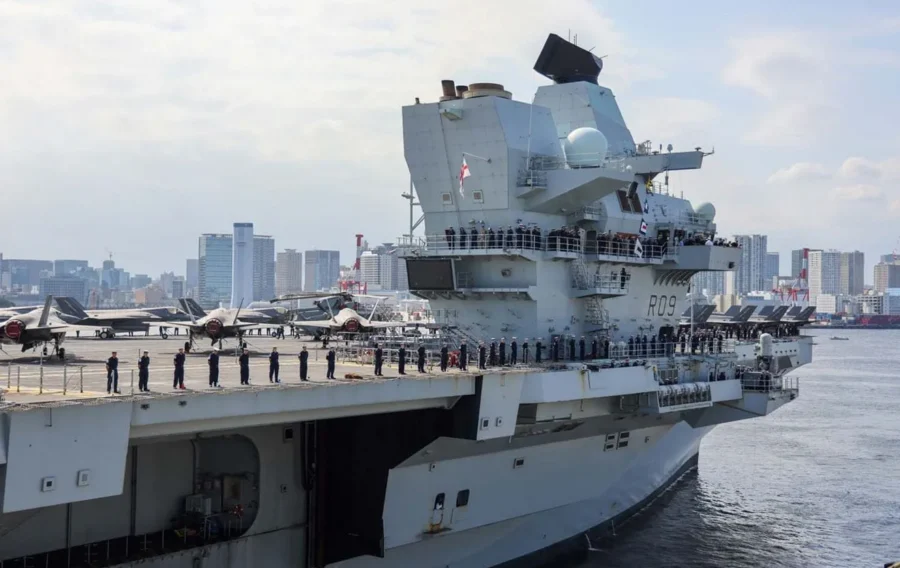
The UK–Japan defence relationship continues to deliver substantial industrial and economic benefits, with new figures confirming significant investment and employment gains in the UK supply chain. The announcement came as Defence Secretary John Healey visited Japan for the first time, meeting Prime Minister Ishiba and Defence Minister Nakatani during the deployment of the Carrier Strike Group to Tokyo.
Central to the bilateral relationship is the trilateral Global Combat Air Programme (GCAP), a partnership between the UK, Japan and Italy to develop a next-generation combat aircraft. The Defence Secretary confirmed that GCAP and associated Future Combat Air System work now support more than 4,500 jobs across the UK, including major clusters in the South West, North West and Scotland. The programme has also generated significant industrial research and development activity, with UK industry investment rising by over £100 million in the past year to exceed £700 million.
The statement underlines the importance of international collaboration to the government’s defence industrial strategy and its wider economic objectives. By embedding UK industry within a long-term multinational programme, GCAP not only secures high-value employment but also ensures opportunities across the supply chain for firms already engaged in advanced aerospace, digital systems and defence manufacturing, while creating openings for new entrants.
During his visit, the Defence Secretary also welcomed HMS Prince of Wales and the wider Carrier Strike Group into Tokyo. The Royal Navy flagship hosted the Pacific Future Forum, bringing together government and industry leaders to discuss shared defence and security challenges. The event provides a platform for reinforcing industrial partnerships in areas such as maritime technology, digital integration and systems support.
The Carrier Strike Group’s presence in Japan forms part of Operation Highmast, the UK’s largest naval deployment in a generation. The operation has engaged with 30 countries across multiple regions, demonstrating Britain’s commitment to international security and the strength of its defence industry through the deployment of advanced capabilities, including the F-35B Lightning II.
The UK–Japan relationship has deepened significantly in recent years, extending beyond GCAP into operational cooperation, such as Exercise Vigilant Isles and the historic first landing of a UK F-35B on a Japanese ship earlier this month. For UK industry, these developments point to a growing demand for interoperability solutions, sustainment support, and future joint capability projects, providing tangible opportunities for the domestic supply chain as the partnership continues to expand.
Image: Royal Navy
If you would like to join our community and read more articles like this then please click here

Post written by: Vicky Maggiani
Vicky has worked in media for over 25 years and has a wealth of experience in editing and creating copy for a variety of sectors.
RELATED ARTICLES

April 2, 2026
Homeland - UK and Ireland Sign Refreshed Defence MoU to Enhance Joint Procurement and Maritime Security
UK and Ireland Sign Refreshed Defence MoU to Enhance Joint Procurement and Maritime Security The UK Ministry of Defence and the

April 2, 2026
Homeland - MOD Initiates £9 Billion Housing Strategy with RAF Brize Norton Development
The Ministry of Defence has announced the commencement of the first new-build service family housing project in nearly a decade,