



A novel laser detection system developed by Sentinel Photonics has evolved from a promising concept to commercial technology through DASA and Dstl support.
The Innovation Journey
For military personnel operating in hostile environments, detecting adversaries’ lasers is a vital capability. From artillery targeting systems to drones, sniper range finders and precision strike guided munitions, lasers pose an increasing threat on the modern battlefield.
This challenge inspired Sean Tipper and Chris Burgess, while working as scientists at the Defence Science and Technology Laboratory (Dstl), to develop a new approach to laser detection. Their innovation showed great promise during development at Dstl, where the core technology was conceived and initially tested.
“We worked on the core technology at Dstl for a number of years, developing the fundamental concepts,” explains Sean Tipper, now Chief Technology Officer at Sentinel Photonics. “We saw the potential for this technology to help protect our forces and founded Sentinel Photonics to take it to the next level of development and productisation.”
In 2019 the scientists and Ploughshare Innovations founded Sentinel Photonics to commercialise their invention, licencing the IP from Dstl and the Ministry of Defence (MOD). The company formally began operations in late 2020 with the critical support of early Dstl funding through the Defence and Security Accelerator (DASA).
A new way of detecting lasers
Traditional laser warning systems rely on photodiodes that convert light to voltage, looking for rapid temporal changes. They look for quick, sharp changes, similar to how you can notice someone flicking a torch on and off in a dark room.
While effective for detecting laser pulses, they struggle with continuous wave lasers and can generate false alarms.
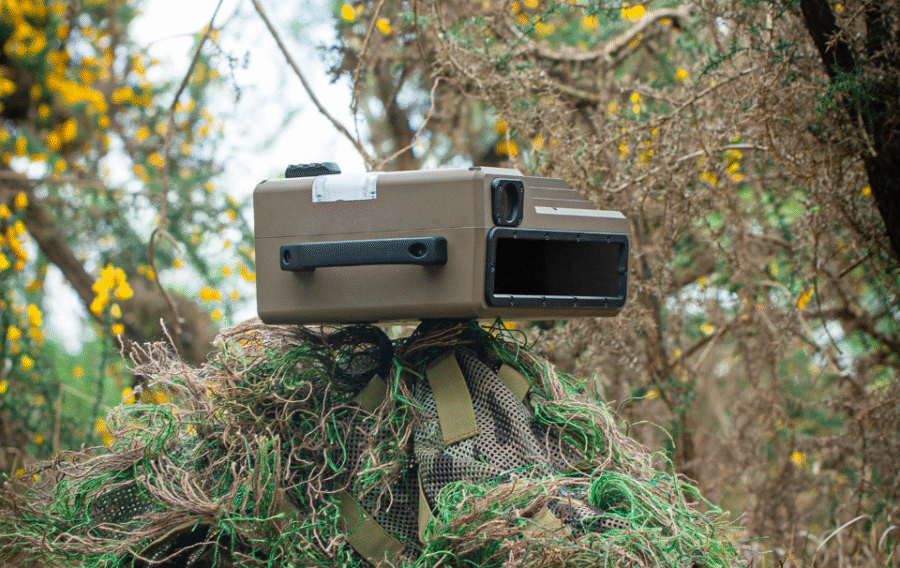
Sentinel’s breakthrough product, LASERD MAX (Laser Signal and Event Recording Device), uses a unique camera-based method that detects the spectral and spatial features of lasers. What sets LASERD MAX apart from conventional systems is its portability and comprehensive coverage. It doesn’t just monitor a narrow field of view but provides complete awareness.
“It’s more of an all-encompassing system,” explains Tipper. “It’s easy to detect one laser in one direction, but what makes our system unique is the ability to detect many different types of lasers simultaneously in a clustered background, even in challenging daylight conditions.”
The system can detect everything from drone LIDAR systems and artillery rangefinders to anti-tank guided missiles. It can also spot battlefield scanning systems that use invisible lasers to find hidden optics like sniper scopes.
“Our system can detect a broad range of laser threats,” says Tipper. “It’s novel because it’s portable and standalone, targeted for dismounted use and also at forward operating bases.”
The DASA and Dstl Impact
DASA and Dstl support proved instrumental at multiple points in Sentinel Photonics’ development journey. Their first DASA projects in late 2020 provided critical funding that allowed Tipper to work full-time on developing the technology.
“Those early DASA projects were really critical because that’s where I experimented with different sensors and camera systems and picked the exact sensors and optics we’re still using today,” says Tipper.
As Sentinel Photonics progressed with their innovation journey, they reached a critical point where they needed to grow their team to meet increasing demand and develop their technology further.
In 2022, DASA’s Defence Innovation Loans provided the perfect opportunity to take this next step.
The loan helped transform the organisation from a founder-led startup into a growing enterprise with the capabilities to deliver advanced defence technology.
“Without the Defence Innovation Loan, we wouldn’t have been able to deliver for Dstl, and we wouldn’t have had the resources to increase the size of our team,” Tipper notes.
Image: Sentinel Photonics’ LASERD MAX system in action – courtesy Sentinel
If you would like to join our community and read more articles like this then please click here

Post written by: Vicky Maggiani
Vicky has worked in media for over 25 years and has a wealth of experience in editing and creating copy for a variety of sectors.
RELATED ARTICLES

March 26, 2026
Maritime - Serco wins contract to support British Army’s marine assets fleet
Serco, the international provider of critical government services, has been awarded a seven-year contract to provide in-service support for the British

March 26, 2026
Homeland - Positioning SMEs at the centre of defence procurement
The Ministry of Defence has unveiled a comprehensive strategic framework designed to integrate small and medium-sized enterprises (SMEs) more deeply