



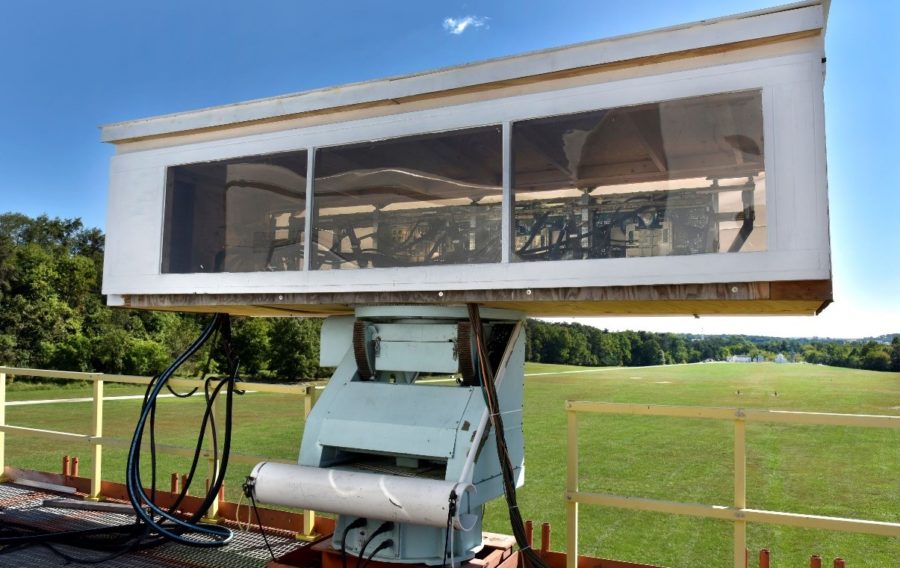
Northrop Grumman has successfully demonstrated an open mission systems (OMS) compliant active electronically scanned array (AESA) sensor in recent ground and multiple flight demonstrations.
For the demonstrations, an advanced Northrop Grumman wideband AESA sensor was connected to an OMS-compliant mission computing system provided by Boeing.
After integrating with the Boeing mission computing environment, the AESA sensor was instructed to focus on specific targets, capture and manage data, and communicate the information back to the mission computing system, which was displayed in real-time on an operator’s workstation.
“These demonstrations continue to act as pathfinders to enable further OMS opportunities,” said Paul Kalafos, vice president, surveillance and electromagnetic maneuver warfare, Northrop Grumman. “Using an agile framework, we can quickly develop and adapt complex, multi-function systems to enable multi-mission nodes at the tactical edge of the battlespace, be it Joint All-Domain Command and Control (JADC2), electronic warfare, or intelligence, surveillance and reconnaissance.”
OMS is an approach based on open architecture design allowing customers to rapidly add new or improved capabilities, regardless of supplier, at a reduced cost. This Northrop Grumman and Boeing joint live flight test demonstrated a key step in continuing the validation and integration of OMS-compliant systems and the ability to successfully transfer relevant active-passive kill chain data.
“Northrop Grumman is a pioneer in developing multi-function sensors,” said Greg Simer, vice president, air dominance and strike, Northrop Grumman. “Through our iterative development and flight demonstrations, we are focused on agile development with OMS-compliant sensors and commercial practices to prove the rapid integration of capabilities across mission sets. The result is faster and more affordable advances in sensor capabilities for US forces and their allies.”
image courtesy of Northrop Grumman
If you would like to join our community and read more articles like this then please click here
Post written by: Matt Brown
RELATED ARTICLES

April 7, 2026
Air - UK Announces £100m Air Defence Allocation to Support Ukrainian Infrastructure
The UK government has announced an urgent allocation of an additional £100 million to bolster Ukraine’s air defence capabilities, marking

April 7, 2026
Homeland - DPRTE 2026: A Defining Moment for UK Defence Procurement
Another DPRTE Expo has drawn to a close – and by every measure, DPRTE 2026 has been the most significant